Marine Log
MARCH 13, 2013 — Canada's Transportation Safety Board (TSB) has released its investigation report (M11W0211) into a December 2011 accident in which British Columbia Ferry Services Inc.'s (BCFS) Coastal Inspiration struck the berth at Duke Point, British Columbia. Crew and passengers suffered minor injuries in the accident, and there was extensive damage to both the vessel and the terminal.
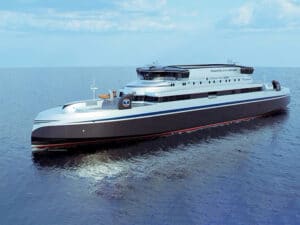
The 160 m long, 1,650 passenger, 370 vehicle capacity, Coastal Inspiration is one of BC Ferries' three "Super-C Class" ferries, which are currently the largest double-ended ferries in the world. They were delivered from German shipbuilder Flensburger Schiffbau-Gesellschaft between 2006 and 2008.
The investigation found a number of contributing factors to the accident, including a lack of adherence to procedures and familiarity with the operation of the propulsion system by the bridge team in an emergency.
On December 20, 2011, the vessel left Tsawwassen on time at 12:45 for its fourth trip of the day, with 346 passengers, 129 vehicles, and a crew of 31 on board. At 14:50, the vessel struck the berth at a speed of approximately 5 knots. Seven passengers and 9 crew members sustained minor injuries as a result of the hard landing and were treated on board. The bow door, the starboard side shell, and the rubbing plate of the ferry were damaged, putting it out of service for 23 days. The terminal sustained damage to the port and starboard berth walls, to pilings and to various electrical fittings, and was out of service for 122 days.
On April 11, 2012, the TSB issued a Marine Safety Information letter (MSI 04/12) to BCFS advising that the speed of advance was a significant factor in the striking.
The TSB investigation found that procedures for testing the propulsion control equipment before berthing were not followed. This meant that a malfunction in the controls went undetected until too late. The investigation also found that the vessel's bridge crew was unfamiliar with the operation of this control in an emergency.
Since the accident, BCFS has made a number of changes to its propulsion control system to provide a warning to bridge crews when the system malfunctions.
BCFS has also improved a number of procedures and developed a schedule of critical failure response drills to ensure that contingency plans are exercised by all key personnel. It has also incorporated verification of responses to critical-system failures into mandatory familiarization training, which is verified in periodic drills.
Conclusions Findings as to causes and contributing factors
- The bow propeller was engaged but not tested as required prior to arrival, which precluded the bridge team from realizing that the pitch control was not functioning.
- The bow propeller pitch control was used once the vessel was at the abort position, in close proximity to the berth, limiting the time for the bridge team to react when it did not respond.
- An isolating amplifier in the propulsion switchboard malfunctioned, causing the overload protection system to activate. This prevented the electronic signal from the pitch control handle from adjusting the pitch on the bow propeller.
- The bridge team did not switch from normal to emergency mode. As the mode was not set to Emergency, the master's attempts to engage the PITCH AHEAD and PITCH ASTERN push buttons were ineffective at regaining control of the pitch.
- Without the braking effect of the bow propeller, and with the astern propeller providing thrust ahead, the vessel struck the berth at a speed of approximately 5 knots.
Findings as to risk
- The operation of equipment for a purpose other than the one intended may result in the equipment being disassociated from its designated function.
- If the bridge team does not participate in regular drills addressing malfunctions of the propulsion system, it may not be proficient in taking mitigating action during an emergency.
- If safety-critical equipment essential for a key operation is not tested before its use, the crew may have reduced time to react in the event the equipment fails to respond.
- Without an alarm specifically linked to safety critical equipment that signals the equipment's malfunction, the crew may be unaware of the failure, putting the vessel, its passengers and crew at increased risk.
- When voyage data recordings are not available to an investigation, the identification and communication of safety deficiencies to advance transportation safety may be precluded.
Read the report HERE
MAY 1, 2013 — Buckley McAllister, President, McAllister Towing, has succeeded Linn Peterson of Kirby Inland Marine, LP as Chairman of the American Waterways Operators, the national trade association representing the tugboat, towboat and barge industry, which elected a new slate of leaders at its Spring Convention recently held in Washington, D.C. Frank Morton, Director, Turn Services, LLC was elected as Vice Chairman.
Addressing the members following his election, Mr. McAllister focused on one of the industry's key characteristics – resilience, citing the industry's response to the low water crisis on the Mississippi River and the devastation caused by Hurricane Sandy as recent examples of how it is able to tackle challenges and come back stronger.
"This is an industry of passionate leaders and dedicated professionals," he said. "You have proven your resilience time and again. Working together as a team, we can achieve much more together than we can individually. As for my role on this team, I will do my best to improve the resiliency of your trade association and industry for generations to come."
Mr. McAllister will serve as AWO's Chairman until April 2014.
The Navy has just gotten $210 million worth of high speed cats for $35 million. The U.S. Maritime Administration reports that it has now transferred the former Hawaii super ferries Huakai and Alakai to the U.S. Navy and that the Navy provided $35 million to the Maritime Administration for both vessels.
Back in October 2005 we reported shipbuilder Austal USA as saying that the order for the pair had become unconditional following Maritime Administration approval of a $139,731,000 Title XI loan guarantee, or approximately 78.5 percent of a total shipbuilding project cost of $178 million. That allowed the signing of a $210 million financial closing agreement .
That works out at a ship price of $105 million a copy (at 2005 prices), which compares with the $151.8 million to $185.4 million a copy the Navy is paying for the seven JHSV's on order at Austal USA.
The Navy plans to use Huakai and Alakai to transport troops and equipment to training areas from Okinawa and other locations. These vessels will help the Navy meet these unique operational requirements without the need to build new vessels. Powered by waterjet engines, the catamarans can each carry 288 cars and 866 passengers.
The Maritime Administration took possession of the two ships after Hawaii Superferry, Inc., defaulted on the loans that the Maritime Administration had guaranteed.
The vessels are currently docked at Lamberts Point in Norfolk, Va.
January 29, 2012
FEBRUARY 7, 2012 — The U.S. Navy last month submitted its Congressionally mandated report on the Navy Combatant Vessel Force Structure Requirement. It has downsized its its overall fleet size requirement from 313 ships to 306 ships.
Those expressing concern include U.S. Representative Duncan Hunter, a member of the House Armed Services Committee.
The figure has always been as much an educated guesstimate as anything else and right now the active fleet is about 288 vessels. Still, the proposed downsizing of the target fleet size is drawing criticism.
"The U.S. Navy is already overworked and experiencing the consequences of an undersized fleet," said Representative Hunter. "The 306-ship target might represent the absolute minimum capacity the Navy needs right now, but cutting the fleet size today will have a long-term effect on the Navy's ability to project force on a global scale and defend American security interests worldwide.
"It wasn't long ago that an independent panel recommended a fleet of 346 ships. And last year, the Navy said it would need a fleet exceeding 500 ships to meet the full spectrum of its requirements. Understanding a fleet of 500 ships is unattainable, this target in particular underscores the dramatic difference in where the Navy needs to be in terms of size and where the Navy is actually heading.
"And while the Navy makes the point that this downsizing is the result of operational requirements, the decision should also send a clear warning about what's ahead in the event the Navy's budget tightens under sequestration, as well as the damage created by the lack of a coherent and forward-looking budget."
See the Navy report HERE
MAY 2, 2013 — Norwegian shipbuilder Havyard has ordered two cranes from Cargotec's MacGregor subsidiary for installation on the 113 m subsea IMR vessel it is building for Nigeria's Marine Platforms Limited (MPL). (See earlier story).
Havyard's contract with MacGregor calls for one 250-tonne MacGregor active heave-compensated (AHC) subsea crane and one 20-tonne MacGregor AHC subsea crane. They will be delivered in July 2014 and the vessel is scheduled for delivery the following month.
"The offshore market in west Africa is recognized worldwide as an area with very promising future prospects," says Frode Grøvan, Sales and Marketing Director for MacGregor Advanced Load Handling. "It is therefore a significant advantage for us to participate in the expansion into this region. For their part, our cranes will deliver reliable, proven load-handling technology to MPL."
More Articles...
Page 28 of 46