Search Results for: container

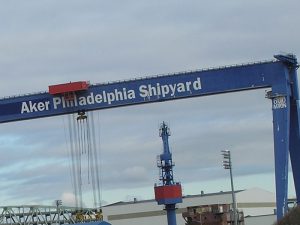
Aker Philly facing higher costs, delivery delays

The company, which is planning to change its name to Philly Shipyard, reported an order backlog of $1,043.2 million as of September 30, 2015, providing for shipbuilding activity with delivery dates through 2018.

In its third quarter report, the company says that it has recently completed a thorough analysis of its production schedule and budgets based on its experiences with the construction activities on the current product tanker program and the purchasing and engineering activities on the two containership’s on order by Matson project.

“As a result of this analysis,” it says, it has “prepared a revised forecast which includes higher costs of construction and later delivery dates for the vessels in AKPS’s backlog than previous forecasts. Corrective actions have been put in place to address some of these additional costs and schedule impacts.”

MORE

  • News

Maersk Line to cut jobs, scale back shipbuilding plans

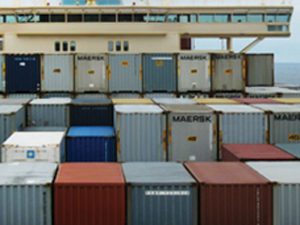
Those initiatives will see it reduce network capacity, shed “at least 4,000” jobs by the end of 2017 and cut back on the ambitious shipbuilding plans announced earlier. It will not exercise previously announced options for six 19,630 TEU vessels and two 3,600 TEU feeders and will postpone its decision on an optional eight 14,000 TEU vessels.

Maersk Line says that, in light of lower demand, these moves will still allow it to grow at least in line with the market to defend its market leading position.

Over the next two years, Maersk Line expects to lower the annual Sales, General & Administration (SG&A) cost run-rate by  $250 million with an impact of $150 million in 2016. SG&A savings will be derived from already initiated transformation projects and the standardization, automation and digitalization of processes.
 
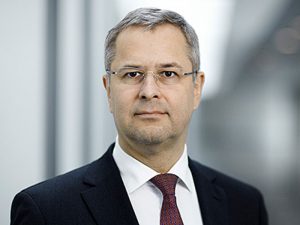
“We are on a journey to transform Maersk Line. We will make the organization leaner and simpler. We want to improve our customer experience digitally and at the same time work as efficiently as possible,” says CEO Søren Skou.

Today, Maersk Line has 23,000 land based staff globally. Organizational transformation and on-going automation and digitalization will, it says, enable it to reduce the global organization by at least 4,000 positions by the end of 2017 with the aim of minimizing redundancies through managing natural attrition.

“We are fewer people today than a year ago. We will be fewer next year and the following year. These decisions are not taken lightly, but they are necessary steps to transform our industry,” says Mr. Skou.

As a response to the current market outlook, network capacity will be reduced in Q4 2015 and throughout 2016. As previously announced, the closure of four  services (ME5, AE9, AE3 and TA4) has already been initiated over the last two months and plans are in place to further cancel a total of 35 sailings in Q4.

  • News

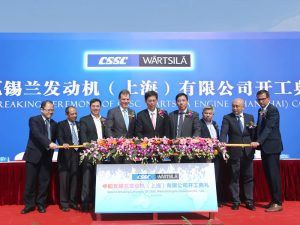
Construction of new Shanghai Wartsila factory begins


After the ground breaking ceremony, CWEC signed strategic cooperation agreements with the Hudong Zhonghua and Shanghai Waigaoqia (SWS) shipyards. It also signed a Letter of Intent ]with SWS for the delivery in 2017 of Wärtsilä Auxpac 32 generating sets for three large container vessels being built at the shipyard.

The CWEC joint venture was established in July 2014 for the manufacture of medium and large bore, medium speed, diesel and dual-fuel Wärtsilä engines. The new factory will be the first in China capable of producing locally large bore medium speed diesel and dual-fuel engines. By being able to produce and deliver locally, the new joint venture will provide CSSC Group and other Chinese shipyards with closer access to the Wärtsilä range of engines with the benefits of faster delivery times and competitive pricing. Wärtsilä’s share of the joint venture is 49 percent.

Products to be manufactured at the new facility will include the Wärtsilä 26, Wärtsilä 32, Wärtsilä 34DF, and Wärtsilä 46F engines, the first of which are expected to be ready for delivery in 2016. The production capacity is planned at 180 engines per year.

“It is an honor and a privilege to celebrate this latest milestone in our joint venture journey. By combining the strengths of our two companies; CSSC’s strong capabilities as the number one ship builder in China and Wärtsilä’s industry leading technologies, we can together make an important difference in today’s challenging global marine market,” said Roger Holm, Senior Vice President, Engines, Wärtsilä Marine Solutions.

This is an important occasion for the shipping industry in China. The new factory will produce state-of-the-art marine engines that will serve our customers with value adding efficiencies. We are pleased to cooperate with Wärtsilä in this exciting joint venture,” said Wu Qiang, President of CSSC.

The CWEC joint venture will target the offshore and LNG markets in particular, both of which are growing significantly in China. It will also serve the large container vessel segment.

  • News

Concept LNG fueled mega box ship would be COGAS electric

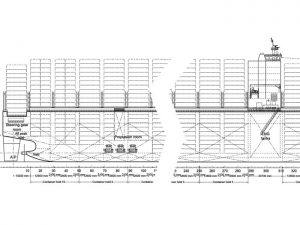
The partners in the study — LNG containment system specialist GTT, containership operator CMA CGM (and its subsidiary CMA Ships) and classification society DNV GL — say the concept that has the potential to offer a more efficient, more flexible and greener box ship design than current 20,000 TEU two-stroke diesel engine driven ultra large container vessels.

They have dubbed the vessel the “Piston Engine Room Free Efficient Containership” (PERFECt).

Essentially, the concept ship takes advantage of the flexibility of electric drive to use space previously occupied by the main to carry cargo, more than offsetting the extra volume required by the LNG fuel tanks in comparison with conventional HFO tanks.

A comprehensive analysis with the DNV GL COSSMOS tool simulated components of the power production and propulsion system to analyze the COGAS system, making it possible to get detailed data for the calculation of the overall fuel efficiency for a complete round voyage.

Using a global FEM analysis, the project partners also evaluated the impact of the changes that were made to the general arrangement.

The two 10,960 cu.m LNG fuel tanks are located below the deck house, giving the vessel enough fuel capacity for an Asia/Europe round trip.

With the gas and steam turbines integrated at deck level within the same deck house as the tanks, space normally occupied by the conventional engine room can be used to increase cargo capacity significantly.

The dissociation of electric power generation from electric propulsion allows the electric power plant to be moved away from the main propulsion system, giving a great deal of flexibility. In fact, say the partners “an engine room is not needed any more.”

The three electric main motors, which are arranged on one common shaft, can be run fully independently of each other providing increased redundancy and reliability and a high level of safety.

With gas turbine-driven power production utilizing a very clean fuel as well as electric propulsion, the ship’s machinery systems will be simplified and more robust. This approach is also expected to lead to new maintenance strategies, already common practice in aviation, that would enable shipping companies to reduce the ship’s engine crew and save costs.

The study also suggests that optimizing the power plant through minimizing the steam turbine size, reducing power capacities, condenser cooling, and using a two-stage pressure steam turbine and steam generator will increase the system’s efficiency further. The next phase of the study aims to optimize the propulsion system and ship design to attain even greater efficiency and increased cargo capacity.

THE PRICE TAG

As part of the analysis, costs for additional and reduced systems to the base case ship (CMA CGM’s 20,000 TEU Marco Polo) were considered.Additional costs included:
ƒƒ

  • membrane tanks,
  • gas and steam turbines,
  • fuel gas handling, and
  • structural reinforcements (needed as there is no aft engine casing).

Costs that could be eliminated or reduced in compared to the two-stroke engine system included:ƒƒ

  • scrubber, which is eliminated,
  • cooling system capacity, which is reduced and the system simplified, and
  • ƒƒHFO treatment or tank heating, which is not needed.

At the end, the CAPEX (capital expenditure) for the COGAS ship are seen as being to be 20% to 24% above those for a conventionally-fueled vessel.

The OPEX (operating expenditure) costs largely depend on the difference in fuel price, the additional income related to the additional containers which can be transported and the savings related to a possibly higher system efficiency.

On the basis of the current gas price in Europe, which is nearly the same as the HFO price a business case in comparison with a two stroke ship using HFO plus scrubber as a reference therefore “needs compensation either by a larger difference between gas and LNG price or by additional benefits from efficiency improvement and additional revenue from additional container slots.”

Still, the partners say that the results of the feasibility study, including the CAPEX and OPEX calculations, encourage them to plan a more detailed evaluation of the overall system in a follow-up project.

MORE

Perfect GA

NTSB: Search fails to locate El Faro pinger

The second stage of the search will now start, attempting to find the vessel using side scan sonar.


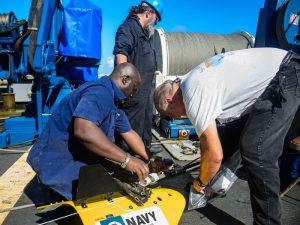
The USNS Apache arrived at the last known position of the El Faro on October 23, and began searching for the vessel with a Towed Pinger Locator (TPL).

The search area consists of a 10 nautical mile by 15 nautical mile area, in which the USNS Apache towed the TPL on five search lines across the search area in order to detect the acoustic signal associated with the El Faro’s pinger.

The USNS Apache concluded the first phase of the pinger locator search on October 26, 2015, with negative results.

The NTSB says that the TPL’s ability to detect the El Faro’s pinger may be affected by the orientation of the vessel as it lays on the sea floor or the current condition and functionality of the pinger.

The second phase of the search began yesterday, using the Orion side-scan sonar system. The second phase of the search will be conducted over the same search area. This phase will consist of 13 search tracks and will take about 14 days to complete. The side scan sonar system will be used to locate the El Faro, and if found, create an image of the vessel.

If the ship is found on the sea floor, its Voyage Data Recorder or “black box” can be retrieved to help investigators determine the El Faro’s final moments. It is suspected that the ship sank in Hurricane Joaquin on October 1 and is lying on the sea bottom in 15,000 feet of water near the Crooked Islands in the Bahamas. All 33 onboard are presumed lost.

  • News

APL in $9.8 million False Claims Act settlement

Scottsdale, AZ, based APL is a wholly-owned American subsidiary of Singapore-based Neptune Orient Lines Limited.

The Department of Defense contract required APL to affix a satellite tracking device to each shipping container transported from Karachi, Pakistan to U.S. military bases in Afghanistan when the Department of Defense (DOD) requested the tracking services.

The United States alleges that APL billed the DOD for tracking services despite knowing that the tracking devices completely or partially failed to transmit data, or were not affixed to shipping containers. The government also claims that APL attached a single satellite tracking device to two shipping containers despite being required to affix one device to every container.

“Today’s settlement demonstrates our commitment to ensure that contractors doing business with the military perform their contracts honestly,” said Principal Assistant Attorney General Benjamin C. Mizer, head of the Justice Department’s Civil Division. “We will continue to ensure that there are appropriate consequences for those who knowingly fail to live up to their bargain and misuse taxpayer funds.”

“Thanks to the collaborative efforts of many U.S. law enforcement professionals, APL is today being held accountable for their actions,” said Director Frank Robey of the U.S. Army Criminal Investigation Command’s Major Procurement Fraud Unit.

“I applaud all those responsible for their continued pursuit of those who attempt to take advantage of the U.S. military through false claims for services that were not provided.

The settlement with APL was the result of a coordinated effort among the Civil Division’s Commercial Litigation Branch; the U.S. Attorney’s Office of the Northern District of California, Affirmative Civil Enforcement Unit; DOD’s Defense Criminal Investigative Service; the Army’s Criminal Investigation Command and DOD’s Defense Contract Audit Agency.

The Justice Department notes that the claims resolved by the civil settlement are allegations only; there has been no determination of liability.

Great Lakes Shipyard holds a double celebration

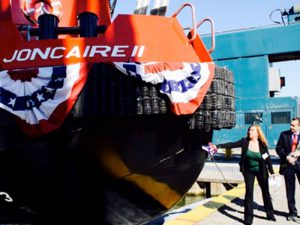
The sponsor of the Commissioning Ceremony was Karen W. Penale, Real Estate Administrator – Western Region, New York Power Authority – Niagara Project.
Breaking the traditional bottle of champagne, she declared “I name this tugboat Joncaire II. May God bless here and all who will sail on her.”

Joncaire II and its sister vessel will be used to service winter operations at the Niagara Power Plant in Buffalo, NY. They will augment and replace aging vessels that are used for the installation, removal, and maintenance of the Lake Erie-Niagara River Ice Boom and for various associated marine construction projects.

Construction for the first tug began last April. The second tug is scheduled for delivery in late-2017.

The new tugs are specially reinforced with heavy stems and shell reinforcement for operations in seasonal ice. The design of the conventional drive tugs includes elevated pilothouses for improved visibility when maneuvering and a spacious work deck aft to facilitate ice boom connections.

In 2010, Great Lakes Shipyard built the New York Power Authority’s new 80′ x 34′ Ice Boom Operations Barge, which incorporates a Terex 80-ton pedestal mounted lattice boom crane.

KEEL LAYING

The tug commissioning was followed by a separate ceremony, marking the keel laying of a new 3,400 H.P. tugboat to be built for Regimen de Pensiones y Jubilaciones del Personal de la Empresa Portuaria Quetzal, Guatemala, Central America. Representing the owner at the ceremony was Eduardo De Jesus Paiz Lemus, Presidente Junta Administrador.

Congresswoman Marcy C. Kaptur, U.S. Representative of the 9th District of Ohio, the principal speaker, commended the Company indicating that “We are fortunate to have a company like Great Lakes – their industry is the gift that keeps on giving. They are [through their education programs] passing on skills to the next generation, who will keep this country great.”

Congresswoman Kaptur also paid compliments to the company’s team – paying special recognition to Ronald C. Rasmus, President of the Great Lakes Group.

She highlighted the significance of the achievement, “To create here, in the heart of America, a shipyard; a place that faces global competition every day, is no small achievement. It is extraordinary. Look at all of the suppliers that benefit from your efforts.”

The tugboat is being built under a contract awarded this August. It will be another of the company’s HandySize Class 3,400 HP twin-screw tugboats and will be used for harbor towing operations in Puerto Quetzal; a growing commercial cargo, container, and cruise port on the Pacific coast of Guatemala.

The buyer, Regimen de Pensiones y Jubilaciones del Personal de la Empresa Portuaria, is a pension benefits plan for port employees and retirees who operate a commercial tugboat service in the port under a Port Authority franchise for the purpose of ensuring future retirement benefits.

Representing the Regimen at the ceremony was Eduardo De Jesus Paiz Lemus, Presidente Junta Administrador, who inscribed his signature on the keel plate declaring that “The keel has been truly and fairly laid.”

The HandySize Class tug was designed by Jensen Naval Architects & Marine Engineers, Seattle, WA.

Set for delivery next year, the tug is specifically designed for harbor work and coastal towing. It is 74-feet long with a beam of 30 feet, and a design draft of 11.5 feet. It is to be built to American Bureau of Shipping (ABS) standards and its Cummins QSK-50 main diesel propulsion engines, each rated at 1700 BHP@ 1600 rpm meet US EPA Tier III emission regulations delivering superior fuel economy, durability, and reliability.

In recognition of the significant achievement for a U.S. domestic shipyard in competitively concluding a foreign sale, the U.S. Department of Commerce’s International Trade Administration and the U.S. Embassy, Guatemala City, was represented at the ceremony by Antonio Prieto, Sr. Trade Specialist, who was credited by the company with facilitating the transparent negotiations and sale.

  • News

Maersk trims profit guidance, sees shares fall


The adjustment reflects the market challenges facing Maersk Line, the world’s largest containership operator. The Group is maintaining its result guidance for 2015 for all its other businesses.

The previous expectation, announced in group’s second quarter report, had looked for an underlying result contribution from Maersk Line above $ 2.2 billion. The Group now expects an underlying result from Maersk Line of around $1.6 billion.

The Group’s sensitivity guidance for the last six months of 2015 states that a general decline in the freight rate of $100 per FFE (Forty Foot Equivalent) will impact Maersk Line’s result negatively by around $ 0.5 billion, and that a volume reduction of 100,000 FFE will have a negative impact of around $ 0.1 billion.

“Maersk Line has over the years taken steps to ensure a cost effective and resilient operation, but the current deterioration in the container shipping market is impacting also our business,” says Group CEO Nils S. Andersen..

In the third quarter Maersk Line achieved an average freight rate of $2,163/FFE down from $2,679/FFE in the equivalent 2014 quarter) and carried 2,427,000 FFE (2,401,000 FFE in Q3 2014. These results were lower than expected.

As a result of the market circumstances, says the Group, “initiatives have been taken to adjust Maersk Line’s network accordingly.”

MORE

  • News

LNG fuel tanks installed in first Crowley ConRo

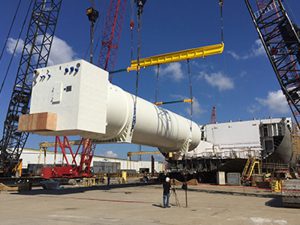
Another important milestone was marked last week, with the installation of three LNG fuel tanks in the first ship.

The double-walled, stainless steel tanks – which are 110 feet in length and 20.6 feet in diameter – weigh 225 metric tons and will hold more than enough LNG fuel for two round-trip voyages between the vessel’s future ports of call, Jacksonville, FL, and San Juan, Puerto Rico.

“While we are all excitedly watching these ships take shape, we are particularly proud of the role we, as a company, are playing to bring the most modern, technologically advanced and environmentally friendly ConRo ships in the world to the Jones Act market of Puerto Rico,” said Tom Crowley, company chairman and CEO. “There are no other ships of their kind being built anywhere else in the world today, and they are being constructed right here at home – in the United States of America. Having that shipbuilding capability here is essential to our national defense and an important reason we as a country need the Jones Act to be maintained and strengthened.”

Crowley’s two Jones Act ConRo ships, which will be named El Coquí (ko-kee) and Taíno (tahy-noh), are are scheduled for delivery second and fourth quarter 2017 respectively.

“It’s very impressive to see these new state-of-the-art Commitment Class ships take shape,” said John Hourihan, senior vice president and general manager, Puerto Rico services. “Seeing those LNG tanks being placed into El Coquí really resonates with me because we are setting a new standard for environmentally responsible shipping.”

The Commitment Class ships have been designed to maximize the carriage of 53-foot, 102-inch-wide containers, which offer the most cubic cargo capacity in the trade.

The ships will be 219.5 meters long, 32.3 meters wide , have a deep draft of 10 meters, and an approximate deadweight capacity of 26,500 metric tonnes. Cargo capacity will be approximately 2,400 TEUs (20-foot-equivalent-units), with additional space for nearly 400 vehicles in an enclosed Ro/Ro garage.

Each ship will be powered by an MAN B&W 8S70ME-GI8.2 main engine and three MAN 9L28/32DF auxiliary engines, all fueled by LNG .

The ship design is provided by Wartsila Ship Design in conjunction with Crowley subsidiary Jensen Maritime.

ceowleyLNG vert