
VIDEO: Fleetzero enters the autonomous and remotely crewed vessel market
Written by Nick Blenkey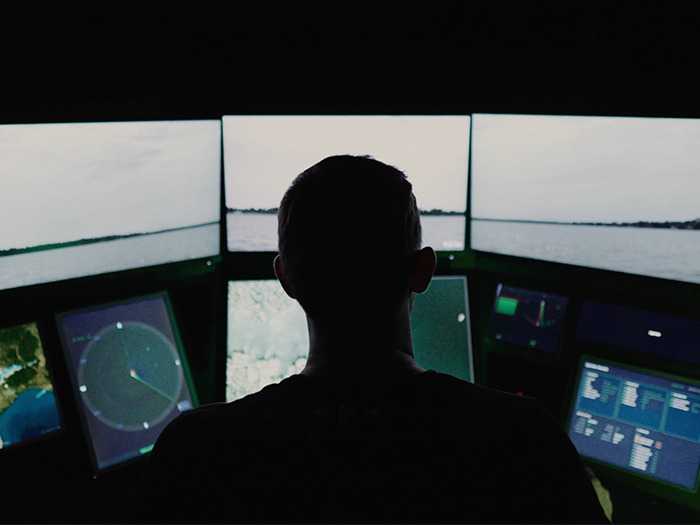
Inside the OctoPod, Fleetzero's tele-operated command and control center.. [Photo: Fleetzero]
Houston-based hybrid and electric propulsion innovator Fleetzero has announced the commercial launch of its autonomy stack. It includes OctoDrive, the company’s autonomy software platform; OctoPod, a full-scale tele-operated command center for small craft; and OctoBox, a mobile autonomy command center built for existing vessels.
Fleetzero says this marks a significant expansion of Fleetzero’s product portfolio beyond its flagship Leviathan battery energy storage system, marine battery container, and Kraken DC-hub power systems, and takes the company into the autonomous and remotely crewed vessel market.
It says that its core autonomy software OctoDrive gives operators a clear on-ramp to autonomous capability, whether they are specifying a newbuild or retrofitting an existing fleet.
“Electrification unlocks autonomy at sea. Electric propulsion eliminates the complex mechanical systems, routine maintenance demands, and onboard intervention requirements that make conventional vessels difficult to operate remotely,” said Mike Carter, Fleetzero co-founder and COO. “With fewer moving parts and reduced engine maintenance, electric vessels are purpose-built for the kind of hands-off, remotely crewed operations that Fleetzero’s OctoDrive makes possible.”
OctoDrive is designed to navigate and operate vessels in conditions and corridors where conventional crewing is impractical, hazardous, or cost-prohibitive. Built by a team of U.S. Navy veterans with operational experience in contested logistics, OctoDrive is engineered to meet the both the demands of commercial shipping lanes and defense mission profiles alike. Fleetzero’s AI-powered, crew-assisting system allows mariners to accomplish their mission from around the world with technologies such as:
- Single-stack software that scales to integrate multiple vessels, sensors, and cameras
- Ability to rapidly integrate with nearly any vessel
- Capability to team and control multiple vessels
- Low-latency, high-visibility performance
- Autonomous route planning
- Multi-sensor fusion combines data from GPS, AIS, INS, radar, onboard systems, and cameras
- Software, onboard robotics, and vessel design paired to enable more hands-off autonomy
- OctoPod: Mission control center for modern mariners
OctoPod is a tele-operated command and control center that gives mariners full situational awareness and operational control from thousands of miles away. Designed for both commercial and defense customers, OctoPod delivers greater visibility and mission capability without requiring crew to be physically aboard the vessel. The system is built for fixed installation, enabling secure persistent remote operations from a shore-based hub. As a single-seat cockpit, it’s built for tele-operation of vessels not subject to inspection under 46 U.S.C. and highlights what’s possible for growing adoption of remotely piloted craft.
OctoBox: Ship-upfitting autonomy
OctoBox is Fleetzero’s mobile, compact autonomy integration package, purpose-built to retrofit nearly any existing vessel with autonomous operating capability. Roughly the size of a suitcase, OctoBox brings the core capabilities of OctoPod into a portable, deployable format, enabling ship owners to bring autonomous control to their existing fleets without a full vessel overhaul. Combined with OctoDrive infrastructure, operators can deploy and manage autonomous vessels from anywhere in the world.
Fleetzero has demonstrated OctoDrive’s capabilities to both commercial and defense customers, with multiple vessels on the water today.
“Autonomy empowers mariners to accomplish their jobs faster and safer. With OctoDrive, OctoPod, and OctoBox, we’re giving operators the tools to extend their reach, protect their crews, and keep cargo moving, whether they’re running a commercial fleet or executing a defense mission,” said Steven Henderson, co-founder and CEO of Fleetzero.
Categories: News, Technology, Video, Video
![After Iranian attacks on three vessels transiting the Strait of Hormuz, U.S. forces yesterday struck over 80 Iranian targets. [Screengrab from YouTube]](https://www.marinelog.com/wp-content/uploads/2026/07/Screenshot-2026-07-08-at-11.02.22-AM-300x223.png)