
Strait of Hormuz may be “open,” but mines are still a danger
Written by Nick Blenkey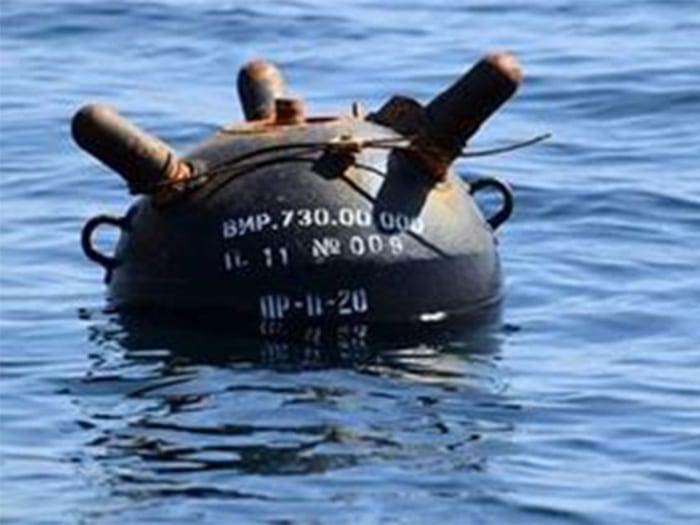
[Romanian Navy photograph]
Following the signing of an MOU between the U.S. and Iran, the Strait of Hormuz is officially open to shipping, but don’t expect normality to return any time soon … with BIMCO warning that the central part of the Strait is mined and un-navigable and that only the inshore traffic zones close to Oman and Iran are reportedly free of mines.
Kpler says that verified crossings are still at historic lows. As of June 17, Kpler observed six verified crossings across the monitored zone. Traffic was weighted east to west, and most vessels followed established Iranian coastal passage routes.
“Iran and the U.S have now agreed to permit transits through the Strait of Hormuz, but significant safety and security risks still persist, said Jakob Larsen, chief safety & security officer at BIMCO. “The central part of the Strait is mined and un-navigable, and only the inshore traffic zones close to Oman and Iran are reportedly free of mines.
“Despite the signing of the ceasefire agreement, we believe the security situation for the shipping industry remains volatile. Due to the risk of congestion and navigational incidents in the inshore traffic zones we still consider it risky for ships to commence transits at this point and advise shipowners to continue doing thorough risk assessments and appeal to all parties to put the safety of seafarers first.
“The MoU also raises several questions and does not offer sufficient information regarding key aspects such as safe routes, measures to separate traffic, sequencing of ships leaving the Gulf, reporting procedures, ship security procedures, procedures for naval protection and emergency response.
“BIMCO expects an international coordination body to be established shortly to facilitate transits. To avoid serious risks associated with an uncoordinated mass transit through the narrow inshore traffic zones, we encourage shipowners to consider waiting for further clarification and direction from the international coordination body.
“The threat of mines in the area remains a concern immediately as well as further down the line, and mine-free routes need to be established. Credible assurances from both sides of the conflict must be given before traffic can resume fully to pre-conflict levels.
“The next step is for shipowners to be reassured that transiting the Strait of Hormuz is not only permitted but also safe. Ships trapped in the Persian Gulf will be interested in leaving as soon as it is safe to do so but this must be done in a coordinated manner due to the confined nature of the Strait.”
Niels Rasmussen, chief shipping analyst at BIMCO commented:
“Once safe and secure passage through the strait has been confirmed, ships already in the Persian Gulf can begin re-establishing trade. This includes more than 100 laden tankers as well as nearly 100 in ballast which could start loading new cargo.\
“Within a couple of months, shipping services could return to pre-war levels. However, a recovery in cargo volumes may take longer due to damages sustained during the war, potentially delaying the rebound.”
“Damage to gas production at Ras Laffan in Qatar and the Habshan complex in the UAE will delay the recovery of LNG shipments and also impact fertilizer production and exports.
“Previous maritime disruptions have typically led to changes in ship routings, while cargo flows have largely continued. Although some situations have temporarily halted cargo movements, none have matched the scale or impact of the recent three-and-a-half-month isolation of the Persian Gulf.”
Categories: News, Safety and Security

![After Iranian attacks on three vessels transiting the Strait of Hormuz, U.S. forces yesterday struck over 80 Iranian targets. [Screengrab from YouTube]](https://www.marinelog.com/wp-content/uploads/2026/07/Screenshot-2026-07-08-at-11.02.22-AM-300x223.png)