Oil & Gas

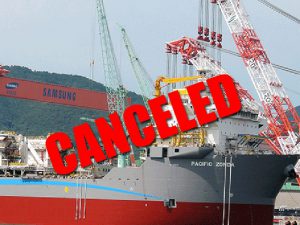
Pacific Drilling cancels drillship order at Samsung

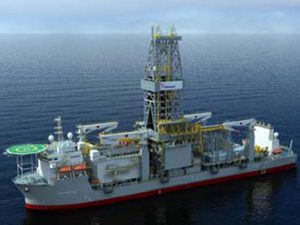
Pacific Drilling S.A. (NYSE:PACD) reports that it has exercised its right to rescind the construction contract for ultra-deepwater drillship Pacific Zonda “due to the failure by Samsung Heavy Industries (SHI) to timely deliver a vessel that substantially meets the criteria required for completion of the vessel in accordance with the construction contract and its specifications.”

Pacific Drilling says it made advance payments totaling approximately $181.1 million under the shipbuilding contract, and will be seeking a refund of the installment payments.

The company inked a contract for the drillship with Samsung Heavy on January 25, 2013 that provided for a delivery date of March 31, 2015.

The cancelation comes after the October 27 news that Fred Olsen Energy had canceled an semisubmersible drilling rig order at Hyundai Heavy Industries and the October 26 announcement that Transocean, Shell ans Daewoo Shipbuilding & Marine Engineering Co. (DSME) had agreed to push back the operating and delivery contracts of two newbuild ultra-deepwater drillships – the Deepwater Pontus and the Deepwater Poseidon – by 12 months each.
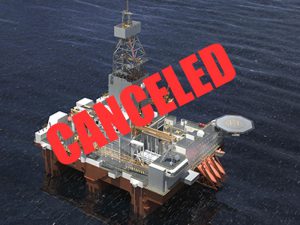

Fred Olsen Energy terminates rig contract at HHI

Today, Fred. Olsen Energy said that its Bollsta Dolphin Pte. Limited subsidiary has notified HHI that it has exercised its contractual termination right under the newbuilding contract as a result of the delay in delivery of the rig, the Bollsta Dolphin, a Moss CS 60 E, sixth generation ultra deepwater semi-submersible.

Fred. Olsen Energy says that the rig construction contract provides that on termination Bollsta will be
entitled to a refund of the first instalment paid to HHI of $186,390,240 plusaccrued interest.

The rig had been under contract to Chevron North Sea Limited under a contract entered into in October 2012. That contract has now been “mutually terminated” on “amicable terms.”

GulfMark Offshore trims its C suite

On October 21, 2015, says the filing, the company and Mr. David B. Rosenwasser, its Senior Executive Vice President and Chief Operating Officer, mutually agreed that his employment will terminate effective October 31, 2015.

On October 23, 2015, the company entered into an agreement with Mr. Rosenwasser that, among other things, provides for the following:

  • payment of benefits earned under the company’s employee benefit plans and accrued but unused vacation;
  • subject to the effectiveness of a release agreement by Mr. Rosenwasser, vesting of all outstanding restricted stock granted under the company’s 2010 Omnibus Equity Incentive Plan and 2014 Omnibus Equity Incentive Plan that would otherwise be forfeited;
  • reimbursement for certain outplacement services;additional semi-monthly payments over the following two-year period in the aggregate amount of $720,000; and
  • agreement by Mr. Rosenwasser to covenants of confidentiality, non-competition and non-solicitation of the company’s employees.

The agreement also provides for payment for limited consulting services by Mr. Rosenwasser over the following 24 months.

BSEE and USCG investigate drillship fatality

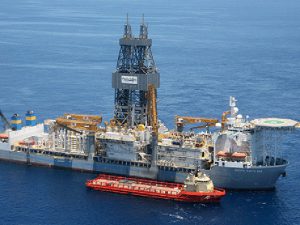
The Pacific Santa Ana was beginning drilling operations for Chevron.

According to the operator, operations on the drillship have been shut down. There were no other injuries reported and personnel remain on the drill ship. There was no reported pollution.  

No details of the circumstances of the fatality have been released.

BSEE and U. S. Coast Guard inspectors traveled to the drillship yesterday and began collecting evidence and taking statements. The incident will be investigated by both BSEE and the U. S. Coast Guard.

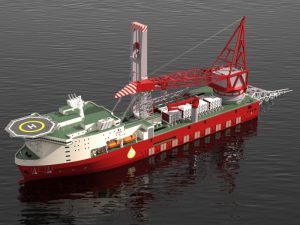
Ulstein offers Capex-friendly shallow water work horse

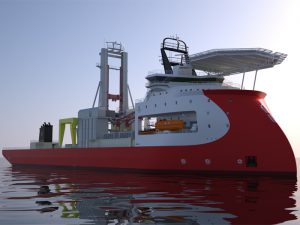
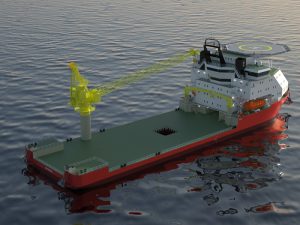
It says the main driver for the new 115.4 m x 30.8 m S182 design was to develop a “very CAPEX friendly” DP vessel with good capabilities to support various offshore operations, including cable lay and offshore construction.

The result is described as “a very versatile workhorse” that is capable of shallow water DP operations (at 4.5m draft) including beaching.

The design features a large open work deck that can accommodate up to 30 m ø carousel, a large cargo hold below deck and approximately 10,000 DWT capacity. A main offshore crane of up to 400 t can be located in the side of the vessel, while a passage way below main deck between the aft casings and accommodations avoids people having to cross the open work deck.

The vessel is capable of supporting a wide variety of operations:

  • Cable laying
  • Offshore construction
  • Shallow water installation
  • Dive support
  • Rock installation
  • Salvage works

Main particulars are:

Loa                             115.4 m           

Beam (molded)              30.8 m          

Depth                             8.4 m          

Draft (operational)           5.0 m

Deadweight             about 10,000 t

Speed                                 9 knots

Installed power             2 x 2,880 kW                                  

                                   2 x 1,920 kW

Positioning                   DP2                                  

                                  4-point mooring

Deck strength              15 t/ m2

Deck space                  2,000 m2

Cargo hold                      850 m2

Complement                    140 p (2 p cabins)                                        

                                       240 p (4 p cabins)

Report projects OSV demand will grow 75% by end of 2020

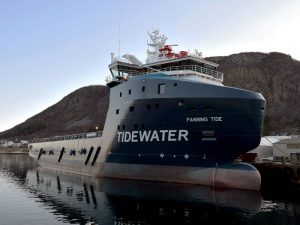
That’s heartening news for Offshore Support Vessel (OSV) operators such as Tidewater, Edison Chouest, Bourbon, Hornbeck Offshore, Seabulk and Maersk, which are dealing with the current challenging offshore oil and gas market. In a presentation at the recent Johnson Rice 2015 Energy Conference, Tidewater reported it had 38 vessels stacked as of the end of June. It has also announed plans to scrap 11 older vessels.

In its most recent monthly report, Baker Hughes reported that there were 29 drilling rigs operating in the Gulf of Mexico, down from 59 a year ago.

 Mordor Intelligence’s report, the Global Offshore Support Vessel Market, focuses on the market sectors by vessel type, including Anchor Handling Tug/Anchor Handling Towing Supply Vessels (AHT/AHTSs), Multi-Purpose/Multi-Role Supply Vessels (MPSV), Platform Supply Vessels, Construction Support Vessel (CSV), Specialty Vessels and others. It also breaks down activity by region: North America, Europe, the Asia-Pacific (APAC), South America and Middle-East & Africa (MEA). The report analyzes and projects the market share of each region for the next 5 years.

Most promising regions for OSV market are the Gulf of Mexico, Brazil, West Africa, the North Sea, South East Asia, the Middle East and Asia. Mordor Intelligence estimates that major part of the demand will be for AHTS, PSVs, and seismic research vessels.

As oil and gas explorations move towards deeper waters, explains Mordor Intelligence, multi-functional offshore support vessels are now called upon to perform different tasks, and have created various niches or categories within the market. Present day offshore support vessels are equipped with increased cargo capacity, panoramic navigation bridge visibility, large accommodation spaces, enhanced crew amenities and state-of-the-art propulsion and automation systems.

According to Mordor Intelligence, AHTS vessels comprise a 56% of the market share, followed by Platform Support Vessels. Inspection, Maintenance and Repair (IMR) Vessels are generally equipped with large accommodation spaces, heavy lift cranes, helidecks and streamlined bow forms for operation in harsh environments. Vessels specialized for multi-tasking carry out maintenance and repair operations on platform facilities, as well as subsea pipelines and equipment.