
VIDEO: CENTCOM continues strikes on Iranian military targets
Written by Nick Blenkey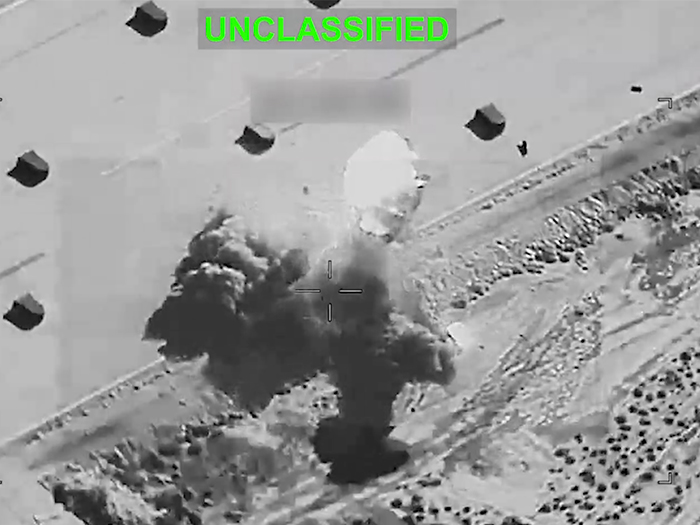
Screengrab fron CENTCOM video.
As had been strongly signaled by President Trump, U.S. attacks on Iranian targets have continued. U.S. Central Command (CENTCOM) reports that its forces completed an additional round of strikes against Iran, July 8, 2026, to further degrade Iran’s ability to attack commercial shipping and innocent civilian mariners in the Strait of Hormuz.
U.S. forces struck approximately 90 Iranian military targets including air defense systems, coastal surveillance assets, missile and drone storage sites, naval capabilities, and military logistics infrastructure along Iran’s coastline. The latest strikes follow successful execution of offensive strikes in Iran the night before.
CENTCOM’s actions are in response to Iran’s attacks on three commercial vessels transiting the strait, the Marshall Islands-flagged M/T Al Rekayyat, Saudi Arabia-flagged M/T Wedyan, and Liberian-flagged M/T Cyprus Prosperity. Those attacks were condemned by IMO Secretary-General Arsenio Dominguez.
“As long as the safety and security of crews cannot be assured, I urge flag States, shipowners, operators and all relevant authorities to avoid exposing seafarers to unnecessary danger by transiting the Strait,” he said.
FULL CONFLICT CONDITIONS
Windward AI assesses that “the Strait of Hormuz is once again operating under full conflict conditions. Overnight into July 8, U.S. Central Command struck more than 80 targets inside Iran in direct response to Iranian attacks on three commercial vessels transiting the Strait. Iran retaliated against U.S. military sites in Bahrain and Kuwait, President Trump declared the ceasefire over, and the U.S. Treasury revoked the general license that had authorized Iranian oil sales under the now-defunct interim agreement.
“The commercial response was immediate and sharp. Four vessels rerouted from the southern corridor to the central corridor within hours of the escalation, and an India-flagged crude tanker carrying approximately 1.95 million barrels of Kuwaiti crude bound for Singapore made a full U-turn. By the July 8 to 9 overnight window, transit volume had contracted to just five crossings, with a single outbound bulk carrier and zero outbound tanker cargo, the sharpest single-window contraction of the reopening period.
“Iranian crude exports have not stopped. Current export pace is assessed at approximately 1.5 million barrels per day, moving almost entirely to China via flag hopping shadow fleet tankers. Kharg Island held full terminal utilization through both strike nights, and an Iran-flagged NITC-operated OFAC-sanctioned VLCC was confirmed loading dark on July 8. What has changed is the legal cover. Approximately 63 million barrels of Iranian crude are now at sea with the U.S. waiver stripped, demand outside China near zero, and any operator, insurer, or intermediary facilitating these flows now fully exposed to secondary sanctions.
“The partial normalization that had been built since mid-June has effectively collapsed. Ceasefire declared over, sanctions reimposed, kinetic exchanges active on both sides, and outbound commercial traffic through the Strait now at levels not seen since the earliest phase of the conflict.”

![Steerprop has signed a repeat contract with Turkey’s Med Marine shipyard to deliver the propulsors for a third RAscal 2100 harbour tug designed by Robert Allan. [Image: Sterprop]](https://www.marinelog.com/wp-content/uploads/2026/07/TUG_MED-A2150_profile-300x225.jpg)