shipyard

Wartsila to power Shell’s 15 LNG fueled barges

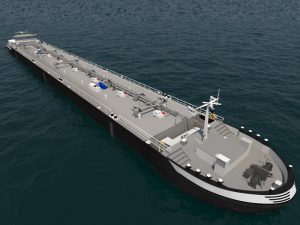
The barges are being built for Belgium based Plouvier Transport N.V. The hulls are under construction at VEKA Shipbuilding BV’s CENTROMOST shipyard in Poland and outfitting will be carried out at VEKA’s Werkendam shipyard in the Netherlands.

The barges will operate primarily on LNG and, for each barge, Wärtsilä will also supply  a 6-cylinder Wärtsilä 20DF dual-fuel main engine, a gearbox, an LNGPac fuel gas handling system (developed in close cooperation with Cryonorm), and a Wärtsilä propeller with an HR nozzle. The equipment is scheduled for delivery to the yards commencing in June 2016.The contract with Wärtsilä was concluded in December.

“Wärtsilä’s total solution capabilities, and its unmatched experience in LNG fuel machinery and systems for marine applications, are providing leading shipowners and operators with the added value they require. We salute everyone involved in this important project for their support in making inland waterway shipping more environmentally sustainable,” says Bram Kruyt, Director Inland Waterways, Wärtsilä.

Crowley takes delivery of second LNG ready tanker

The shipyard is the sole operating subsidiary of Oslo-listed Philly Shipyard ASA, which is majority-owned by Converto Capital Fund, which in turn is majority-owned by Aker ASA.

“We are proud to deliver another ship to Crowley and the first under our new name, Philly Shipyard. The Texas, like our 21 previously delivered vessels, continues the long tradition of men and women building quality vessels in Philadelphia,” said Philly Shipyard President and CEO Steinar Nerbovik. “As we continue to build the eight ships in our backlog, we are always looking for more skilled men and women to add to our team.”

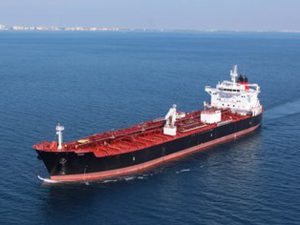
The 50,000 dwt, 330,000-barrel-capacity Texas and sister ship Ohio, which was delivered to Crowley in October, are first ever tankers to receive ABS(ABS) LNG-Ready Level 1 approval, meaning Crowley has the option to convert the tanker to liquefied natural gas (LNG) fueled propulsion in the future. The remaining two product tankers being built by Philly Shipyards for Crowley have planned deliveries from the shipbuilder in 2016.

“We are excited to close out 2015 with the addition of this technologically advanced vessel to our fleet of U.S.-coastwise product tankers,” said Rob Grune, Crowley’s senior vice president and general manager, petroleum and chemical transportation. “We constantly strive for ways to enhance the services we provide to our chemical and petroleum customers. The introduction of vessels like Ohio and Texas, with their advanced technology and environmentally friendly fuel options, prove that we are innovating the industry and we are doing it with American built, Jones Act vessels.”

The new 50,000 dwt product tankers are based on a proven Hyundai Mipo Dockyards (HMD) design which incorporates numerous fuel efficiency features, flexible cargo capability, and meets the latest regulatory requirements. The vessel is 600 feet long and is capable of carrying crude oil or refined petroleum products.

Crowley’s Seattle-based, naval architecture and marine engineering subsidiary Jensen Maritime is providing construction management services for the product tankers. Jensen now has an on-site office and personnel at the Philadelphia shipyard to ensure strong working relationships with shipyard staff and a seamless construction and delivery program.

  • News

Kleven books order for advanced stern trawler

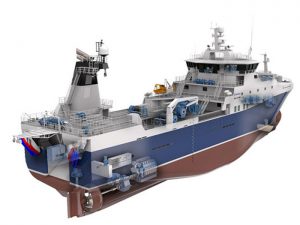
DECEMBER 23, 2015 — Norwegian shipbuilder Kleven has won an order to build a state-of-the-art stern trawler for France’s Compagnie Des Peches Saint-Malo S.A. & SAS Comptoir Des Peches D’Europe Du Nord

Gladding-Hearn delivers pilot launch

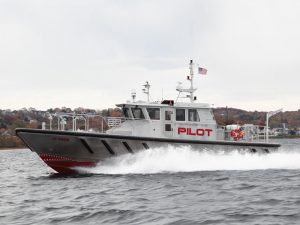
Designed by C. Raymond Hunt & Associates, the all-aluminum pilot boat is 52.6 ft long overall and has a 17-ft beam and 4.8-ft draft.

With a top speed of 25 knots, it is powered by twin Volvo Penta D16 diesel engines, each delivering 651 bhp at 1,800 rpm, turning five-bladed NiBrAl propellers via ZF 500-1-A gearboxes.

Each engine has a two-circuit Fernstrum keel-cooling system recessed into extra heavy bottom plating for operation in ice.Volvo Penta’s EVC system is mounted at the control stations in the wheelhouse and at the transom.The vessel is fitted with a Humphree Interceptor automatic trim optimization system.

The wheelhouse is outfitted with five Stidd seats and a three-zone, diesel-fired Espar Hydronic 35 heater for the cabin, main deck, and handrails. The forward wheelhouse windows feature ¾-inch electrically-heated laminated glass for de-icing. Interior sound levels are approximately 78 dba.

At the transom is a winch-operated rotating davit over a recessed platform for pilot rescue operation.

Tidewater Transportation takes delivery of latest towboat

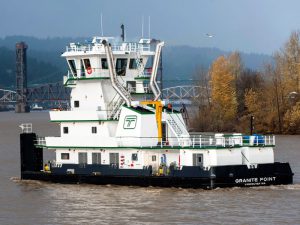
The vessel, built by Vigor Industrial’s Portland, OR, shipyard, follows towboat Crown Point, which began operations along the Columbia Snake River in May 2015.

Like the Crown Point, the Granite Point is a custom-built, environmentally-friendly towboat that was specifically designed by naval architects and marine engineers CT Marine, Edgecomb, ME, to serve Tidewater’s customers.

“Granite Point performed exactly as we wanted it to during its river trials earlier this month,” says Marc Schwartz, Maintenance & Engineering Manager at Tidewater. “We are ready for the Granite Point to team up with Tidewater’s current fleet of 16 towboats to provide our customers with the highest quality river transportation.”

Named for the granite cliff in Washington, about 20 miles southwest of Pullman along the Snake River, the towboat was built to the same specifications as the Crown Point and forthcoming sister vessel, the Ryan Point.

Measuring 102 ft by 38 ft, with a depth at full load of 11 ft, the Granite Point has a hexagonal wheelhouse with floor-to-ceiling windows on all six sides. The hexagonal design continues to the main deck, which features a galley, a media room, and a health and fitness facility.

“Tidewater understands that the ability of our crew members to cope with operational risk factors, like frequent sleep disruptions and heavy workloads, depends on their level of endurance,” says Bruce Reed, Chief Operations Officer and Vice President of Tidewater. “The responsibility for maintaining a high level of crew endurance rests with us. Therefore, all three towboats incorporate a comprehensive sound and vibration control package designed by Noise Control Engineers of Billerica, Massachusetts. The noise levels register at less than 60 decibels in the quarters during vessel operation, which is equivalent to the sound of an air conditioner.”

“When you are in the wheelhouse, which is three decks above the engines, you would really need to concentrate to hear the engines at all,” says Brian Fletcher, Tidewater Port Captain who piloted the Granite Point through river trials.

“You couldn’t ask for a quieter tug, nor a better tug in tight situations. It turns on a dime.”To meet the challenges of maneuvering barges through swift-moving currents, high winds, and eight navigation locks along the CSR System, CT Marine designed an enhanced steering system utilizing four main steering and four flanking rudders. Coupling the steering system with two Caterpillar 3516C Tier 3 engines, the design team was able to increase the margins of safety and efficiency.

“The Granite Point can ‘get up and go’,” says Josh Nichols, Assistant Port Captain, “but there is an ease and steadiness to it.”

“The up-front work paid off,” says Bob Curcio, Tidewater CEO. “The vessels are fuel-efficient, ecologically-responsible, and are giving our Captains and crews exactly what they’d asked for.”

“We are proud to have worked with Tidewater on Granite Point. Like its sister ship Crown Point, this vessel sets new standards for future towboat design. It will serve our community well for decades to come,” says Corey Yraguen, Vigor Executive VP of Fabrication.

TECHNICAL PARTICULARS

The Granite Point is powered by two Caterpillar 3516C EPA Tier 3 certified diesel engines each producing 2,240 BHP at 1,600 RPM. The engines drive two 92″ x 100″ fixed pitch, stainless steel propellers through CT28 Kort Nozzles. The vessel is capable of a service speed of 8 knots.

Electrical power is provided by two C7.1, Tier 3 generators, rated at 480 V, 200 kW at 1,800 RPM. The generators are controlled through an automatic transfer system that ensures the vessel will recover from a generator power loss in less than 30 seconds.

Deck machinery includes seven Patterson WWP 65E-7.5, 65 ton electric deck winches, with pilot house remote operation and local push button control stations on the main deck. Each winch has Samson 1 3/8″ Turbo 75 Synthetic Line.

To minimize power usage, variable frequency drives were used in all major rotating machinery applications and LED lighting was employed in both interior and exterior lighting applications.

The vessel is fitted with a Kidde NOVEC 1230 fire suppression system. Centralized fire detection and alarms cover both the machinery spaces and accommodations.

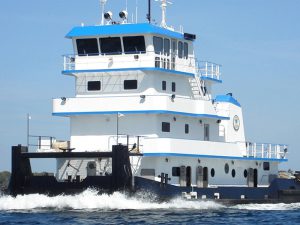
Chesapeake Shipuilding completes fifth hull fab building

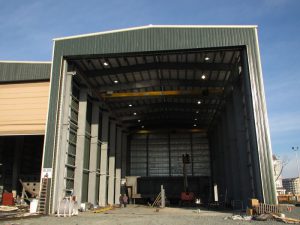
The new building is 160 feet long by 70 feet wide and 70 feet high and will allow larger hull sections to be construction in an indoor environment at the shipyard.

The building provides advanced climate control and has been fitted with two overhead cranes and state-of-the-art equipment.
It is large enough to accommodate the construction of complete tugboats or large hull sections in a controlled indoor environment.
Currently under construction in the building is an aft module of Hull 119, a 275 ft. coastal cruise ship.

The building demonstrates Chesapeake’s continuing commitment to quality and continuous improvement. The yard has upgraded its production capacity significantly in recent years, by acquiring additional land, building two new hull fabrication buildings and investing in additional automated equipment.

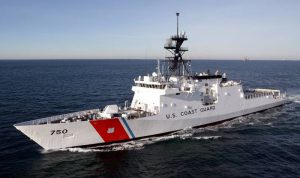
Omnibus bill funds ninth National Security Cutter

No mystery why the ninth NSC is in the legislation. It was put into 2016 Homeland Security appropriations bill (which was wrapped into the omnibus bill) by Senator Thad Cochran (R-MS), who is chairman of the Senate Appropriations Committee, even though it was widely criticized as “an unnecessary acquisition.”

“The demands on the Coast Guard to protect our coasts and waterways from terrorism, human trafficking, drug smuggling and other maritime threats are not diminishing. They’re increasing and will continue to do so as its jurisdiction in the Arctic region expands. The National Security Cutter is the best weapon we have to meet that demand,” said Senator Cochran, back in June. “The current Coast Guard production goal for only eight National Security Cutters is based on dated assessments and is insufficient to meet current or future requirements,”

“I am pleased that the Senate bill would maintain the national security cutter production line in order to give the Coast Guard more certainty and capabilities to meet its operational requirements,” he added.

The NSC production line is, of course, in Senator Cochran’s home state at the Pasagoula, MS, shipyard of Huntington Ingalls Industries’ Ingalls Shipbuilding Division.