Wartsila waterjets selected for Mols-Linien superferry

The shipyard has previously specified Wärtsilä waterjets for a number of fast ferry projects. This latest order was placed in November.

The scope of supply includes four Wärtsilä LJX 1500 SRI waterjets and a Wärtsilä Lipstronic control system. The equipment is scheduled for delivery to the shipyard in September, 2016.

“The strong relationship between Wärtsilä and the Incat yard continues, and this latest order confirms the good cooperation that the two companies enjoy. It also underlines Wärtsilä’s commitment to the Australian market. We are pleased to once again be supplying Wärtsilä waterjets, which provide reliable and efficient propulsion for fast ferry applications,” says Hans Laheij, Sales Director, Wärtsilä Marine Solutions.

“Incat, and our client Mols Linien, have continued to be satisfied with the performance of the Wärtsilä waterjets on KatExpress 1 and KatExpress 2 so it was a logical decision to select the Wärtsilä LJX 1500 SRI jets for KatExpress 3,” says Robert Clifford, Incat Chairman.

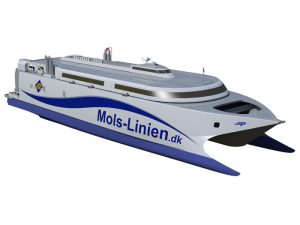
Set for delivery in March 2017, KatExpress 3 is a 109 m long wave piercing catamaran capable of carrying around 1,000 passengers and with capacity for 411 cars or a mix of trucks, vans and cars. .

GAO calls for hold on FY 2016 LCS funding

The GAO report, an unclassified version of a report published in July, was released as news surfaced that Secretary of Defense Ash Carter, in a Dec. 14 memo to Navy Secretary Ray Mabus, had told the Navy to reduce the planned LCS/FF shipyard procurement from 52 to 40 and to downselect to one variant by FY 2019 (see earlier story).

The GAO reiterates a number of arguments made by critics of the program. It says that the lethality and survivability of the Littoral Combat Ship (LCS) remain l largely unproven, six years after delivery of the lead ships.

According to GAO, LCS was designed with reduced requirements as compared to other surface combatants, and the Navy has since lowered several survivability and lethality requirements and removed several design features—making the ship both less survivable in its expected threat environments and less lethal than initially planned. The Navy is compensating for this by redefining how it plans to operate the ships.

In 2014, the Navy conducted its first operational test of an early increment of the surface warfare mission package on a Freedom variant LCS, demonstrating that LCS could meet an interim lethality requirement. The Navy declared LCS operationally effective. However, says the GAO, the Navy’s test report stated that the ship did not meet some key requirements.

Further, the Department of Defense’s Director of Operational Test and Evaluation has stated that there is insufficient data to provide statistical confidence that LCS can meet its lethality requirements in future testing or operations, and further testing is needed to demonstrate both variants can meet requirements in varied threat environments.

The Navy also has not yet demonstrated that LCS will achieve its survivability requirements, and does not plan to complete survivability assessments until 2018—after more than 24 ships are either in the fleet or under construction, says GAO.

The Navy has identified unknowns related to the use of aluminum and the hull of the Independence variant, and plans to conduct testing in these areas in 2015 and 2016. However, the Navy does not plan to fully determine how the Independence variant will react to an underwater explosion.This variant also sustained some damage in a trial in rough sea conditions, but the Navy is still assessing the cause and severity of the damage and GAO has not been provided with a copy of the test results.Results from air defense and cyber security testing also indicate concerns, but specific details are classified.

Read the GAO report HERE

Signal International in $5 million settlement with EEOC

DECEMBER 19, 2015 — The U.S. Equal Employment Opportunity Commission (EEOC) reports that bankrupt Mobile, AL, headquartered shipbuilding and repair company Signal International, LLC will pay an estimated $5 million to 476

Colonna’s Shipyard to add larger dry dock

DECEMBER 18, 2015 — Virginia Governor Terry McAuliffe announced today that Colonna’s Shipyard, Inc. will invest over $30 million to expand its operation in the City of Norfolk, VA, creating 51 new

Shell Rotterdam charters LNG fueled inland barges

DECEMBER 18, 2015 — Shell Trading Rotterdam BV (Shell) has signed a time-charter agreement with Plouvier Transport NV and Intertrans Tankschiffahrt AG for 15 new inland dual-fuel barges, which will predominantly run

NASSCO gases up second LNG fueled box ship

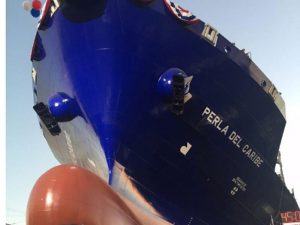
DECEMBER 18, 2015 — General Dynamics NASSCO reports that on December 11 itsuccessfully completed bunkering of liquefied natural gas (LNG) for TOTE Maritime’s Perla Del Caribe, the world’s second containership to be

DNV GL uses drone for surveys without scaffolding

“We have been looking at ways we could help our customers by accelerating the survey process,” says Cezary Galinski, Manager of the DNV GL – Maritime classification flying squad based in Gdansk. “Camera equipped drones are now much more widely available and affordable, and by using them for a first screening we can identify areas that require closer inspection quickly and without extensive staging, which can be both costly and time-consuming.”

Using drones to visually check the condition of remote structural components has the potential to significantly reduce survey times and staging costs, while at the same time improving safety for the surveyors.

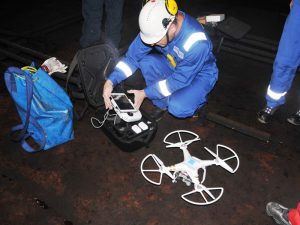
The tests used a camera-equipped drone to visually evaluate structural components through video streamed to a tablet. One surveyor operated the drone, while a second checked the video feed in real time. The stream was also recorded for review and documentation purposes.

Equipped with a powerful headlight, the drone was able to produce a video of sufficient quality for initial inspection purposes. In the event any damage is detected, a traditional close-up survey may still be required.

“We used a modified off-the-shelf drone for our tests,” says Mr. Galinski. “Because there are currently no drones formally certified as explosion-proof commercially available, we performed a risk assessment. Of course, before the drone operation started, we also ensured that the cargo tank was gas-free and certified for safe entry.”

“Our next step is to work with a more advanced tailor-made drone in early 2016,” says Mr. Galinski. “We are also developing a special guideline for performing drone-based surveys. This could open the way to remote or even autonomous inspections being carried out as part of our survey scheme in the near future.”

DNV GL has a longstanding R&D program working on developing advanced inspection technologies, including the IRIS system which can automatically associate photos onboard a ship with a 3D model of the vessel’s structure.

“Using a drone in combination with a system like IRIS could be very beneficial to our customers,” says Dr. Pierre C. Sames, Director of Group Technology and Research. “We have already demonstrated the ability to place images within a 3D model and furthermore to assess the individual findings. These are the first steps towards an automated survey process which might include using a drone to make the initial survey, taking the images generated and then running them through an algorithm to determine the hull condition.”

drone 700

GulfMark and Simek agree PSV delivery delay


According to the filing, “on December 14, 2015, a subsidiary of GulfMark Offshore, Inc. (“GulfMark”) entered into an agreement with Simek AS to delay the delivery of its North Sea vessel under construction in Norway from 2016 to 2017. Under the original agreement, GulfMark’s subsidiary paid 20% of the construction price within three months of contract inception, and was to pay the remaining 80%, or approximately $33 million, in February 2016 upon delivery. Under the new agreement, GulfMark’s subsidiary will take delivery of the vessel in January 2017 and will pay approximately $2 million in the fourth quarter of 2015, approximately $5 million in the first quarter of 2016, approximately $4 million in the second quarter of 2016 and approximately $22 million in the first quarter of 2017 upon delivery of the vessel.”

Triyards tanker trio to be Wartsila equipped

The 153 m long ships are being built for Swiss-Canadian Maritime Ltd and will be managed by Switzerland based ABC Maritime A.G. They are set to be delivered by the shipbuilder in 2017 and will operate between Rotterdam in the Netherlands and Montreal, Canada.

The contract covers Wärtsilä largest scope of supply thus far for delivery to a shipyard in Vietnam. It was signed in November and includes options for three more vessels.

Wärtsilä’s capability to provide a total solution package and to be responsible for the engineering and integration of the solutions provided were key factors in winning the contract.

For each vessel, Wärtsilä will supply a controllable pitch propeller (CPP), a tunnel gearbox, a shaft alternator, two tunnel thrusters, three Auxpac generating sets, a Wärtsilä Propulsion Condition Monitoring System (PCMS), as well as all related auxiliaries for the various systems.

The Wärtsilä equipment is scheduled to be delivered to the yards during 2016.

In addition, the ships will be powered by a 6-cylinder Wärtsilä X40-B two-stroke main engine designed by Winterthur Gas & Diesel, a joint venture between Wärtsilä and China State Shipbuilding Corporation (CSSC). The engine contract was agreed separately between Triyards Marine Services Pte. Ltd. and Chinese two-stroke engine builder, Yuchai Marine Power Co., Ltd. (YCMP).

“Wärtsilä is a global leader and their propulsion and power generation systems are among the best in the world. We are therefore confident that the technology of their systems will enhance the capabilities and performance of the chemical tankers we are building,” says Chan Eng Yew, Chief Executive Officer of Triyards Holdings Limited.

“These are the first chemical tankers that the yards have been contracted to build, and Wärtsilä’s support and know-how for the engineering and systems integration is of considerable importance. We are delighted to be working once again in Vietnam and are extremely pleased to be cooperating with Triyards in this important project,” says Hans Laheij, Sales Director, Wärtsilä Marine Solutions.

Triyards 700

Ingalls Shipbuilding launches DDG 114


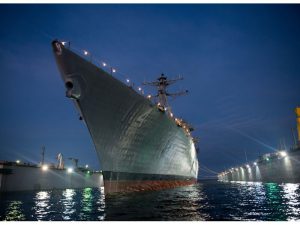
The ship was translated from the land level facility to the drydock which was slowly flooded until the ship was afloat.

“This is an exciting milestone and represents a significant amount of effort by our Navy and industry team to get the ship to this point” said Capt. Mark Vandroff, DDG 51 class program manager, Program Executive Office (PEO) Ships. “We’re looking forward to completing outfitting efforts, undergoing test and trials and delivering another highly-capable asset to our Fleet.”

“The last week of translating this quality ship across land and then launching it from our drydock is no small task, and our shipbuilders accomplished it in a very efficient manner,” said George Nungesser, Ingalls’ DDG 51 program manager. “All crafts and personnel making up this DDG shipbuilding crew have performed very well, and we were able to launch DDG 114 ahead of schedule. It’s a nice milestone to accomplish as we end the year.”

Ingalls has built and delivered 28 Arleigh Burke-class destroyers. There are currently four more under construction at Ingalls, including Ralph Johnson, which is scheduled to be christened in the spring of 2016.

John Finn (DDG 113) was christened in May and is expected to undergo sea trials in 2016. Paul Ignatius (DDG 117) celebrated her keel-authentication milestone in October and is expected to launch in the first half of 2017. Delbert D. Black (DDG 119) started construction in July and is scheduled for keel laying in the second quarter of 2016.

DDG 114 is named to honor Pfc. Ralph Henry Johnson, who was awarded the Medal of Honor for his heroic actions that saved others during the Vietnam War. Johnson shouted a warning to his fellow Marines and hurled himself on an explosive device, saving the life of one Marine and preventing the enemy from penetrating his sector of the patrol’s perimeter. Johnson died instantly. The Charleston, S.C., native had only been in Vietnam for two months and a few days when he was killed at the age of 20.

The highly capable Arleigh Burke-class destroyers are capable of simultaneously fighting air, surface and subsurface battles.

,/p>

LOAD MORE