
Maersk Group profit plunges
AUGUST 12, 2016 — Hit by low average container freight rates and low oil prices, Maersk Group delivered a second quarter profit of $118 million compared with $1.1 billion in the same
AUGUST 12, 2016 — Hit by low average container freight rates and low oil prices, Maersk Group delivered a second quarter profit of $118 million compared with $1.1 billion in the same
Leading shipowners and operators, gas suppliers, ports, class societies, and technologists gathered last month in London to announce a new cross-industry initiative aimed at accelerating the adoption of Liquefied Natural Gas (LNG) as a marine fuel. The initiative hopes to address the issues of LNG bunkering infrastructure, regulatory concerns, and the higher initial capital investment costs in building LNG-fueled vessels.
Called SEA/LNG, the initiative brings together participants from Carnival Corporation & plc, DNV GL, ENGIE, ENN, GE, GTT, Lloyd’s Register, Mitsubishi Corporation, NYK Line, Port of Rotterdam, Qatargas, Shell, TOTE Inc. and Wärtsilä.
The goal of the initiative explains TOTE Inc. Executive Vice President Peter Keller, who is serving as SEA\LNG’s Chairman, is to address “market barriers and help transform the use of LNG as a marine fuel into a global reality.”
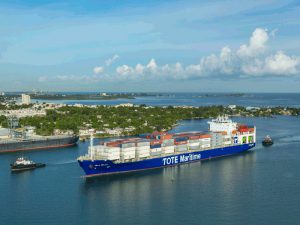
When it comes to using LNG as a marine fuel, TOTE is all in. It’s committed about $500 million in capital investments to have its entire fleet to burn LNG. The U.S.-flag operator has built two 3,100 TEU LNG-fuelled containerships now in operation between the Port of Jacksonville, FL, and San Juan, PR, and is converting the two ORCA Class Roll-on/Roll-Off ships in its fleet to burn LNG. The first of those two is being converted at Singapore’s Keppel Shipyard this fall.
TOTE is not alone in adding dual-fuel and LNG-Ready tonnage to its oceangoing fleet in the U.S. Harvey Gulf International Marine, Crowley Maritime Corp., Matson Navigation, Kinder Morgan, and SEA VISTA/SEACOR all have vessels in operation or under construction that burn or could eventually burn LNG as a marine fuel. In all, there are 29 vessels that are designed or could be converted to burn LNG as shown in the accompanying table. This does not include inland and coastal vessels such as towboats or ferries.
The U.S. Maritime Administration, for example, is supporting the conversion of a towboat to burn LNG as fuel.
The use of LNG as a marine fuel has increased with Emission Control Areas (ECAs) coming into force in Northern Europe and North America under MARPOL Annex VI. LNG is relatively clean burning, containing virtually no sulfur content and it produces lower NOx and particulate matter in the combustion process than fuel oil and marine diesel oil.
A long-time, well-known proponent of LNG as a marine fuel, John Hatley, PE, Gas Initiatives Wärtsilä North America, sees gas as a compelling solution for box feeders, RO/RO vessels, ferries and cruise ships, product tankers, Great Lakes vessels, and ATBs on short coastal voyages that enter into ECAs.
LNG is therefore able to offer a fuel solution compliant with both current and anticipated future regulations.
The larger effect from Annex VI will come when the requirement to reduce sulfur content of marine fuels to 0.5% on a global basis effective 2020 or 2025 depending on the outcome of an IMO low sulfur fuel availability study to be completed in 2018. The issue for ship owners and operators is how to find alternatives to economically meet the low sulfur fuel mandate about to be imposed by MARPOL Annex VI.
However, while LNG is a competitive fuel relative to current alternatives, LNG infrastructure is needed in ports around the world to enable quick, safe and cost effective bunkering. In the U.S., the first LNG bunker transport barge with GTT Mark III Flex tank technology is under construction at Conrad Orange shipyard in Orange, TX, and expected to be delivered in early 2017. LNG bunkering infrastructure is far more advanced in Europe.
“Everybody is calling for alternatives to reduce environmental impacts says Philip Olivier, CEO of ENGIE Global LNG. “That’s why we have joined forces to actively promote LNG as a key fuel in maritime transport. LNG has the potential to take a 10% market share of global bunker demand by 2030. ENGIE will contribute to achieving this target.”
Tom Strang, Senior Vice President, Maritime Affairs, Carnival Corporation & plc, says, “By working together proactively across the whole marine LNG value chain we can make the transition to a lower emission marine sector a reality.”
Lauran Wetemans Shell’s general manager downstream LNG agrees. “To make the transition to LNG as a fuel happen it needs close collaboration with key players across the full value chain,” says, Wetemans. “SEA/LNG aims to promote the benefits and potential of LNG fuel, and create a level playing field for LNG with other fuels. It will complement the work being done by other organizations like the Society for Gas as a Marine Fuel.”
Leo Karistios, Gas Technology Lead, Lloyd’s Register, points out, “LNG fuelled shipping has mainly been for the visionaries and, until now, concentrated in specialist ship sectors: short sea shipping and ferries, mainly sailing between two fixed ports. We want to help drive the expansion of LNG as a marine fuel of choice, with not just more short sea and local ships burning gas, but also the deep sea trades.”
Timo Koponen, Vice President, Flow & Gas Solutions, Wärtsilä Marine Solutions, says his company will contribute “its vast experience and know-how in gas driven propulsion systems and the entire gas value chain” to the initiative. “By working together, we plan to overcome the challenges and speed the general acceptance of LNG. Having been a pioneer in the use of LNG as a marine fuel, and a developer of major technologies facilitating the adoption of LNG fuel, it is natural that Wärtsilä supports wholeheartedly the aims of the SEA/LNG coalition.”
Developing bulk carrier concept
Wärtsilä is also involved with an effort with class society ABS, Arista Shipping, Deltamarin, and GTT in the Project Forward joint development project (JDP) to develop a dry bulk carrier concept that employs LNG as fuel.
The goal is to develop a Kamsarmax bulk carrier design to be the first of this type suitable for worldwide services powered by LNG in compliance with the IMO’s Energy Efficiency Design Index 2025 standards, NOx Tier III and MARPOL Annex VI SOx emission levels. This landmark design will be the first LNG-fueled cargo ship capable of full-range operations.
“The long-term potential for LNG as a marine fuel is tremendous,” says ABS Vice President of Global Gas Solutions Patrick Janssens. “We see the near-term opportunities for larger vessels on fixed and known trade routes, but more opportunities will emerge as concepts mature and bunkering infrastructure expands. Environmental stewardship will continue to be a concern, and owners will be evaluating alternative fuel choices.”
“Project Forward represents a milestone for the shipping industry in bringing to the market a practical, achievable design for what are the workhorses of the shipping fleet,” says Arista Shipping Principal Alexander P. Panagopulos. “Our mission is to develop the next generation of energy efficient and environmentally friendly dry bulk cargo ships to be sustainable worldwide beyond 2030. It marks a number of ‘firsts’ and draws together the experience of a team of leaders in their field to make LNG powered shipping a reality on the high seas.”
Technical challenges in developing this design were considerable, as there is a need to carry a large volume of LNG (2,500 m3) – which corresponds to full-range operation and 40 days – in a type of ship where available space is limited and cargo space is at a premium.
ABS will provide Approval in Principle (AIP) for the concept, which is based on the highly optimized Deltamarin B.Delta 82 design, utilizing a GTT membrane LNG fuel tank. This design also could be applied to other bulk carrier sizes and serve as the basis for an LNG-fueled tanker. The concept features a Wärtsilä four-stroke, medium-speed engine without auxiliary generators, the first time this configuration has been applied to a vessel of this type, significantly simplifying the vessel’s engine room arrangement and contributing to lower capital expenditure.
Read more from our Green Technology & Sustainable Shipping section in our Digital Edition.
“Orders are drying up. We are faced with an unimaginable situation at which our dock may soon be empty,” wrote Choi Kil Seon, Chairman of the world’s largest shipbuilder, Hyundai Heavy Industries, in a letter to employees this past March. Complacency had set in during the boom years of the 2000’s, he said, despite strenuous efforts to compete with Chinese shipbuilders.
His stark warning has been echoed around shipbuilding halls across Asia. Chinese shipbuilding is undergoing massive retrenchment with the closure of many second-tier shipyards and massive state aid for those still in business. Meanwhile, Japanese shipyards fear a slump that could prove worse than the crash that followed the 2008 financial crisis. Shipyard executives fear the worst as current projects come to an end and have no pipeline of business to speak of.
About 5,000 miles away, workers in the high-tech Kleven Shipyard just outside Ulsteinvik on Norway’s west coast may or may not be aware that their counterparts in Asia are staring into the abyss. And they would certainly not recognize the term complacency in any aspect of shipyard operation.
A combination of effective marketing, chunky investment in automation and robotics, clever use of the country’s export credit arrangements, and close cooperation with Rolls-Royce ship designers who work just across the fjord, has enabled the family-owned shipyard to build up an order book now potentially worth more than $1.8 billion.
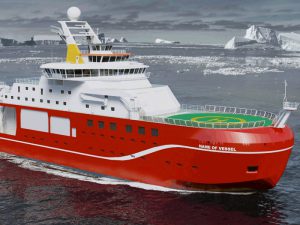
 Early in July, the yard announced its latest contract for the construction of two—with an option for an additional two—ice-strengthened expedition ships designed by Rolls-Royce (rendering pictured at right) for Norway’s Hurdigruten. Hurdigruten operates a fleet of cargo and passenger vessels around the country’s 15,700-mile coast. The order, worth billions of Norwegian krone, is the largest in Hurdigruten’s history and is a major coup for the shipyard and Rolls-Royce which, in addition to vessel design, will supply about $15 million of equipment for each ship.
Together with the yard’s existing 16-ship order book, Kleven now has work for the rest of this decade. Ships under construction include six anchor handlers for Maersk Offshore, four high-tech stern trawlers of Rolls-Royce design for German, French and Spanish owners, the world’s most advanced cable layer with the highest DP3 position-keeping for ABB, two Rolls-Royce design live fish carriers, a deep-sea mining vessel for de Beers, and two luxury megayachts for a New Zealand entrepreneur. Talk about a diverse order book.
How has the yard been able to buck the global trend, particularly in one of the most expensive parts of the world? Certainly the Norwegian Export Credit Guarantee Agency has played an important role by making attractive financing terms available for foreign owners and vessels to be deployed overseas. But the yard’s management has spent almost $60 million on upgrading yard facilities over the past five years.
The robotic welding process, using lasers, continues to evolve, with a vision control system recently installed and developed by the University of Trondheim. The automated process allows welding rates of more than 300 feet per hour transforming manual rates of a typical eight feet per hour. “This is how we believe we can stay ahead of our competition and be competitive on price,” said a yard representative recently.
However, while the Kleven story may be exceptional—other yards in Norway’s usually bustling Sunmøre region are wrestling the challenge of an unprecedented offshore downturn—the design and shipbuilding innovation evident in northern Europe still facilitates construction of some of the world’s most sophisticated vessels.
In a radius of just a few miles from Kleven, there are several Vard yards, now owned by Fincantieri, the Havyard and across the fjord, next door to Rolls-Royce is Ulstein. Between them, these shipbuilders have completed some of the most sophisticated vessels ever built. They include the latest generation seismic survey ships, light well intervention vessels, offshore construction vessels and ultra-sophisticated cable layers.
Norway is not alone, however, in blazing a shipbuilding innovation trail. Finnish ship designers have unmatched expertise in ice-class design and construction, likely to be in heavy demand as warming seas enable navigation through the Northern Sea Route. Presumably with this in mind, Russia’s United Shipbuilding Corporation completed the acquisition of what is now called Arctech Helsinki Shipyards at the end of 2014.
Sited adjacent to the ice model test basin now known as Aker Arctic Technology Inc, the Helsinki shipyard has undergone various changes in ownership over the years, but has always focused primarily on ice-class design and construction. More than 500 ships have been built since it was established 151 years ago and more than 60% of the icebreakers now in operation around the world were built there.
The Helsinki yard has pioneered a range of ice-class innovations over the years, often with others. These include ‘double-acting’ vessels, which can break ice by bow or stern, azimuthing propulsion for ice operation, heeling and air-bubbling systems, shallow-draft icebreaker designs for inland waterways and coastal seas, and nuclear-powered icebreakers.
The shipyard continues to innovate. In 2014, the shipyard delivered the first “oblique icebreaker” to Russia’s Federal Agency of Sea and River Transport. The Baltika has an asymmetric hull and three azimuthing thrusters with a total installed power of 9 MW. She can break ice ahead, astern or sideways and can open up a 160-foot channel in two-foot thick ice.
The shipyard’s most recent delivery is the first dual-fuelled icebreaker to be powered by LNG and diesel. The Polaris, with a bollard pull of 200 tonnes, is powered by two 6.5 MW stern Azipods and one 6 MW unit, all supplied by power and automation company ABB. She is the Finnish Transportation Agency’s eighth icebreaker.
Polaris will be powered by Wärtsilä’s dual-fuel engines capable of operating on both liquefied natural gas (LNG) and low sulfur diesel fuel. Wärtsilä’s scope of supply consists of one 8-cylinder Wärtsilä 20DF, two 9-cylinder Wärtsilä 34DF, and two 12-cylinder Wärtsilä 34DF engine. Additionally, Wärtsilä secured a five years maintenance agreement for all engines and generators including spare parts, remote online support, CBM monitoring and training services.
The EURO 123 million ($136 million) vessel, classed by Lloyd’s Register, also has an emergency response and oil spill recovery capability and completed sea trials successfully in June. Her 800 m3 of LNG storage will provide an endurance of up to 30 days when operating in the Gulf of Bothnia.
Norway has led the way in the development of gas-powered ships and Rolls-Royce has been one of the pioneers. Designed by NSK Ship Design, the gas-powered cargo ship M/S Høydal features a Bergen gas engine, Promas combined rudder and propeller, and a hybrid shaft generator from Rolls-Royce. The ship was built at Tersan Shipyard in Turkey and delivered to NSK Shipping. The DNV GL class Høydal transport fish feed manufactured by BioMar to the numerous salmon and trout farms of northern Norway.
Boaty McBoatface lives on
Rolls-Royce engineers are also designing the 128m polar research vessel RRS Sir David Attenborough, which will be built at Cammell Laird’s site in Birkenhead on Merseyside, England. As you might recall, the project drew worldwide attention and almost blew up the internet when the public overwhelmingly chose the name “Boaty McBoatface” for the £200 million vessel during a “Name Our Ship” campaign held by Britain’s Natural Environmental Research Council. The council saved face—pun somewhat intended—by choosing the fourth most popular name submitted, “Sir David Attenborough,” after the famous British naturalist.
NERC says a remotely operated vehicle used by the Sir David Attenborough in its research will be named Boaty McBoatface instead.
The project is the biggest commercial shipbuilding contract in Britain and one of the biggest for more than a generation. When delivered in 2019, the Sir David Attenborough will carry out oceanographic and other scientific work in both the Antarctic and Arctic as well as transporting supplies to Antarctic research stations.
The research vessel will be Polar Code 4 ice class, with an endurance for voyages up to 19,000 nautical miles, space for a total of 90 people and a large cargo capacity. The vessel is also designed to generate very low levels of underwater radiated noise and minimize the risk of pollution. Onboard laboratories will allow the prompt analysis of samples.
As part of its £30 million contract, Rolls-Royce will supply the diesel electric propulsion system which will include new Bergen B33:45 engines, two nine-cylinder and two six-cylinder engines, and two 4.5m diameter Rolls-Royce Controllable Pitch Propellers (CPP). The powerful, efficient and compact engines and strong propellers will be able to push the vessel through approximately one meter thick level ice with extremely low underwater radiated noise, avoiding interference with survey equipment or disturbing marine mammals and fish shoals.
According to Jørn Heltne, Rolls-Royce, Senior Vice President for Sales in Ship Design & Systems, Rolls-Royce will also deliver automation and control systems, including its Dynamic Positioning system and Unified Bridge.
Also, Rolls-Royce deck handling systems will support a wide range of tasks, such as towing scientific equipment for subsea acoustic survey equipment using up to 12,000m of wire, or deploying equipment over the side or through a moonpool to collect seawater and seabed samples at depths of up to 9,000m.
OEMs capitalize on new era of ‘smart shipping’
Rapid advances in satcom technology is finally enabling shipping to go digital and make the most of ship-shore connections. While a handful of companies have wired up their ships over the last few years—notably the world’s largest container line, Maersk, high-throughput broadband now facilitates 24/7 connectivity and introduces a new era of remote monitoring, diagnostics, predictive maintenance and shore-side support.
Other transport modes have been using these technologies for some time, but satellite coverage across the world’s oceans has remained a challenge. Many thousands of unconnected ships still provide manually prepared noon reports for managers ashore, an asset monitoring procedure which some from outside shipping can scarcely believe.
Rolls-Royce, through its TotalCare service, has been monitoring the performance of thousands of jet engines for years. Instead of signing service agreements and charging customers for call-outs, spare parts and attendance at unexpected breakdowns, the company’s “power-by-the-hour” concept is aimed at keeping planes in the air and avoiding any downtime.
Earlier this year, London-listed Inmarsat launched Fleet Xpress, a high-throughput broadband service available through its Global Xpress network on its latest satellite constellation. As well as enabling a completely new range of ship-shore connections including internet, email, social media and video conferencing, third party app providers can procure bandwidth on Fleet Xpress to provide their own “smart” services (see accompanying feature, “Fleet Xpress brings ‘smart’ ship tipping point,” for more details).
Systems similar to the Rolls-Royce TotalCare service are now being introduced in shipping. Wärtsilä recently paid EURO 43 million ($47.5 million) for Finnish energy management and analytics firm Eniram which has sensor and analytics equipment installed on about 270 vessels and a turnover of EURO 10 million ($11 million) in 2015. The Helsinki-based firm has established a sound track record in raising vessel efficiency by optimizing trim, engine load and speed, thereby saving fuel and cutting emissions.
The acquisition will strengthen the company’s recently launched Wärtsilä Genius service in which key components are monitored in real time, exceptions noted, and maintenance procedures optimized. A virtual service engineer will also be available as part of the service and the company plans to make more details available at this year’s SMM in September.
 Competitor ABB is preparing to open its fourth “Integrated Operations Center” in the United States later this year, probably in Houston. The company has already opened a facility for its offshore clients in Billingstad, Norway, and two similar centers for shipping customers in Helsinki and Singapore.
A fifth center is also likely to be set up in China. By mid-year, ABB had established real-time connections between the centers and clients’ ships, enabling ABB personnel to track performance and provide shore-side support if necessary. Meanwhile Rolls-Royce Marine is also in the process of setting up connections to monitor its equipment in operation at sea.
Following a successful remote monitoring pilot project, Radio Holland recently struck a deal with China Navigation Company for the maintenance of its navcom equipment onboard the owner’s newbuild, multipurpose vessels and bulk carriers.
“The maintenance agreement with Radio Holland has been designed to dovetail with the end of the warranty period for our newbuildings,” says Martin Cresswell, Fleet Director, China Navigation Co. Pte., “and is a continuation of the excellent cooperation that we have built over the last few years. The agreement incorporates remote monitoring, which we believe will significantly reduce out of service periods, increasing operational safety.”
MAN Diesel’s largest two-stroke engine yet
Just this past June, China State Shipbuilding Corporation (CSSC) acquired Wärtsilä’s 30% shareholding in Winterthur Gas & Diesel Ltd. (WinGD). WinGD, Winterthur, Switzerland, will continue as an independent, international company to develop and innovate its two-stroke low-speed marine engine portfolio serving all merchant markets and customers worldwide.
WinGD was one of the earliest exponents of diesel technology. It started the development of large internal combustion engines in 1898 under the “Sulzer” name.
“With the transfer of the shares in WinGD from Wärtsilä Cooperation to CSSC, we will be able to establish even closer cooperation with one of the leading global shipbuilding conglomerate CSSC enabling us to accelerate the development of reliable, efficient and innovative two-stroke low-speed engines meeting the market demands of merchant shipping of the future. WinGD will continue to work with the Wärtsilä Corporation Service Network to serve our customers for after-sales support,” says Martin Wernli, CEO of WinGD.
In other news in the two-stroke diesels, this past May, the 19,437-TEU MSC Jade was delivered by Korea’s Daewoo Shipbuilding & Marine Engineering (DSME) with what is the largest and most powerful engine yet from MAN Diesel & Turbo. Built by Doosan Engine in Korea under license from MAN Diesel & Turbo, the MAN B&W 11G95ME-C9.5 two-stroke engine is rated at an impressive 75,570 kW (103,000 hp).
The G95 is a popular choice in the large containerships (9,000 to 21,000 TEU), with 68 sold in the segment since August 2013.
“We attribute the G95’s popularity in this segment to its ability to provide sufficient power for such vessels to reliably achieve their desired operating speed,” says Ole Grøne, Senior Vice President Low-Speed Sales and Promotions, MAN Diesel & Turbo. “Here, the G95’s rpm ensures that a propeller of optimal size can be employed, in turn delivering a low fuel-oil consumption for an optimal fuel economy.
Japan’s Mitsui Engineering & Shipbuilding, another MAN Diesel licensee, completed the world’s first ME-GIE ethane-operated two-stroke diesel engine. The Mitsui-MAN B&W 7G50ME-C9.5-GIE will be installed in the first of three 36,000 m3 liquefied ethane gas carriers being built by Sinopacific Offshore Engineering in China.
MAN Diesel & Turbo reports that ethane was chosen as fuel over HFO because of its competitive pricing as well as the significantly shorter bunkering time it entails. As a fuel, its emissions profile is also better than HFO, as it contains a small amount of sulphur, 15-20 lower CO2 and emits signficantly fewer particles during combustion. The ME-GI engine can also easily be converted to run on methane, if the operator desires.
Obligation, vigilance, and perseverance are among the professional qualities of the merchant mariner. Whether one attends a maritime academy, as I did, or comes up through the hawsepipe, in seagoing service mariners learn and practice the ethos of care to crew, ship, and the environment. Mariners are supposed to display those qualities in spite of cold, or rain, or discomfort–one of my strongest memories of the academy is being on lookout, freezing, wearing all my jackets. Mariners are supposed to be ready, to be watchful, to put together skills and equipment and to balance paradox and contradiction to make a successful voyage.
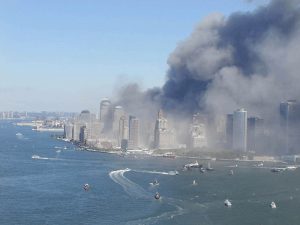
The New York Harbor community combined all these unique attributes on 9/11, evacuating hundreds of thousands of commuters and residents of Lower Manhattan to Staten Island, to New Jersey, and elsewhere in New York City in an improvised fleet of boats: tugs, dinner boats, tour boats, private vessels. Over the course of those hours, boats made trip after trip across the harbor. Then, as the number of evacuees from Manhattan tapered off, the boatlift shifted to transporting responders and supplies to the island, an operation that continued for several days. They accomplished the largest water evacuation in history without planning, without practice—and without accidents.
What made this possible? To find out, my coauthor Tricia Wachtendorf and I talked with boat operators and waterfront workers, piecing together their stories for our book American Dunkirk: The Waterborne Evacuation of Manhattan on 9/11. Foremost was a spirit of service and a duty to rescue that is characteristic of the maritime community. Law and tradition require a mariner to come to the aid of a person at sea in danger of being lost. On 9/11 mariners widened the compass of their obligation to include the people who were queuing up at the shoreline.
The participants in this evacuation saw themselves as part of an active maritime community. Everyone knew everyone else, they said. They knew each others’ boats, and personnel were always moving from company to company, creating a strong network of acquaintance. Even though the commercial setting could sometimes be highly competitive, there were also habits of cooperation: any company might need help from any other in an emergency. It’s almost a rule in the disaster field that the planning process is more important than the plan itself. Responders have to become familiar with each others’ capacities, resources, and limitations. The years of interaction and familiarity were actually a planning process for urban disaster management, though they didn’t know it.
Mariners lead lives of paradox. GPS provides fabulous accuracy, but the prudent mariner is still reminded to check it by other means. Some mariners have attended disciplined and hierarchical academies where they live a regimented lifestyle while also learning Bridge Team Management, to adopt proper communications skills that short-circuit the intimidation of hierarchy. They operate in a complex web of maneuvering rules, which also contain a rule that prescribes that the rules should be broken when they’re not working. Often their information is ambiguous, as with weather, so they are sensitive to margins of error. In this complex milieu, mariners are always making judgments about safety, speed, and efficiency. These judgments abounded on 9/11.
They carried passengers on boats not certified for that. In some cases, they exceeded boats’ passenger capacity. Boat operators said they didn’t do this recklessly, but looked at the boat’s performance, the distribution of additional weight, and the demands of the immediate crisis. Certainly the usual margin of safety was narrowed in this event both with respect to capacity and to navigation. In some areas around the harbor the dust was so thick that visibility was zero, but they continued on. “Radar, don’t fail me now!” recalled one captain thinking as he approached the entrance to North Cove. Sometimes, boat captains took on bystanders to assist in embarking evacuees or in handling lines. Boats used piers they were unaccustomed to, or that weren’t designed for passengers, and had to jury-rig gangways because of the different heights. The captains were careful, using their experience and judgment to know how much they could push the boundary of risk. Other rules were slackened. A Coast Guard officer authorized fueling without permits. Two harbor pilots took golf carts to move supplies. The main thing was that when they pushed the limits, they were thoughtful, weighing the risk as experience has taught them.
Sometimes older technologies are more adaptable than modern ones. A break-bulk ship can work cargo anywhere, but a container ship, not so much. Efficiency sometimes erases adaptability, but disasters remind us of the importance of older tools and technologies, such as radio. Certainly there are tools to help the modern disaster manager: satellite photography, robotics, drones. But a lot of disaster management is old-fashioned work: moving things and people, staging equipment, organizing activities, talking on the phone. Probably the exemplar of this principle during 9/11 was the John J. Harvey, a retired fireboat that had been bought and restored by a group of enthusiasts. On the morning of September 11, the group boarded the Harvey and got underway first just to see what was happening, then they moved some evacuees, but then the Harvey’s real talent became obvious: the capacity to pump a lot of water. That capacity, left over from now-ancient days of wooden piers and warehouses and stacked-up flammable cargoes, was just what was needed to charge the fire hoses now substituting for the destroyed infrastructure at Ground Zero. Even in normal times, the Harvey demonstrated the qualities of prudence and vigilance. One of her owners, a retired fireboat captain, insisted they always have some usable firehose on hand, just in case.
Of course, there were challenges. The era of deep-draft commercial maritime use of much of Lower Manhattan has long since past. The waterfront had few good locations for the boats to embark passengers and lacked critical shoreside infrastructure, such as bollards or cleats, to tie boats to. Meanwhile, the smooth stone surface of the Battery Park seawall threatened to damage boats that were coming alongside. The sailboat Ventura, for example, could not tie up there because of being buffeted against the wall. “We’re going to have a boat that’s full of matchsticks and it’s going to sink,” said the captain. Even the durable Harvey got “quite a battering.” Some boats tied up to trees to hold steady for taking on evacuees. In other instances there was too much infrastructure, some of it in the form of fences and ornamental ironwork. Several participants in the evacuation reported simply cutting down the fences to clear a path for the evacuees.
The boat operations demonstrate what we have seen in many disasters: the importance of improvised, unscripted activities, and the importance of new groups, organizations, and networks. In spite of a widespread desire to “command and control,” that is not possible in an unfolding community-wide disaster. Most people are rescued by bystanders, for example, often well before formal responders arrive, which shows that there is always a grassroots dimension to disaster management. 9/11 maritime activities took place all around New York Harbor. No one could have full “command” of these activities, where needs were being identified and handled in an organic way through a growing network. The Coast Guard took a coordinating but not a commanding role. They wisely made no effort to take over the entire operation, recognizing that they needed to let it unfold. And there would be no way to command activities that were happening at Liberty Landing, or at Weehawken, or at Highlands, a 17-mile transit from Manhattan, where they were all dealing with their own needs of sorting passengers, decontaminating people, and offering comfort and bottles of water.
The 9/11 boat operations offer some insights for urban disaster management and resilience, organizations, and communities. Key features of resilience are redundancy, substitutability, and mobility. Some vessels can operate even if others are out of service. Boats are a mobile resource, easily moved around as needed. If some facilities are damaged, others may be available or can be improvised on short notice. Some vessels of more rugged construction served as floating piers, so that other vessels of lighter design would not be damaged against the seawall. Vessels are connected by VHF radio—nearly always available– and vessel movements are organized not by a flowchart or a rigid command structure but rather by a nautical chart and the mariners’ operational knowledge of that area: its laws, regulations, and customs. Public officials in waterfront cities should look closely at the different transport modes available. In particular, emergency managers and urban planners and engineers should work much more closely together to identify needs and resources.
That’s the key. People, groups, and communities share what they know; identify what they need; and connect to others. The maritime operations on 9/11 are an example of principles that extend to other settings. In situations as diverse as U.S. wildfires to the Fukushima tsunami and nuclear plant catastrophe, people have built new networks and improvised with whatever is available. A resilient disaster response depends on deep knowledge of a place, memory, gathering resources, and finding substitutes. These are the pieces that people can assemble creatively and strategically to manage a disaster.
You can view a list of the vessels and operators that lent their support on 9/11 at www.fireboat.org/911_rescue_boats.php
James Kendra is a graduate of Massachusetts Maritime Academy and a former merchant marine officer. He is Director of the Disaster Research Center at the University of Delaware.
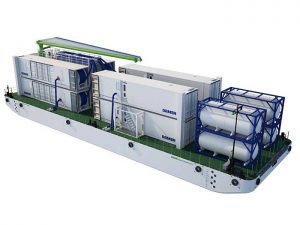
AUGUST 10, 2016 — Although Damen’s InvaSave mobile ballast water treatment technology is designed for use in ports, in order to qualify for IMO Type Approval the system has now completed shipboard
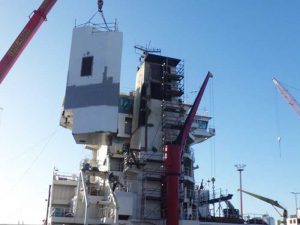
AUGUST 9, 2016 — Jork, Germany, headquartered shipowner Reederei H.-P. Wegener is reporting major fuel cost savings using Alfa Laval PureSOx exhaust gas cleaning systems. The company’s four container feeder vessels, include
JULY 28, 2016 — In what it says is a breakthrough finding for ultra-large containerships, ClassNK has concluded that the minimum required brittle crack arrest toughness for extremely thick brittle crack arrest
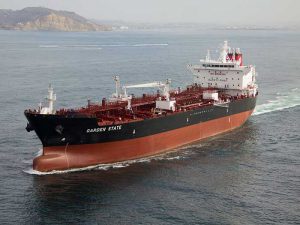
JULY 27, 2016 — General Dynamics NASSCO marked a milestone Monday by delivering its seventh ship in the span of just over a year. The Garden State, an ECO Class tanker built
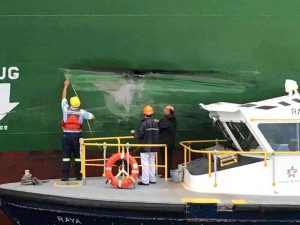
JULY 25, 2016 — A Cosco neopanamax containership last month became the first ship to make a commercial transit of the expanded Panama Canal. Now another Cosco neopanamax, the 8,500 TEU Xin
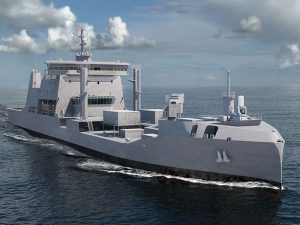
JULY 25, 2016 – South Korea’s Hyundai Heavy Industries (HHI), the world’s largest shipbuilder, has won an order to build a 23,000 ton class logistics support vessel for New Zealand Defence Force’s