


VIDEO: Advanced new D.E.E.P. propeller blade enters production phase
Written by Nick Blenkey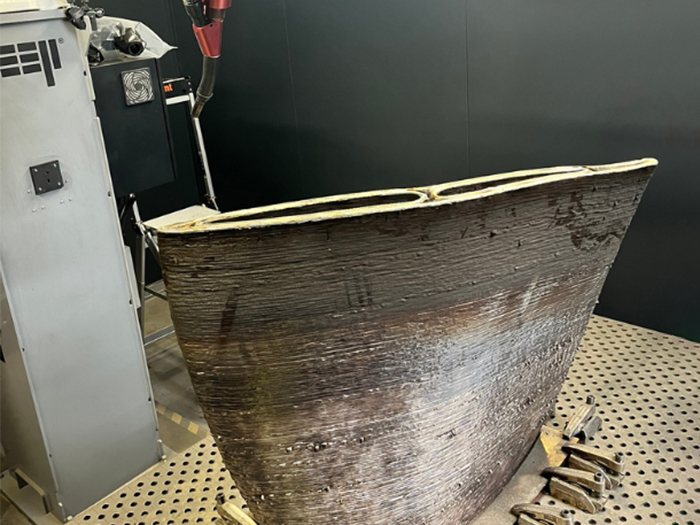
Photo: DEEP Manufacturing
In a 3D printing breakthrough, a U.K.-based consortium led by Enki Marine Ltd has completed an 815-millimeter, 45 kilogram, section of a next-generation nickel aluminum bronze marine propeller blade using the process of wire arc additive manufacturing (WAAM). Completion of the section marks a major milestone in the Digitally Enabled Efficient Propeller (D.E.E.P) project, which is backed by funding from Innovate UK.
Timelapse footage captures the propeller blade taking shape – offering an insight into the additive manufact,ure of large-scale marine propulsion components.
The seven-month programme is demonstrating how industrial-scale additive manufacturing can unlock lighter, smarter and more efficient propulsion systems for the future of clean shipping.
Traditionally, propeller blades are typically produced using casting processes, which can restrict design flexibility and limit performance optimization. D.E.E.P is investigating how industrial 3D printing can overcome these constraints, enabling lighter, more efficient and more intelligent propulsion systems designed for the future of clean and smart shipping.
At the center of the project is a structurally and hydrodynamically optimized blade architecture. This approach offers lighter, more efficient propeller blades while allowing real-time data collection. In time, this could allow vessels to monitor propulsion performance in real time, autonomously optimise engine power and speed, and enable predictive maintenance.
https://www.deep.com/In addition to Enki Marine – responsible for system integration and commercialization – the consortium includes DEEP Manufacturing Ltd (a spin-off from ocean engineering and technology company DEEP), Stone Marine Propulsion, TWI, Authentise, ASTM International and Newcastle University – spanning expertise in design, materials testing, digital workflows, certification and hydrodynamic validation.
WAAM offers potential lead time reductions of up to two thirds compared to conventional casting, while supporting regional production and improved supply chain resilience. This milestone comes as DEEP Manufacturing continues to scale its WAAM capability internationally, including recent expansion into Houston, where increasing demand for large-scale, high-integrity metal components is accelerating adoption across energy, defense and maritime sectors. :
“This is the point where digital ambition becomes physical reality,” said Peter Richards, CEO at DEEP Manufacturing Ltd. “We are not simply printing a propeller – we are demonstrating a new way of thinking about propulsion design, production and long-term resilience.
“As we continue to scale our WAAM capabilities internationally, including our recent expansion into Houston, we are seeing first-hand how demand is growing for faster, more flexible manufacturing of large-scale, high-integrity components across critical industries.”
The next phase of the program will focus on scaling to a full-size propeller sea trial and operation optimization platform development.
Categories: News, Technology, Video, Video
![The 52-foot Mirage is the third flagship platform in Saronic’s growing ASV fleet. [Photo: Saronic Technologies]](https://www.marinelog.com/wp-content/uploads/2026/07/smirage-300x225.jpg)
![USNS William Mclean (T-AKE 12). [U.S. Navy photograph]](https://www.marinelog.com/wp-content/uploads/2026/07/TAKE-12-300x225.jpg)

![Going forward, all operations of the combined operation will be conducted under the Moran Towing Corporation name. [Photo: Moran Towing]](https://www.marinelog.com/wp-content/uploads/2026/07/MichaelS-300x250.jpg)