
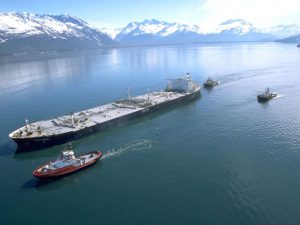
Crowley loses bid to renew Alyeska contract
MARCH 17, 2016 —Crowley Marine Services will no longer be providing oil spill prevention and response services in Valdez and Prince William Sound, Alaska, once its current contract expires June 30, 2018.
MARCH 17, 2016 —Crowley Marine Services will no longer be providing oil spill prevention and response services in Valdez and Prince William Sound, Alaska, once its current contract expires June 30, 2018.
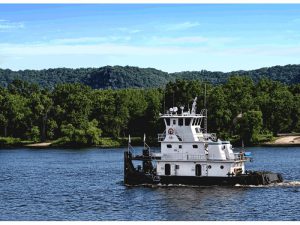
Countless Federal laws govern nearly every aspect of the inland waterways transportation industry, yet the convergence of the United States Coast Guard (USCG) Subchapter M impending Final Rule with Internal Revenue Services (IRS) Inland Waterways Excise Tax audit practices might have a more profound, far reaching impact then industry observers have as yet considered. Fortunately, it appears that taxpaying tow & barge operators may come out on top if they take full advantage of this unlikely Federal rulemaking interplay.
Background
The inland waterways constitute a 25,000 shallow-draft transportation system of which 12,000 miles are taxable Inland Waterways. This domestic waterborne transportation system is a prominent fixture in supporting key American industries such as: mining, agriculture, timber, petroleum and chemicals, cement, metal, and paper and allied products. Barging is a highly energy-efficient freighting solution that has historically been safe, congestion free, and creates a low impact land use and low pollution impact footprint. The movement of immense quantities of raw materials at low cost over long distances is the sustaining force of the waterways system. Stretching from Pennsylvania in the Northeast, to Texas in the Deep South, and Minnesota in the Heartland this “waterways highway” is a vital “import & export” network between states and an artery to foreign markets.
The economic impact in terms of product value transported between states on the inland waterways exceeds $100 billion annually. The 70,000 person inland waterways workforce underpins various industries of more than 800,000 workers. States along the inland waterways contribute 54 percent of the national population, 49 percent of GDP, 50 percent of Federal tax revenue, 56 percent of heavy manufacturing jobs, and 61 percent of agricultural jobs. Countless millions of payroll taxes are generated for Federal and State governments as a result of the inland waterways industry. The Inland Waterways Trust Fund has accrued in excess of $1.6 billion from fuel tax revenue since 1986 and is a catalyst for major construction and rehabilitation projects on the inland waterways.
Subchapter M is the result of the Coast Guard and Maritime Transportation Act of 2004 (CGMTA 2004) in which Congress authorized the Secretary of Homeland Security to create regulations for towing vessel safety management systems and hours of service for towing vessel personnel. The Towing Safety Advisory Committee (TSAC), a Federal Advisory committee to the United States Coast Guard comprised of a broad spectrum of interested parties in the inland waterways industry, established a working group to assist USCG in framing the rules required under CGTMA 2004. Over the course of six years TSAC conducted numerous public meetings that culminated in four TSAC reports submitted to USCG for review and revision. USCG published the Subchapter M Notice of Proposed Rulemaking (NPRM) in August 2011 and held four public hearings nationwide for public comment. Publication of the Sub Chapter M Final Rule is anticipated in 2016.
Objective Evidence
Objective evidence is best defined as documented statements of fact, other information or records, both quantitative and qualitative, related to the quality of an item or activity, based on observations, measurements, or verifiable tests.
The 2011 NPRM publication set forth the U.S. Coast Guard’s intent to adopt “objective evidence” as a safety requirement through “…detailed processes, procedures, recordkeeping and auditing…” documented in “logbooks, non-conformity reports, and/or other reports of audits.”
The Internal Revenue Service applies accounting’s “Objective Evidence” standard when conducting audits of towing operators for compliance with the Inland Waterways Excise Tax as reported on IRS Form 720. A typical IRS Information Document Request (IDR) to an inland towing operator will include the vessel log, fuel purchases, maintenance records, machinery tech manuals, and fuel operating reports.
Workboat eLogs
Federal law details what entries must be made by watch officers in the vessel’s official logbook. TSAC, in a 2008 report to USCG, reinforced existing recordkeeping requirements for inland towing operators and expanded upon the increased recordkeeping burden Sub Chapter M rules will likely have from a watch officer perspective. Although Federal law does not require log entries related to geographic position, waterway conditions, or commercial activities, it does require the logging of pre-departure testing of steering & propulsion, safety items & drills, crew, and marine casualties. Log entries must be timely and are presumed accurate thus binding the vessel owner to those entries. Negating the binding effect in litigation is held to a rigorous test. The maintenance of a proper and accurate log cannot be over-emphasized as the consequences for poor onboard recordkeeping can be legally and financially catastrophic to a marine operator.
Appreciating the increased onboard recordkeeping burden Subchapter M posed, the U.S. Coast Guard provided for the automation of the onboard recordkeeping processes through definition of a towing vessel record, or workboat eLog, in Part A Section 136.110 of the NPRM. This definition allows any onboard recordkeeping or documentation of events required by Subchapter M to be “a book, notebook, or electronic record”. Thus, according to the NPRM, inland towing operators have the advantage of adopting workboat eLogs as a primary recordkeeping tool.
Workboat eLogs and Marine Enterprise Solutions
While the presence of an onboard workboat eLog offers considerable advantage to watch officers and onboard auditors, it is only through the integration of the eLog with a shoreside marine enterprise solution that its benefits can be fully realized. The ability to “push” onboard data shoreside for interrogation by various marine enterprise solution modules offers an unlimited variety of analytical models for decision makers to consider.
The two distinct audit report functions of safety (USCG) and accounting (IRS) are easily achievable within the framework of a mature, interfaced onboard/shoreside recordkeeping solution. Of course, affordability, scalability, ease of user interface, system stability, and system configurability play an irreversible role in the success of a mature marine enterprise solution. It should also be noted that the presence of Key Performance Indicator data pushed by eLogs to the marine enterprise solution and applied to an industry best practices regime can only improve asset utilization, workforce performance, and customer satisfaction.
Conclusion
The unintended opportunities facing inland waterway operators by opting into the Subchapter M onboard electronic recordkeeping options in lieu of manual recordkeeping are hard to contest. These options are greatly enhanced if the marine operator also elects to interface office accounting, safety, and personnel functions with the vessel as part of a shoreside marine enterprise solution.
Adopting a software architecture and infrastructure where the marine operator can satisfy the reporting requirements of a multitude of Federal agencies (USCG, USACOE, IRS, EPA) through a single electronic reporting system which also provides critical commercial data to the carrier, clients, vendors, and other interested third parties offers immeasurable value.
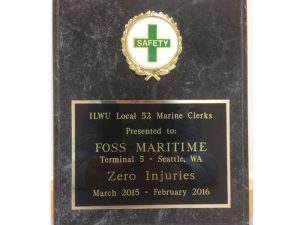
MARCH 4, 2016 — Foss Maritime has been recognized by the ILWU Marine Clerks Local 52 for zero injuries at Terminal 5, Seattle, WA, between March 2015 and February 2016. The first-ever
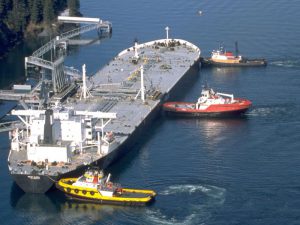
FEBRUARY 4, 2016 – Crowley Maritime Corporation’s tanker escort and docking services group in Valdez, AK, is celebrating over seven million man hours and more than six years since logging its last
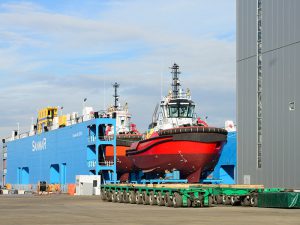
JANUARY 12, 2016 — Copenhagen, Denmark, headquartered Svitzer is ordering two more ASD tugs from Sanmar Shipyards in Turkey. The two latest newbuilds willservice the multi-billion dollar INPEX-operated Ichthys LNG Project in
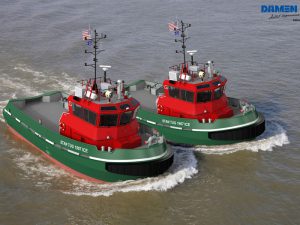
Under the license, signed at this week’s Workboat Show, Great Lakes Shipyard will receive full construction, design and engineering support from Damen, which will also provide expert assistance based on it experience with construction of nearly two hundred Damen designed vessels of other types in the U.S. over the years.
The Stan Tugs 1907 were chosen based on Damen’s reputation for quality and following fact-finding visits made by the management of the Great Lakes Towing Company to Damen in the Netherlands that demonstrated that the Stan Tug 1907 exactly matched the Towing Company’s needs.
In addition to the Ice Class specification, the tugs will also be treated with special, high endurance paint capable of withstanding the abrasion that comes with moving through ice.
The partnership with Damen provides Great Lakes Shipyard with a portfolio of proven vessel designs for U.S. customers. Most of the designs have been refined through the progression of multiple builds.
Damen vessels built under license in the U.S. since the mid-1990s include 55 Fast Crew Supplier 1204 class, built at Horizon Boat Builders and Trinity Shipyard, 25 Fast Crew Supplier 1605 class vessels built by Blount Boats and eighty 26-m patrol boats for the U.S. Coast Guard, built by Bollinger Shipyards which is also the builder of the Sentinel-class Fast Response Cutters (based on Damen’s 47 m Stan Patrol 4708) for which 58 licenses have been sold.
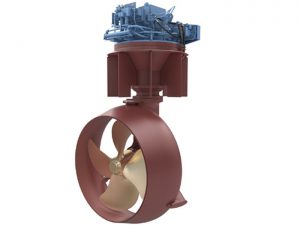
NOVEMBER 20, 2015 — Rolls-Royce has signed a contract for the delivery of 12 azimuthing thrusters to Sanmar Shipyard in Turkey during 2016, with an option for an additional 30 units. The
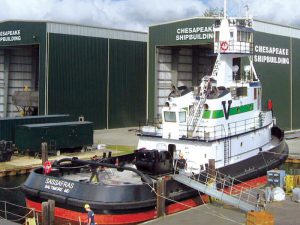
They will be the 15th, 16th and 17th tugboats built for Vane Brothers by Chesapeake Shipbuilding since 2008.
Construction on the first new tug has already begun in one of Chesapeake Shipbuilding’s hull fabrication buildings.
The design of the new tugboats will be nearly identical to previous tugboats built for Vane Brothers. Each will be equipped with twin Caterpillar 3512 main engines, producing a combined 3,000 horsepower, and will have a single drum hydraulic winch from JonRie of New Jersey.
The tugs will measure 94′ long with a 32′ beam, and a 13′ depth.
All Chesapeake Shipbuilding tugs are built in a controlled indoor environment prior to being moved and launched into Maryland’s Wicomico River.
Chesapeake Shipbuilding has recently made significant upgrades to its shipyard to increase its production capacity and efficiency, including acquiring additional land, building two new hull fabrication buildings and investing in additional automated equipment.
The yard is located on 14 acres of level land, with more than 2,400 ft of deepwater bulkhead, along the protected waters of the Wicomico River. It has two large outfitting basins, three side launch systems, plus a ground transfer system and various hull fabrication buildings and shops.
It has won an order to build four RAstar 3400 Azimuth Stern Drive tugs for new client Greenbay Marine Pte Ltd, a Singapore-based internationalspecialist marine craft group.
The four vessels are expected to be delivered in early 2017 and Triyards says the order is worth some $12.8 million, excluding owner-furnished equipment.
Powered by 4,400 kW engines, each of the 34-m tugs will be constructed for escort operations in adverse sea and weather conditions.
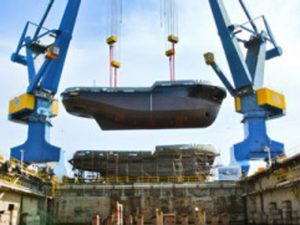
JUNE 11, 2015 — Mexican shipbuilder TNG (Talleres Navales del Golfo) is making good progress with four azimuthing tugboats under construction for Pemex at its Port of Veracruz. The Tarahumara is already