shipyard

Damen hands over RoPax ferry to Canadian customer


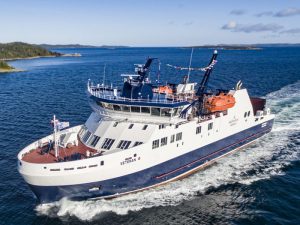
Launched at the end of March by Damen Shipyards Galati in Romania the vessel will start services from Fogo Island and Change Islands before the end of November.

MV Veteran was delivered by the shipbuilder on time and within budget.MV Veteran is the first of a two-vessel contract. Its design results from a partnership between Fleetway of Canada and Denmark’s Knud E. Hansen.

Several Canadian companies have provided services, rangingrom electrical equipment to fire-fighting systems, for the MV Veteran and its sister ship, the MV Legionnaire, which is scheduled for delivery from Galati in the spring of 2016 and will operate on the busy short-haul route from Portugal Cove to Bell Island.

The Veteran will replace the MV Earl Windsor built in 1975. The Legionnaire will replace the MV Beaumont Hamel built in 1985.

Both vessels are part of a large “lifeline” vessel replacement program being undertaken by the Provincial Government to modernize its fleet, which annually transports over 900,000 passengers, 400,000 vehicles and 20,000 tonnes of freight with more than 50,000 arrivals and departures.

As the region in which they operate is located near the Arctic, the vessels have to maneuver in drifting ice.

According to Damen Manager North America Jan van Hogerwou, the two new ferries can handle the impact of 40 cm-thick floating ice at 4 knots.

“Their rudders, hull and propellers have been strengthened and are outfitted with extra plate thickness for heavy winter conditions,” he says.

Damen Ferries Product Director Henk Grunstra says: “The highest certificate available for ferries is the Ice Class 1A Super certificate. These diesel-electric propelled vessels also have redundant systems. The bridge is ergonomically designed and has optimal working space for efficient and safe operation. The modern, low maintenance interior was designed by an internationally recognized designer. The shift crew lives on board the ship in 15 single crew cabins.”

A Canadian service and support hub for these vessels is being established. A certified Damen maintenance center will be located in the capital of the Newfoundland and Labrador region, St. John’s. An agreement with a local Newfoundland-based company is in place and its employees are currently being trained at Damen Shipyards Galati.
  • News

German owner to convert containership to LNG fueling

Funding was provided through the federal program Mobility and Fuel Strategy which promotes the maritime use of LNG as an environmentally friendly fuel.

“For many years our shipping company has been committed to ‘Green Shipping’ – through the development and implementation of more efficient alternative propulsion systems,” said Gerd Wessels, Managing Owner of Wessels Reederei GmbH. “With the conversion to LNG we and our partners are showcasing our technical expertise and demonstrating practical environmental solutions for the merchant marine industry.”

Wessels Reederei has been investigating the conversion for the past two years, in collaboration with the main engine manufacturer, MAN Diesel & Turbo, and gas specialist TGE Marine Gas Engineering GmbH.

Delivered in 2011 by China’s Jiangdong Shipyard, Wes Amelie is a modern 1,000 TEU containership that operates in the North Sea and Baltic.

Wes Amelie has 23 sister ships, 16 of them structurally identical, and in selecting the vessel for conversion, special attention was paid to the scalability of the engineering services as well as the development costs, significantly reducing the costs for follow-up projects. continent.

One reason for the providing of funding for the conversion by BMVI is that it contributes to resolving the “chicken and the egg” problem of LNG fuel availability vs. demand by being a a demand-generating flagship project.

Wessels Reederei says that “due to the long delivery time for LNG tanks,” the conversion will begin in fourth quarter 2016, with full operational usage of LNG as fuel planned for early December 2016.

Fednav takes delivery of first BWTS equipped Laker

The ship, the 34,500 dwt ocean going laker Federal Biscay, is fitted with a ballast water treatment system (BWTS) — a first for ships transiting the Great Lakes, says Fednav, the largest international operator in the Great Lakes/Saint Lawrence Seaway System.

Fednav announced in April that it would equip all 12 ships in its Oshima shipyard newbuild program with BallastAce ballast water treatment systems (BWTS) (see earlier story).

Developed by JFE Engineering Corporation in Japan, the BallastAce system will be effective in both fresh and salt water. BallastAce operates through a combination of filtration and sodium hypochlorite (bleach) injection into the ship’s ballast system.

“This is a pivotal step in protecting the Great Lakes against invasive species and preserving biodiversity in the region,” said Paul Pathy, president and co-CEO of Fednav Limited. “Fednav is proud to be the first shipping company to deploy such systems, and we are pleased that the Federal Biscay is serving as a test ship for this technology.”

Fednav will start using BallastAce in the Great Lakes at the opening of the St. Lawrence Seaway in 2016.

With the assistance of Fednav, the BallastAce system (which is already USCG AMS approved) will continue the necessary testing for full U.S .Coast Guard type approval for fresh, brackish, and salt water at the GSI facility in Superior, WI, and at MERC in Baltimore, MD. During the first six months of 2016, the system installed on the Federal Biscay will be be used for the shipboard testing element of the type approval requirements.

Fednav expects that the IMO Ballast Water Management Convention, to which Canada is a signatory, will most likely enter into force in 2016, the year the U.S. Coast Guard and EPA require the installation of systems on ships trading in US waters.

Austal launches first of two HSSVs for Oman

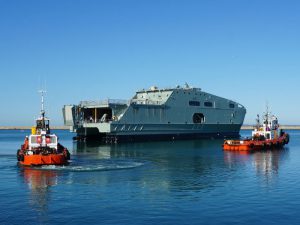
Hull 390 — the future RNOV Al Mubshir — entered the water on schedule after 13 months of construction and fit out.

Based on the proven Expeditionary Fast Transport (EPF) platform — previously known as the Joint High Speed Vessel (JHSV) — being built for the U.S. Navy at Austal’s Mobile, AL, shipyard, the HSSV offers a range of capabilities to support naval operations, including helicopter operations, rapid deployment of military personnel and cargo, search and rescue operations, humanitarian aid and disaster relief missions.

The shipbuilder was awarded the US$124.9 million contract for the design, construction and integrated logistics support of the two Omani HSSVs in March 2014 and construction commenced in August 2014.

This first HSSV will now complete final fitout before sea trials, prior to delivery to the RNO early in 2016. The second HSSV is under construction and is on schedule for completion in mid 2016.

Austal Chief Executive Officer Andrew Bellamy said the on-schedule launching of the first HSSV demonstrates Austal’s proven capability to design, construct (and support) large, multiple naval vessel programs.

“From our defense portfolio, Austal is currently contracted to deliver ten 127 m frigate-sized Littoral Combat Ships and ten 103 m Expeditionary Fast Transport (EPF) vessels to the United States Navy – as well as two OPV-sized 72 m High Speed Support Vessels, here in Western Australia for the Royal Navy of Oman,” said Mr. Bellamy.

“Our track record here in Australia and overseas clearly supports Austal’s strong proposition that we can effectively and efficiently deliver the Australian Government’s Future Frigate and Offshore Patrol Vessel programs,” he added.

Front Street Shipyard to build carbon fiber hulled ferries

Working in conjunction with Maine Composites Alliance and Martin Grimnes, a Norwegian composites expert living in Maine, Arcadia Alliance is aiming its highly efficient ferries at state and federal agencies seeking to replace aging, less efficient passenger vessels.

Brødrene Aa designs and builds carbon-fiber passenger vessels in a modern shipyard, well suited for manufacturing of composite products, with a total of 3,000 square meters of fully moisture-and temperature controlled indoor facilities, The company has built 50 carbon ferries to date.

Carbon fiber ferries are lighter weight and consume less fuel than aluminum or fiberglass vessels, releasing fewer emissions into the air.

“Given the significance of ferry transport to travelers in coastal regions coupled with concerns about gas consumption and emissions, efficiency of our country’s ferries is critical,” says J.B. Turner, president of Front Street Shipyard. “Brødrene Aa has a progressive design to reduce consumption and emissions, and they have an exceptionally efficient construction method we can apply to the U.S. ferry market at Front Street Shipyard.”

Brødrene Aa is a 60-year-old company that introduced the world’s first carbon-fiber passenger vessel more than a decade ago.

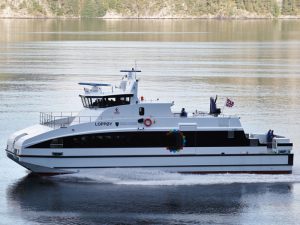
It has built 50 carbon ferries to date. Last month it won an international tender issued by Guangzhou Panyu Lianhuashan Port Passenger Transport Co., Ltd , (subsidiary of Chu Kong Shipping Enterprises Holdings Co. Ltd) to design and build two coastal high speed catamarans for Hong Kong. The contract is for two identical vessels; both made of carbon fiber composites, each with a capacity of 270 passengers.

Representatives from Front Street Shipyard met with officers of Brødrene Aa in Hyen earlier this summer.

“Given Front Street Shipyard’s modern facility and boatbuilding capabilities, we believe their team can deliver the same high-quality vessels in the United States that we produce in Norway,” said Leif Riksheim, chairman of the board at Brødrene Aa.

The organizations are now working together to develop ferry designs for U.S. waters. The Arcadia Alliance sales team will begin marketing the boats later this year, with hopes that Front Street Shipyard will be able to begin construction on the first fast ferry in 2016.

Recent contracts won by Brødrene Aa include two 270 passenger coastal high speed catamarans for Hong Kong

 hong kong

  • News

LNG fuel tanks installed in first Crowley ConRo

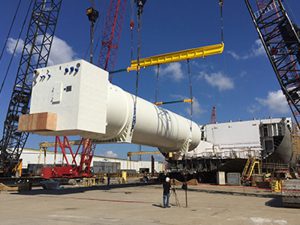
Another important milestone was marked last week, with the installation of three LNG fuel tanks in the first ship.

The double-walled, stainless steel tanks – which are 110 feet in length and 20.6 feet in diameter – weigh 225 metric tons and will hold more than enough LNG fuel for two round-trip voyages between the vessel’s future ports of call, Jacksonville, FL, and San Juan, Puerto Rico.

“While we are all excitedly watching these ships take shape, we are particularly proud of the role we, as a company, are playing to bring the most modern, technologically advanced and environmentally friendly ConRo ships in the world to the Jones Act market of Puerto Rico,” said Tom Crowley, company chairman and CEO. “There are no other ships of their kind being built anywhere else in the world today, and they are being constructed right here at home – in the United States of America. Having that shipbuilding capability here is essential to our national defense and an important reason we as a country need the Jones Act to be maintained and strengthened.”

Crowley’s two Jones Act ConRo ships, which will be named El Coquí (ko-kee) and Taíno (tahy-noh), are are scheduled for delivery second and fourth quarter 2017 respectively.

“It’s very impressive to see these new state-of-the-art Commitment Class ships take shape,” said John Hourihan, senior vice president and general manager, Puerto Rico services. “Seeing those LNG tanks being placed into El Coquí really resonates with me because we are setting a new standard for environmentally responsible shipping.”

The Commitment Class ships have been designed to maximize the carriage of 53-foot, 102-inch-wide containers, which offer the most cubic cargo capacity in the trade.

The ships will be 219.5 meters long, 32.3 meters wide , have a deep draft of 10 meters, and an approximate deadweight capacity of 26,500 metric tonnes. Cargo capacity will be approximately 2,400 TEUs (20-foot-equivalent-units), with additional space for nearly 400 vehicles in an enclosed Ro/Ro garage.

Each ship will be powered by an MAN B&W 8S70ME-GI8.2 main engine and three MAN 9L28/32DF auxiliary engines, all fueled by LNG .

The ship design is provided by Wartsila Ship Design in conjunction with Crowley subsidiary Jensen Maritime.

ceowleyLNG vert

  • News

World’s largest LNG fleet owner reports increased profits

It said the results reflected its “strategic development, the success of its joint ventures, and the company’s resilience in the challenging economic climate.”

The Nakilat board said that Nakilat is in an enviable position as its ships are on long-term charter hire contracts that are not impacted by temporary fluctuations in oil prices. The board also affirmed its continued commitment to Nakilat’s growth and development strategy, in line with Qatar’s National Vision 2030.

“Nakilat continues to show robust profits and growth,” said Managing Director Eng. Abdullah Al Sulaiti. “Despite regional challenges, our policy of making prudent investments for achieving higher economic benefit in the short and long-term, and seeking sustainable growth opportunities continues to work in our favor. We have also lowered our operating costs, and our financing costs are decreasing as we have repaid a suitable amount of our loans.”

Mr. Al Sulaiti added: “We have also seen increased profits from our joint ventures, particularly since the launch of new two vessels during the year, along with an additional five vessels that became fully operational. Nakilat’s place as the lynchpin in the Qatari marine services sector will continue to grow unabated.”

Credit rating agency Standard & Poor’s (S&P) has reaffirmed Nakilat’s senior debt credit rating at “AA-” with a stable outlook, which Nakilat says is indicative of its strong capability to meet its financial commitments.

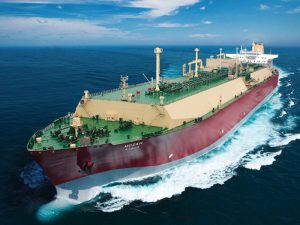
In addition to owning  63 LNG vessels  Nakilat also manages and operates four large LPG carriers via two strategic joint ventures: N-KOM and NDSQ.  It also operates the ship repair and construction facilities at Erhama Bin Jaber Al Jalahma Shipyard in Ras Laffan Industrial City and offers a full range of marine support services to vessels operating in Qatari waters.

NASSCO christens first Kinder Morgan ECO tanker

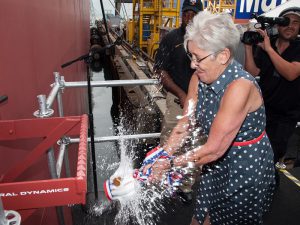
San Diego Mayor Kevin Faulconer spoke at the ceremony, and the ship’s sponsor, Mrs. Helen Downs, christened the ship with the traditional breaking of a champagne bottle.


The ECO tanker, the Lone Star State, is the first of a five-tanker contract between NASSCO and APT, which calls for the design and construction of five 50,000 deadweight ton, LNG-conversion-ready product carriers with a 330,000 barrel cargo capacity. The 610-foot-long tankers are a new “ECO” design, offering improved fuel efficiency and the latest environmental protection features including a Ballast Water Treatment System.

The ships were designed by DSEC, a subsidiary of Daewoo Shipbuilding & Marine Engineering (DSME) of Busan, South Korea. The design incorporates improved fuel efficiency concepts through several features, including a G-series MAN ME slow-speed main engine and an optimized hull form. The tankers will also have dual-fuel-capable auxiliary engines and the ability to accommodate future installation of an LNG fuel system.

“Incorporating new and innovative green ship technology, these tankers are the future of American petroleum shipping. When delivered they will be among the most fuel-efficient and environmentally friendly tankers anywhere in the world,” said Kevin Graney, general manager and vice president for General Dynamics NASSCO.

“This christening ceremony is an important step forward for Kinder Morgan’s expanding fleet of Jones Act product tankers and demonstrates the strong demand for domestic waterborne transportation to move petroleum products and crude oil,” said Robert Kurz, vice president of Kinder Morgan Terminals and president of American Petroleum Tankers. “We look forward to taking delivery of this vessel next month and, along with our seven other operating tankers, providing first-class service to our growing customer base.”

In September 2014, Mayor Faulconer signaled the start of construction of the ECO tanker. In March 2015, San Diego’s First Lady and wife of Mayor Faulconer, Mrs. Katherine Faulconer, laid the keel.

“The Lone Star State is a great example of the kind of innovative technology being employed by NASSCO and our blue tech industry. Its construction has employed hundreds of San Diegans and helped sustain jobs for thousands more,” Mayor Faulconer said. “This ship is a symbol of the jobs and opportunities the maritime industry brings to our city.”

On Friday, October 16, NASSCO shipbuilders began construction on a fifth tanker for APT.

  • News

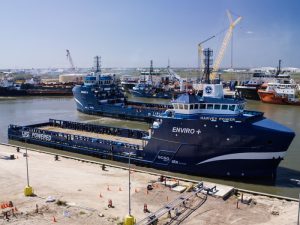
Harvey Gulf takes delivery of second LNG fueled OSV

The vessel is already in service under a five year contract working for Shell Upstream America’s deep water operations in the Gulf of Mexico.

Like her sistership Harvey Energy, Harvey Power is capable of operating on LNG or diesel fuel and also meets the criteria of the ABS Enviro+, Green Passport notation.

When operating on 99% LNG, the dual fuel vessels exceed the requirements of the new EPA Tier IV for reductions of SOX and NOX emissions within the North American ECA can operate in excess of 19 days in normal GOM rig supply mode between refuelings.

Harvey Power will refuel with LNG at Harvey Gulf’s new LNG bunkering facility at Port Fourchon in southern Louisiana, which allows easy access to more than 600 oil and gas rigs and platforms within a 40-mile radius.

Harvey Power is a 310′ x 64′ x 24.5′ platform supply vessel powered by three Wärtsilä 6L34DF dual fuel gensets, providing 7.5 MW of power and fueled by a Wartsila provided LNGPac system.

With 5,219 metric tons of deadweight the vessel is capable of carrying 253,000 USG of fuel oil, 18,000 bbls of liquid mud, 1,600 bbls of methanol, 10,250 cu.ft of dry cement and 73,000 USG of LNG fuel.

When operating on LNG the Harvey Power can operate in excess of 19 days in normal GOM rig supply mode between refueling.

The acquisition of Gulf Coast Shipyard Group by a new Harvey Gulf International Marine affiliate, Harvey Shipyard Group, was announced back in June.

The shipbuilder’s new COO, Marvin Serna, says that new protocols and operational improvements he has put in place are yielding results, such as a 45 day reduction in the commissioning time of the second vessel in comparison with the first.

Harvey Gulf has four more vessels under construction with Gulf Coast Shipyard Group and is confident the shipyard can maintain the high quality of construction while continuing to improve on construction techniques resulting in shorter delivery times.

Mr. Shane Guidry, Chairman and CEO of Harvey Gulf, says: “This is our second vessel capable of operating on LNG and is a testimony of Harvey Gulf’s commitment to its customers and the environment to provide the most affordable, innovative, environmentally-friendly technical solutions to meet their business demands.”