Silver Ships delivers multi-mission boat

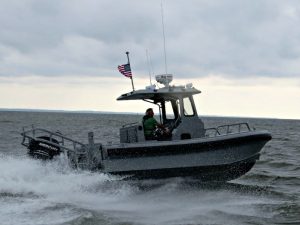
OCTOBER 14, 2015— Silver Ships, Inc., Theodore, AL, recently delivered a Freedom 21 all-aluminum patrol/rescue boat to the Southampton, NY, Bay Constables.  The 21-foot center console boat was designed and engineered for

Harley newbuild will be first with Cat marine Tier 4 engines


When Harley Marine decided to build the new line haul boat, the Earl W. Redd, for towing up and down the U.S. Pacific Coast, the company wanted a proven power platform that would meet the new emissions requirements.

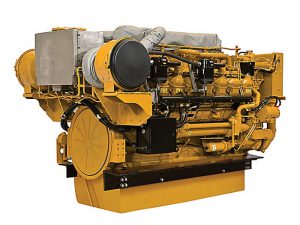
Over the years, Harley Marine has successfully operated line haul tugs powered by Cat 3500 Tier 1 and Tier 2 propulsion engines. Cat dealer Peterson Power suggested two 3516E engines —a flexible power solution that addressed both Harley Marine’s need for power and the upcoming Tier 4 regulations.

To meet the Tier 4 Final emissions standards coming in 2016, each of the two continuous duty 3516E engines—individually rated with a 10% horsepower increase of 2,682 hp at 1,600 rpm—is paired with a selective catalytic reduction (SCR) aftertreatment system, using DEF (diesel exhaust fluid) a urea-based solution, to reduce NOx emissions in the exhaust.

“Harley Marine should save over $1 million across a 15-year lifecycle on total fluid consumption (diesel plus DEF) costs for this newbuild compared to an equivalent Tier 2 powered vessel. They are able to deliver an increased level of performance due to the higher power rating with increased efficiency,” says Ryan Darnell of Caterpillar’s Large Power Systems division. “That’s a direct result of engine fuel efficiency improvements that our SCR technology allows us to make by reducing NOx downstream of the engine combustion process.”

Harley Marine has a long-standing relationship with Caterpillar Marine, including parts and service support from dealers across the United States.  In addition, Cat Financial has provided construction and ownership financing for multiple Harley Marine vessels— including the Earl W. Redd.

“Harley Marine appreciates that they can get the whole package from one source,” says Brent Nelson, a Caterpillar Marine territory sales manager who works closely with Harley Marine. “Caterpillar Marine is able to bring together multiple parties to make sure the design and installation is exactly what they need.”

For this particular vessel, that includes not just Harley Marine, but also Diversified Marine, Peterson Power, the naval architect and Cat engineers back at the factory. Caterpillar says that everything is now on track for the Cat engines to be delivered to the shipyard in April 2016, with vessel construction complete in October of that year.

Davie set to start box ship to fleet oiler conversion

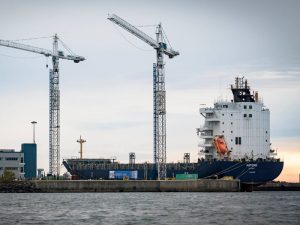
The project will see Davie convert MV Asterix, a 183 m containership acquired from Greece’s Capital Ship Management for a reported Canadian $20 million, into a stop gap fleet oiler for the Royal Canadian Navy. Some of the work will be done by the Aecon Group, whose Pictou, Nova Scotia, facility specializes in pipe fabrication. At one time it was thought that the Asterix would go first to Aecon’s Pictou shipyard, but its arrival at Davie indicates that Aecon will work on the ship there.

The interim fleet oiler is needed because of the earlier than anticipated retirement of Canada’s Protecteur-class ships.

In March last year, Davie and its partners, Aecon, naval architect firm NavTech and V.Ships, set out to find an interim solution that would provide a fast-track, affordable, compliant and fully managed service.

After over one year of design, engineering and planning, after a lengthy consultation with industry, an agreement was reached in August 2015 with the Government of Canada to provide at-sea support services to the Royal Canadian Navy.That agreement is a letter of intent that, according to the Government, provided the two companies “with the ability to start limited activities to advance the schedule. It will also provide some financial protection to the shipyard for these expenses, should a contract not be awarded. Any proposed costs would be pre-approved by the government, which will require Davie to provide a rationale in every instance.”

What the status of an actual contract is remains unclear. But the Asterix is already at the shipyard with Davie saying that the “acquisition from its former owners is now complete.”

The cost of the conversion has been reported as Canadian $250-300 million.

Once converted, the ship will be chartered to the Canadian Government by Project Resolve, Inc. which, like Davie, is a subsidiary of privately held, Monaco headquartered Inocea Group.

Reportedly, the Canadian Government will pay Canadian $75 million a year to charter the vessel. The ship will be crewed with Canadian merchant mariners.

Yesterday, the ship provided the back drop for the introduction of the CEO of Project Resolve Inc., Spencer Fraser, to the Lévis-Bellechasse candidates. He likely showed them some of the pictures you see here.

Resolve SM2

project resolve finished product

Resolve exploded

Gladding-Hearn delivers new generation pilot launch

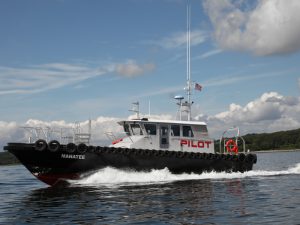
The 28 knot vessel is the association’s second Chesapeake Class launch and the first in a new generation of the popular, mid-size pilot boats.

The Somerset, MA, shipyard introduced the Chesapeake Class pilot boat in 2003.Since then, 15 have been delivered to pilot associations throughout the U.S.

The latest improvements incorporate the performance benefits of Volvo Penta’s IPS2 inboard propulsion system.

“The IPS2 system was created to improve the performance and the arrangement of planning hulls like our pilot boats,” said Peter Duclos, the shipyard’s president. “This new generation of Chesapeake launches, named Chesapeake Class MKII, is equipped with the IPS2 pods, which provide what pilots have been asking for: higher speeds, lower fuel consumption, and more comfort.”

With a deep-V hull designed by C. Raymond Hunt & Associates, the all-aluminum pilot boat measures 52.7 ft overall, with a 16.8-ft beam and a 4.5-ft draft.

It is powered by twin Volvo Penta D11, six cylinder, EPA Tier 3 diesel engines, each producing 503 bhp at 2,250 rpm. Each engine is connected to a Volvo Penta IPS propulsion pod, which is fitted with dual forward-facing, counter-rotating propellers and integrated exhaust system, and Volvo Penta’s integrated EPS electronic steering and control system.

The EPS control system and three-axis joystick increases the boat’s overall maneuverability alongside a ship and when docking, says Mr. Duclos.

The financial incentive for the Tampa Bay pilots to optimize fuel economy, vessel handling and comfort led the shipyard to install a Humphree Interceptor automatic trim- optimization system.

“The combination of the Volvo Penta IPS system and the Humphree interceptors gives the pilots higher speeds and improved comfort, while burning 25 percent less fuel than similar Chesapeake Class launches,” says Mr. Duclos.

Electrical requirements are met by a 9 kW Northern Lights generator.

Key design changes to the Chesapeake Class MKII include positioning the wheelhouse aft of amidships to improve comfort and provide for a larger foredeck.

With the pods close-coupled to the engines, the engine room is located well aft of the wheelhouse with easy access to machinery through a deck hatch.

This new generation of pilot boats is also designed to accept a gyro-stabilization system, designed to reduce vessel roll.

The wheelhouse, with forward-leaning windows, is outfitted with five Stidd seats and a settee and cooled by two 16,000 Btu air-conditioning units.

The forecastle, with a 12,000 Btu AC unit, has one berth and an enclosed head.Outside of the wheelhouse are wide side-decks and boarding platforms, port and starboard, on the foredeck.

At the transom is a winch-operated, rotating davit over a recessed platform for pilot rescues operations.
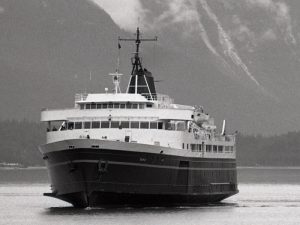
Alaska may try to sell 52 year old state ferry

The Juneau Empire reports that General Manager of the Ferry System Captain John Falvey and Michael Neussi, deputy commissioner of the Alaska Department of Transportation, have discussed what’s next for the Taku and “everything from selling it to trying to run it again” is on the table.

During a presentation last month, Mr. Neussl said he believed the ferry system would sustain itself by reducing the size of the fleet.

“I think the numbers are speaking that we can’t afford to operate an 11-ship fleet with the frequency of service that we’ve kind of become accustomed to,” he said on Sept. 15.

The Juneau Empire says the Taku would be on the block before others because it’s the smallest of the system’s main line ferries.

As the state’s budget forces the system to cut service and take ferries out of service, the ferries that are operating will run closer to capacity.

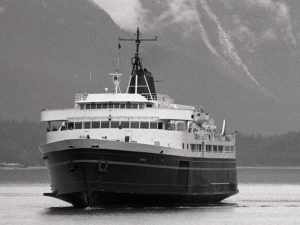
Built in 1963 by the Puget Sound Bridge & Dry Dock Company in Seattle,WA, the 352 ft Taku can carry 370 passengers and 69 vehicles.

It is one of three AMHS ferries that is SOLAS certified.

It is currently in lay up, serving as a “hotel ship” for other AMHS ships being overhauled at the Kechikan shipyard.

Read the Juneau Empire report HERE

Alaska may try to sell 52 year old state ferry


The Juneau Empire reports that General Manager of the Ferry System Captain John Falvey and Michael Neussi, deputy commissioner of the Alaska Department of Transportation, have discussed what’s next for the Taku and “everything from selling it to trying to run it again” is on the table.

During a presentation last month, Mr. Neussl said he believed the ferry system would sustain itself by reducing the size of the fleet.

“I think the numbers are speaking that we can’t afford to operate an 11-ship fleet with the frequency of service that we’ve kind of become accustomed to,” he said on Sept. 15.

The Juneau Empire says the Taku would be on the block before others because it’s the smallest of the system’s main line ferries.

As the state’s budget forces the system to cut service and take ferries out of service, the ferries that are operating will run closer to capacity.

Built in 1963 by the Puget Sound Bridge & Dry Dock Company in Seattle,WA, the 352 ft Taku can carry 370 passengers and 69 vehicles.

It is one of three AMHS ferries that is SOLAS certified.

It is currently in lay up, serving as a “hotel ship” for other AMHS ships being overhauled at the Kechikan shipyard.

Read the Juneau Empire report HERE

Alaska may try to sell 52 year old state ferry


The Juneau Empire reports that General Manager of the Ferry System Captain John Falvey and Michael Neussi, deputy commissioner of the Alaska Department of Transportation, have discussed what’s next for the Taku and “everything from selling it to trying to run it again” is on the table.

During a presentation last month, Mr. Neussl said he believed the ferry system would sustain itself by reducing the size of the fleet.

“I think the numbers are speaking that we can’t afford to operate an 11-ship fleet with the frequency of service that we’ve kind of become accustomed to,” he said on Sept. 15.

The Juneau Empire says the Taku would be on the block before others because it’s the smallest of the system’s main line ferries.

As the state’s budget forces the system to cut service and take ferries out of service, the ferries that are operating will run closer to capacity.

Built in 1963 by the Puget Sound Bridge & Dry Dock Company in Seattle,WA, the 352 ft Taku can carry 370 passengers and 69 vehicles.

It is one of three AMHS ferries that is SOLAS certified.

It is currently in lay up, serving as a “hotel ship” for other AMHS ships being overhauled at the Kechikan shipyard.

Read the Juneau Empire report HERE

Finance: Attractive Terms

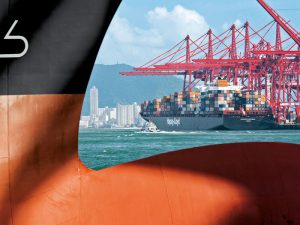
October 13, 2015 — Hapag-Lloyd secures banking facility for boxship series at Hyundai Samho Heavy Industries (Extended coverage from Marine Log’s October 2015 issue). German container shipping giant Hapag-Lloyd signed a $

Underwriters sue expert witness for alleged negligence

OCTOBER 12, 2015 — In a case that shows the need for those acting as expert witnesses to have professional indemnity insurance, International Transport Intermediaries Club (ITIC) reports that hull & machinery

Deltamarin and Brevik launch gas carrier design


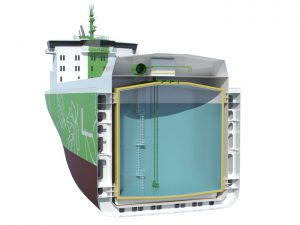
A new multigas carrier design uses the successful B. Delta bulk carrier hull from Finland’s Deltamarin to carry gas in new-generation cylindrical gas tanks developed by Vard affiliate Brevik Technology AS.

The design can be utilized for LNG, LPG, LEG and ethane carriers.

“Up to now gas carriers have been complex and expensive to design and construct. This is not the case anymore as Brevik Technology has developed cylindrical steel tanks, which are separate from the vessel hull,” says Brevik Technology’s Managing Director Øystein Kristoffersen Sæther.

Brevik Technology’s independent gas carrying method challenges the traditional and expensive way of building the vessel and the tanks as one entity. The patented containment design has already been approved by classification societies.

BrevikThe cylindrical tank design allows the tanks to expand in all directions without putting stress on the vessel hull. The independent containment system, which can be built into a vessel as is, results in better possibilities to utilize the existing well-proven ship design.

“This is where the shipowner can get significant benefits by choosing a readily available and highly efficient B.Delta hull design already proven in operation”, says Deltamarin’s Managing Director Mika Laurilehto.

The design based on the B.Delta is actually a bulk carrier design equipped with cylindrical tanks for the gas cargo.
“As a bulk carrier, the vessel is easier and cheaper to build compared to a traditional gas carrier, and there may be many new potential shipyards capable of constructing such a vessel,” says Mr. Laurilehto.

The new design is now available for the market for smaller-scale gas carriers of 31,000 cu.m, with similar designs for medium- and larger-scale vessels to follow.

The design will also be available for retrofit vessels, such as the conversion of a bulk carrier to gas carrier.


LOAD MORE