shipbuilding

  • News

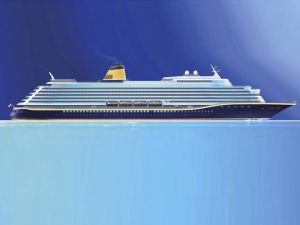
Saga Cruises orders 1,000 passenger newbuild at Meyer

The dock is presently used for block construction and by reopening it the shipyard will be able to deliver three cruise ships, including the Saga newbuild. The cruise line’s memorandum of agreement with Meyer has an option for a second vessel for 2021 delivery.

The Meyer Werft ship will be Saga Cruises’ first newbuild.  Catering for passengers in the 50+ age group, the cruise line currently has two ships, the 446-passenger Saga Pearl II and the 706-passenger Saga Sapphire, both built in 1981. According to Daily Telegraph, demand for sailings on the ships is extremely high: they carried around 25,000 passengers last year, with a 75 per cent repeat passenger rate.

The new ship will be 234 m long by 30.8 m wide and will have 540 cabins, all with balconies and with about 15% designed for passenger cruising solo.

“This is an important milestone in the future of Saga Cruises,” said the line’s CEO, Robin Shaw. “We are happy to develop this vessel, tailored to our individual needs, and we’re delighted to be working with Meyer Werft, a recognized leader in cruise ship construction.”

  • News

Bulker sea trials confirm benefits of Kappel FP propeller

The ships — the Elsabeth C and Mirela — feature single MAN B&W 5S60ME-C8.2 engines delivering 8,050 kW SMCR @ 89 rpm. They are owned by Frontmarine, an associate company of Lemissoler Navigation of Cyprus, and were

Lemissoler reports that the Kappel propeller offers significant fuel savings compared to conventional propellers and, together with the new vessels’ design and lines as well as the silyl acrylate antifouling paint, contributed to favorable results from the first two vessels’ sea trials. It reports that both vessels consumed an average 23 mtns per day at a speed of about 14.2 knots in ballast conditions during the trials. The Elsabeth C also performed a successful crash-stop test that was notable for its lack of noise and vibration.

Thomas Leander, Head of Propulsion – PrimeServ Four-Stroke – Denmark, said: “A key point during the design stage was to address the problem experienced by similar vessels that experience an overly-small light running margin (LRM). Therefore, MAN Diesel & Turbo recently introduced new light running margins for all FP propellers and two-stroke engines of 4-10%. Furthermore, the propeller layout for these 58,500-dwt vessels is 3-4% higher than normally applied to these vessel types. In doing so, MAN Diesel & Turbo has managed to ensure safe and reliable operation, while improving the vessel’s efficiency and maneuverability during its entire lifetime.”

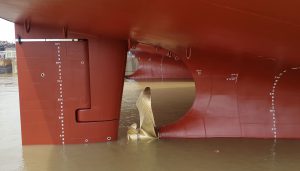
The MAN Alpha Kappel propeller was optimized out based on the stern and wake field for the newly designed 58,500-dwt vessel, with a 58,500-dwt stock propeller.

The Elsabeth C and Mirela were constructed by New Times Shipbuilding Co’s Jiangsu, China, shipyard . The remaining sisters are scheduled for delivery over the next 12 months.

lemisoler two 700

DOF charters in PSV from Vard for Chevron job

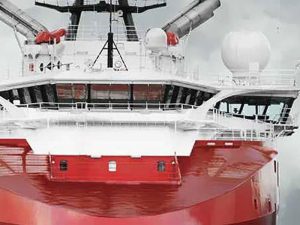
The vessel, now named Skandi Responder, is a VARD 1 08 design platform supply vessel. According to Vard it is the first of two vessels whose original shipbuilding contracts were terminated earlier this year. It has now been delivered from the Vard Vung Tau shipyard in Vietnam and sold to Vard Shipholding Singapore Pte. Ltd., a newly established wholly-owned subsidiary of Vard Holdings.

Vard says that it continues to explore opportunities for a sale of the vessel. The second PSV whose contract was terminated is still under construction at Vard Vung Tau, with an expected completion date in second quarter 2016.

Vard CEO and Executive Director Roy Reite commented, “I am delighted that together with our long-term client DOF, we have found a solution that secures employment for this vessel following completion at the yard in Vung Tau. Securing this charter in today’s difficult market is proof of the attractiveness of Vard-built vessels for some of the most demanding jobs in the offshore industry, and I am confident that successfully operating it in Australia will increase our chances for a sale.”

Marathon buys Aker Philly interest in four newbuilds


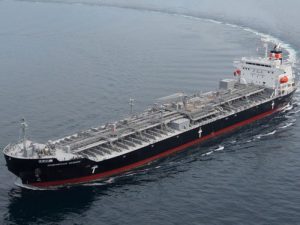
This follows last month’s news that Kinder Morgan, Inc. (NYSE: KMI) had agreed the four Jones Act tankers building for the shipyard’s wholly-owned U.S. subsidiary, Philly Tankers LLC.

Marathon’s buy-out of APSI’s interest in the Crowley joint venture with respect to each vessel will occur on its delivery from the shipyard. Deliveries of all four vessels are expected to occur from Q3 2015 to Q3 2016. APSI expects to recognize a pre-tax gain of approximately $10 million per vessel from the transaction.

APSI will make an investment in the vessels during their construction, but will no longer maintain the previously planned long-term investment in the vessels post-delivery, which was expected to be approximately $110 million in the aggregate.

“This transaction is an important part of AKPS’s plan to divest its shipping investments and realize the value created for shareholders,” said Kristian Rokke, Chairman of AKPS. “We are proud of what we have accomplished together with Crowley under the joint-venture and look forward to serving both Crowley and Marathon Petroleum as shipbuilders into the future.”

All four of the vessels subject to the transaction are under construction. APSI has also begun construction of the first two of four additional 50,000 dwt tankers for a subsidiary of Kinder Morgan, Inc., which are planned to be delivered between November 2016 and November 2017.

The shipyard also has contracts for two 3,600 TEU containerships for Matson Navigation Company, Inc., which are planned to be delivered in 2018.

On July 16, 2015, the company announced that it intends to change its name to Philly Shipyard by the end of the year, pending shareholder approval.

  • News

First MHI-MME low speed engine enters service

Mitsubishi Heavy Industries Marine Machinery & Engine Co (MHI-MME) has been developing the 500 mm bore, 2,300 mm two stroke as a state-of-the-art engine incorporating cutting-edge technology to meet market needs that including reduced fuel consumption, slow steaming, low engine-load capabilities and compliance with emission regulations.

The 6UEC50LSH-Eco-C2 in Chemroad Queen was built by licensee Kobe Diesel and was delivered to the shipbuilder, Shin Kurushima Dockyard, in March after completing shop testing, onboard testing was completed last month and the ship, owned by Iino Kaiun Kaisha, went into service without any complications.

Design of the UEC50LSH-Eco engine began with thorough market research and engine power output and speed were adjusted to those suitable for chemical tankers, handymax bulk carriers, supramax bulk carries and medium range tankers.

MHI-MME has now received follow up orders for M/E 5UEC50LSH-Eco-C2 main engines for 38,000 dwt chemical tankers to be built at Kitanihon Shipbuilding and says that many inquiries are also being received.

Principal Particulars of the UEC50LSH-Eco Engine

5UEC50LSH-Eco 6UEC50LSH-Eco
Cylinder bore mm 500
Piston stroke mm 2,300
Stroke / bore 4.6
Engine output kW 8,900 10,680
Revolution min-1 108
Mean effective pressure MPa 2.19
Fuel consumption rate g/kWh 164
Weight ton 194 225
  • News

TTS Group: first the good news, then the other

The total order value is approx. MNOK 112, under construction at Daewoo Shipbuilding & Marine Engineering Co, South Korea, for Maersk. TTS has previously delivered similar equipment between 2012 and 2014 for another 20 vessels built at same shipyard for same shipowner.

The winches will be manufactured at TTS’ factory in Korea and deliveries will take place 2016 – 2017.

The less good news comes from subsidiary TTS Offshore Solutions AS in Bergen, Norway. It is to implement temporary workforce reductions with immediate effect.

A workforce of approximate 30 full-time equivalents will be temporary laid off, while another approximate 20 full-time equivalents will be contracted out to other TTS companies.The adjustment affects approximate 40 percent of the workforce of TTS’ offshore operations in Norway and Poland.The adjustments are in response to the current offshore market situation.

Jobs ax swings at Newport News Shipbuilding

“There’s no good way to do this,” the Virginian-Pilot reports Newport News Shipbuilding President Matt Mulherin as saying, adding that the swiftness of laid-off workers’ departures was largely related to the fact that the shipyard is a secure facility.”

Though the abruptness of the dismissals came as a shock, the layoffs themselves came as no great surprise.
Back in July, the shipbuilder warned workers that, as work on three major aircraft carrier projects winds down, layoffs lay ahead for both hourly paid and salaried employees. It projected that 500 jobs would go this year and another 1,500 plus in 2016.http://bit.ly/1KnifmT

In a “Dear Shibuilders” letter and accompanying FAQ, issued at that time, Mr. Mulherin said “remember that the workload valley has both a beginning and end as our workload increases again in 2017.

“”We will issue 60-day notices to all affected employees,” the workers were told. “Employees will be expected to work during the 60-day notice period.”

However, because the actual number of layoffs was kept below the 500 number, Newport News was not required to give advanced notifications and the workers separated from the company on the day they were laid off.

Seventy seven of those laid off who have the appropriate skills will have the opportunity to return to an hourly trade job.

  • News

OceanSaver BWTS ordered for two VLCCs

“We are very pleased to be awarded this contract. It proves OceanSaver’s strong position in the market and the increasing adoption of our leading technology by both shipyards and shipowners, who are increasingly preparing for a life post full IMO ratification,” says OceanSaver CEO Helle Hundseid.

OceanSaver’s Mark II BWTS is MO compliant and USCG AMS approved. It delivers high performance filtration in combination with disinfection through patented electrodialysis.

“Our easy-to-operate, energy optimized and compliant system represents a streamlined solution for both retrofit and newbuildings. It offers customers a small footprint through its modular nature and is simple to maintain. All features are valued by our customers. We look forward to delivering our Mark II BWT system to STX Offshore & Shipbuilding, and a good cooperation throughout the project,” says Alan Linderoth, Vice President Sales & Marketing.

OceanSaver will deliver its Mark II BWT system by Q3 2016. Contract value is undisclosed.

  • News

Eight technologies that will transform shipping

“The marine world in 2030 will be a connected and digital one, bringing closer integration between people, software and hardware in a way that could transform the way we operate,” says LR’s Marine Marketing Director, Luis Benito. “We know technology is changing our world and there is a great deal of overlap between technologies and how they combine will be important.”

LR was the lead partner on the commercial shipping parts of the report and focused on eight technologies that will transform commercial shipping:

  • advanced materials,
  • big data analytics,
  • robotics,
  • sensors,
  • propulsion and powering,
  • communications,
  • shipbuilding,
  • smart ships

LR says that these eight will have a profound impact on ship system design and operation in the next 15 years. With faster technological advances, there will be a move towards delegating authority from the human operator to the machine. Machines will perform many more of the tasks which are considered dull, dirty and dangerous to achieve a higher level of safety and efficiency.There are varying degrees by which a human can delegate responsibility to a machine, depending on the nature of the task and goal they wish to accomplish, and depending on the levels of automation and autonomy built into a ship.

The report identifies two groups of technology drivers – those that will transform the ship design and build space – leading to advancement in shipbuilding, propulsion and powering and the development of smart ships; and the technologies that drive safety, commercial and operational performance – advanced materials, big data analytics, communications, sensors and robotics.

Looking at the impact of these drivers on different ship types, the report presents “Technomax” scenarios for bulk carriers, tankers, containerships and gas carriers. These scenarios are not concept ships but give an indication of the potential maximum technology uptake relevant to the four ship market sectors.

Tom Boardley, LR’s Marine Director commented: “Shipping is likely to evolve quickly now. That evolution is likely to be uneven but while 2030 is not far away, we think that shipping is likely to have changed significantly.”

MORE


  • News

Evergreen gears up for projected increase in intra-Asia trade

All twenty newbuildings are planned to be deployed in the intra-Asia trade. Evergreen believes that under the Regional Comprehensive Economic Partnership (RCEP) that is now being negotiated, the ASEAN countries, Australia, China, India, Japan, South Korea and New Zealand will remove trade barriers,  boosting regional cargo growth.

The first ship in CBC series is set to be delivered during the second half of 2017 with the completion of the CSBC series due by the first half of 2018. The first ship from Imabari Shipbuilding is planned to be delivered during the first half of 2018 with the completion of the series due by the first half of 2019.

Evergreen’s B-type vessels will be 211 meters in length, 32.8 meters wide, and have a design draft of 10 meters with a capacity of around 2,800 TEU. The ships are designed to load 13 rows of containers on deck, which is within the span of existing gantry cranes in the major ports on the intra-Asian trade.

The hull design of the vessels is wider in comparison to ships of a similar capacity, enabling the ships to navigate in the shallower ports encountered in the intra-Asia trade and to enhance their cargo carrying capability. The ships can cruise at a speed up to 21.8 knots, enhancing their on-time performance and competitiveness.

Vessels operating on regional trades, such as intra-Asia, often sail in coastal areas. To reduce their impact on port communities and eco-systems, Evergreen has imposed stringent eco-friendly criteria on their operation. The B-type vessels will be equipped with a range of environmental protection devices.They will have electronically-controlled fuel injection engines, meeting IMO Tier II standards for NOx emissions and Energy Efficiency Design Index (EEDI) requirements.

The agreement for B-type vessels is the third project in which Imabari will participate in Evergreen Line’s fleet renewal program. Evergreen has signed agreements with Shoei Kisen Kaisha, the ship owning arm of Imabari Shipbuilding Group, to charter five 14,000 TEU containerships to be delivered in 2017 and eleven 18,000 TEU containerships to be delivered in 2018 and 2019.