shipbuilding

  • News

Ultra Deep orders new design DSCV plus option

UDS says the order is in line with its strategic plan to spearhead the development and operation of efficient, cost-effective diving and support vessels in the oil and gas industry.

Andy Warhol is planned to be delivered mid 2018 with the second vessel following at the end of 2018. Vessel number two is to be confirmed by end of April 2016.

Norway’s Marin Teknikk has entered into a contract with Wuchang Shipbuilding for delivery of design and engineering for both ships.

The vessels are being built to a newly developed MT6023 DSCV design, and will be equipped with an 18 men diving system for operations down to 300 m water depth.

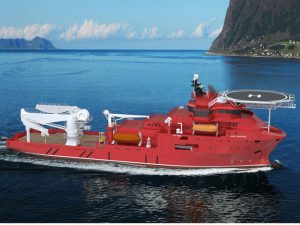
The MT6023 DSCV has been developed for demanding operations worldwide. The vessel will have a length of 103 meters and a breadthof 23 meters, top class accommodations for 120 persons plus 18 divers, two heave compensated subsea cranes, one 150 ton offshore crane with depth capability to 3,000 m water depth, and one 20 ton offshore crane for operation down to 300 m water depth. In addition, it includes arrangement for two WROVs (unmanned remote operated submarines/robots) for operation down to 3000 meters water depth.

Marin Teknikk says it has designed a cost efficient and functional Diving & Construction vessel with high focus on safety for the crew/divers, and following up designing environment-friendly, modern and advanced multifunctional offshore vessels to compete in a market with very low oil and gas prices.

With more than 800 sq.m open work deck area with deck strength of 10 ton/sq.m and a smaller storage on top of dive hangar, the design creates a good platform for the vessels operation and function.

The vessels will be built according to DNV GL requirements, included the new SPS code; DNV GL + 1A1, EO, SPS, DYNPOS AUTR, DK(+), HELDK-SH, COMF-V(3), CLEAN DESIGN, DSV-SAT, DSV SURFACE, CRANE, ICE C, NAUT-OSV(A), BWM-T, REYCYCLABLE.

“I am pleased by the positive response by oil majors and major diving companies to the design of our diving support vessels, and it affirms our company is heading in the right direction to build quality and size-appropriate vessels catered for the market,” says UDS CEO Shel Hutton. “The current slowdown in the market allows us time to ensure our designs are optimized and customized for relevance in the oil and gas industry. I am thankful to our partners, and supporters, especially Marin Teknikk, DNV GL, and the shipyard, which have supported the company’s vision, and realizing our plans to build these vessels. With these vessels Ultra Deep follows up the company’s strategic focus, and will be a spear point in the market.”


ultra deep pair


Chesapeake Shipbuilding adds to leadership team

With more than 20 years of engineering and maritime experience, Mr. McGee will oversee vessel design from preliminary conceptual design to complete Coast Guard and regulatory approvals.

Chesapeake Shipbuilding currently has on staff five naval architects and two engineers.

“McGee’s experience in various positions with the U.S. Coast Guard, including Hull Division Chief at the Marine Safety Center and former Officer in Charge, Marine Inspection, is a valuable asset we look forward to having on our team,” said Charles A. Robertson, President and CEO. “His rock solid reputation in the maritime industry will be critical for the retention and expansion of our customer base.”

Mr. McGee holds a bachelor’s degree in naval architecture and marine engineering from the U.S. Coast Guard Academy and a master’s of science in both naval architecture and marine engineering as well as aerospace engineering from the University of Michigan.

Chesapeake Shipbuilding designs and builds steel and aluminum commercial vessels primarily between 100 and 400 feet. The shipyard has upgraded its production capacity significantly in recent years, by acquiring additional land, building two new hull fabrication buildings and investing in additional automated equipment.

  • News

Indian shipyards get their subsidies back

The industry was hit hard by the ending in 2007 of a subsidy scheme that had helped Indian shipyards edge up from the tenth place in the world shipbuilding league table (0.4% market share) in 2006, to fifth position (1.1% market share) in 2009. Since then, India has plunged to eleventh position (0.6% market share).

A plan for Indian yards to build three of nine LNG carriers required by state owned GAIL to import LNG from the U.S. has gone nowhere and yards have put all their focus on the defense sector.

India has been struggling to come up with a replacement for the previous scheme since 2008. Wednesday, the Cabinet approved a ten year, $600 million scheme

According to Indian business publication Mint, the financial assistance (it.s no longer called subsidy) to shipbuilders – both state-owned and private – will be for 10 years.

“The quantum of aid will come down by three percentage points every three years, starting with 20% for the first three years, 17% for the next three years, 14% for the next three years and 11% in the 10th year,” according to Mint.

The assistance will be given on the contract price or fair price, whichever is lower. The shipbuilding policy approved by the cabinet also includes granting tax incentives and infrastructure status for the shipbuilding and ship repair industry.

It further grants a so-called right of first refusal for Indian shipyards for government purchases, whereby local shipbuilders can take up state-funded contracts by matching the lowest price quoted by an overseas entity in a public auction.

The assistance will be given for all types of ships, though smaller boats and fishing vessels are not included in the scheme.
Both state-owned and private yards will get the assistance only after they construct and hand over to the ship to the buyer.

Bollinger promotes Brent Blackburn


“Brent has been a key contributor to Bollinger’s success in leading our proposal and estimating efforts on the major governments programs the company has pursued over the years,” said President and CEO Ben Bordelon.

“His leadership and management skills will assist in guiding the continuous success of our engineering department.”Mr. Blackburn has over 16 years of experience in the U.S. shipbuilding and maritime industry.  He joined Bollinger in 2004 working in various key engineering, estimating, and proposal roles mainly focusing on the company’s government programs.  

Mr. Blackburn’s career began as a Project Engineer in Bollinger’s engineering group and he has risen steadily through the engineering and technical design departments.  In 2014, he was promoted to Technical Manager, a position that solidified and proved his abilities, skills, and overall knowledge in managing projects and priorities.

Austal lowers U.S. shipbuilding earnings forecast

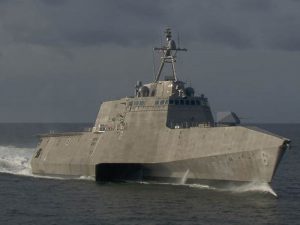
In a stock exchange announcement, the company noted that in its FY2015 results it had reported experiencing schedule and margin pressure on Littoral Combat Ship (LCS) 6, the first that it is building as the prime contractor.

“Austal is building multiple LCS in parallel,” said the announcement, “with the impact of cost and schedule performance on LCS 6 continuing to impact LCS 8 and LCS 10 – both of which are in an advanced state of completion.

“Austal’s ability to apply lessons learnt and productivity enhancements from LCS 6 to vessels in advanced construction, namely LCS 8 and LCS 10, has been more limited than anticipated. As a result, FY2016 earnings from Austal’s U.S. shipyard are expected to be lower than in FY2015, with U.S. shipbuilding EBIT margin expected to be in the range of 4.5% to 6.5%. [Its U.S, shipbuilding EBIT margin was 5.2% in 2015 and 6.6% in 2014]

“Austal’s other major vessel program at its U.S. shipyard, the Expeditionary Fast Transport program (formerly called the Joint High Speed Vessel), has reached construction program maturity, with shipbuilding margin stable”.

Austal CEO Andrew Bellamy said that, while there were flow on effects from LCS 6 onto LCS 8 and 10, vessels at earlier stages of construction would benefit from the lessons learnt on LCS 6 to increase future US shipbuilding margin.

“The LCS program is maturing more slowly than we had expected, however we are working hard to manage the risks and expect an improvement across the program after delivery of LCS 10,” Mr. Bellamy said. “The ongoing strong performance of the US$1.6 billion Expeditionary Fast Transport program at our U.S. shipyard is a great illustration of the efficiencies we can deliver once a vessel program reaches the mature production phase and we are confident the LCS program will be no different.

“Austal has a strong balance sheet and is generating good cash flow, which is enabling further investment in the business during the 2016 financial year to best position the company to win additional contracts and service work to build our order book, revenue, and earnings into the future.”

  • News

Shell cuts steel for LNG bunker vessel

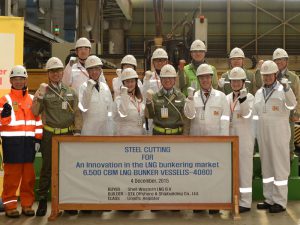
The steel cutting ceremony took place at the shipyard December 4, with representatives from Shell and the shipbuilder in attendance.The new LNG bunker vessel will be based at the port of Rotterdam in the Netherlands, and will load from the new LNG break bulk terminal currently under construction by the Gas Access to Europe terminal. Once ready, it will deliver to LNG-fueled vessels in northwest Europe. The vessel is also seagoing and, therefore, able to bunker customers at other locations.

Shell says the vessel will be “pioneering in design.” It will have a capacity to carry 6,500 cu. m of LNG fuel and will be highly efficient and maneuverable. Featuring an innovative transfer system and sub cooler unit, it will be able to load from large or small terminals and able to bunker a wide variety of customer vessels.

Finland’s Containerships Ltd Oy will be the launch customer for the vessel’s services, after signing an LNG supply agreement with Shell on November 24.

As we reported earlier, Containerships Ltd Oy is to charter the two 1,400 TEU LNG fueled containerships currently being built for Nordic Hamburg Group at China’s Yangzhou Guoyu Shipyard .

The vessels will receive LNG fuel from Shell at the port of Rotterdam, after the LNG bunker vessel becomes operational in mid-2017.”This is a significant landmark in bringing this innovative LNG bunker vessel with cutting-edge technology to reality,” said Dr Grahaeme Henderson, Vice President of Shell Shipping & Maritime.

“I am delighted to be working with STX on this project and Shell is proud to be leading in the development of LNG fuel in shipping.””The supply agreement between Shell and Containerships is another example of the marine LNG fuel supply chain coming together,” says Lauran Wetemans, Shell’s General Manager Downstream LNG. “Working together with customers like Containerships is critical to encourage the use of LNG as a fuel in the marine sector, and we’re committed to helping make the transition to LNG.”

LNG bunker vessel

ShellLNGBunkervessel


Navy awards Ingalls $200 million LPD 28 contract

.


According to defense media, BIW will get the additional destroyer under a “hull swap” agreement in a 2002 MOU between the Navy and its two largest shipbuilders that, among other things, reportedly included an agreement that, should a twelfth LPD be ordered,a fourth DDG 51-class ship or equivalent workload would be awarded to BIW.

Apparently, that’s likely to happen and that destroyer will be DDG 127, once Congress comes through with the funding.

However all that works out, the funds awarded Huntington Ingalls under the contract announced today will be used to purchase long-lead-time material and major equipment, including main engines, diesel generators, deck equipment, shafting, propellers, valves and other long-lead systems.

“This funding demonstrates the priority the Navy places on Ingalls getting started on this important ship,” said Ingalls Shipbuilding President Brian Cuccias. “Our shipbuilders have made great strides in the LPD program, and we are performing well. Building LPD 28 is key to maintaining a reliable supplier base and leverages our hot production line, enabling our team of shipbuilders to build this ship and future amphibious warships as efficiently and as affordably as possible.”

Ingalls’ 10th San Antonio-class LPD, John P. Murtha (LPD 26), was the most complete and lowest-cost LPD when launched, with many key systems finished months ahead of the shipyard’s historic best in the program.

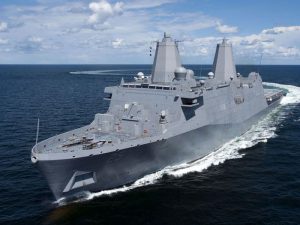
Though LPD 28 will be substantially similar to its predecessors, it won’t have quite the same appearance. Gone will be the towering enclosed masts that had been built at HII’s now-closed Gulfport, MS Composites Center of Excellence facility, in their place will be open masts similar to those on the DDG 51 destroyers.

The 684-foot-long, 105-foot-wide LPD 17 class ships are used to embark and land Marines, their equipment and supplies ashore via air cushion or conventional landing craft and amphibious assault vehicles, augmented by helicopters or vertical takeoff and landing aircraft such as the MV-22 Osprey. The ships support a Marine Air Ground Task Force across the spectrum of operations, conducting amphibious and expeditionary missions of sea control and power projection to humanitarian assistance and disaster relief missions throughout the first half of the 21st century.

Rolls-Royce wins China AHTS equipment order

The contract is to equip nine SPA80A Anchor Handling Tug Supply vessels to be designed and built by Sinopacific Shipbuilding Group and owned and operated by the Abu Dhabi National Oil Company (ADNOC) and its wholly-owned subsidiary, ESNAAD.

The vessels will be built at Sinopacific’s Zhejiang Shipyard and the first vessel is due for delivery in 2017.

Each ship will have a bollard pull of 80 metric tonnes will be equipped with Bergen diesel engines, main and tunnel thrusters, electrical power system and a deck machinery package from Rolls-Royce.

“The visit of Rolls-Royce senior executives to Sinopacific in 2013 reinforced the relationship between our two companies as did the provision of  Rolls-Royce integrated equipment packages for Sinopacific’s in-house designed SPA150 AHTS series. This was a first for Rolls-Royce in the Chinese market,” said SinJiang Qiang, Chief Executive Officer of Sinopacific. “The Rolls-Royce Chinese team has provided us with great support by staying close, enhancing communications and giving us confidence for future cooperation. Sinopacific aims to work closely with our strategic partners, such as Rolls-Royce, presenting the best products and services for our ship owners while strengthening our leadership in the most demanding markets.”

“This is a significant contract. It demonstrates our market leading capabilities in a wide range of offshore marine products, and our ability to combine them in a way that creates real value for our customers,” said Richard Wang, Rolls-Royce, Senior Vice President Commercial – Marine.  “We look forward to working with and continuing a profitable and long-lasting relationship with Sinopacific.”

  • News

ABS teams with SDARI on next generation feeder vessel

ABS Senior Vice President and Chief Technology Officer Howard Fireman and SDARI President Jintao Hu signed the agreement yesterday in Shanghai, China. Dr. Christina Wang, Vice President of ABS Operational and Environmental Performance (OEP), Dr. Franck Violette, Director of ABS OEP China, and Gangyi Wang, Vice President of SDARI also attended the signing ceremony.

“Changing environmental regulations, unpredictable energy prices and volatile freight rates have made it imperative for ship designers to continuously improve the operational and environmental performance of their next generation designs,” Mr. Fireman said. “ABS is working with industry as designs change and new concepts are introduced.”

The objective of this project is to develop the next-generation feeder design with a focus on operational efficiency and flexibility.

The project will bring together innovative design and technology solutions with a novel concept that incorporates technology-readiness features to enable cost-effective implementation of present and future regulations by applying extensive life-cycle cost analyses. This innovative feeder container carrier design will meet future market and trade needs that are being driven by the increase in ultra-large container carriers and the growth of specific regional markets.

“SDARI has always promoted ship innovation and technology development. At this crucial moment when China is transforming from shipbuilding nation to a shipbuilding power, the collaboration that we have strengthened with ABS in container carriers positions us to generate new concepts based on market demand and to launch cutting-edge products,” says Jintao Hu, “I believe the development of this new generation of feeder container carriers will further strengthen the partnership between SDARI and ABS, promoting the transformation and upgrading of Chinese shipbuilding industry.”

  • News

WinGD DF engines to power MOL LNG newbuild

The vessel will be engaged in a 20-year free-on-board (FOB) off-take of approximately 800,000 tons per year of LNG, sourced from U.S.Gulf liquefaction projects, including the planned terminal near Freeport, Texas.

The official contract for the vessel between MOL and DSME was signed in February 2015 and the decision to adopt WinGD X-DF engines was taken in August. The first engine is due for delivery to the shipyard in June 2017.About WinGD low-pressure DF

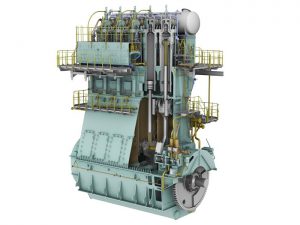
The low-pressure gas admission system used by WinGD on its X-DF engines draws on Wärtsilä’s long experience with what has become a well-proven industry standard technology on medium-speed dual-fuel engines. In contrast to high-pressure gas injection engines that operate on the Diesel cycle, WinGD’s low-pressure DF system works on the lean burn Otto cycle – i.e. ignition of a compressed lean air-gas mixture by injection of a small amount of liquid fuel.

Results from the X-DF technology demonstrator engine that WinGD operates jointly with licensee Diesel United at its Aioi, Japan, factory show that the WinGD low-pressure gas admission is characterized by stable combustion, inherently low NOx emissions and high overall system efficiencies. In terms of NOx, WinGD X-DF engines undercut IMO Tier III limits for Emission Control Areas (ECAs) by considerable margins without any additional measures, such as EGR or SCR.

With low-pressure gas admission the gas fueling system on X-DF engines does not require a high-pressure electrically-driven compressor, reducing equipment costs, onboard energy consumption and maintenance.

“With the imminent implementation of the IMO Tier III regulations in Emission Control Areas for new vessels, we are registering an increasing interest in our X-DF series from markets worldwide, especially for the propulsion of LNG carriers,” says Rolf Stiefel, Vice President Sales and Marketing at WinGD.