
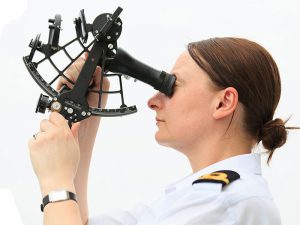
Over reliance on GPS poses dangers
MAY 12, 2016 — Warning that vessels’ over-reliance on GPS as a navigational tool may be a danger, the UK P&I Club is encouraging navigating officers to also practice traditional methods of
MAY 12, 2016 — Warning that vessels’ over-reliance on GPS as a navigational tool may be a danger, the UK P&I Club is encouraging navigating officers to also practice traditional methods of
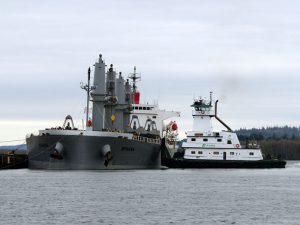
MARCH 24, 2016 — The 54,881 dwt Panamanian flagged bulk carrier Sparna is now awaiting repairs pierside in North Kalama, WA, after briefly grounding near river marker 36 in Oregon on Monday
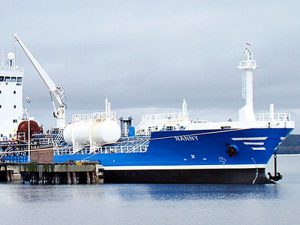
MARCH 15 2016 – The Transportation Safety Board of Canada says fatigue was a factor in the October 14 grounding of the 110 m oil and chemical tanker Nanny west of Deer
MARCH 11, 2016 — Taiwan media reported that two people died when a helicopter carrying five crashed into the sea off New Taipei City today while checking for oil slicks during an
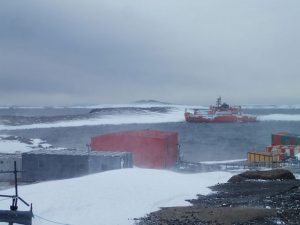
FEBRUARY 26, 2016 — The Australian Antarctic Division expedition members have been safely transferred by barge from a grounded icebreaker to the Mawson antarctic research station. The ship’s crew remain on board
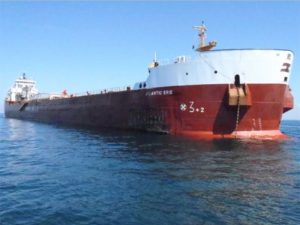
FEBRUARY 25, 2016 — The Transportation Safety Board of Canada (TSB) says that “ineffective visual navigation leading to the loss of situational awareness” contributed to the January 11, 2015 grounding of the
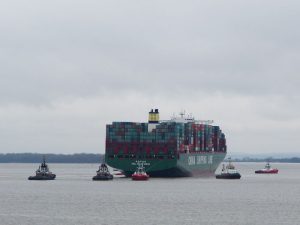
FEBRUARY 9, 2016 — After an operation that started just after 2.00 a.m. this morning, the 399.6 m containership CSCL Indian Ocean arrived in Hamburg at 06.15 a.m., local time. The ship
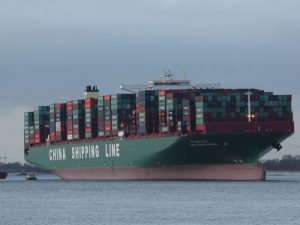
FEBRUARY 5, 2016—The 19,000 TEU containership CSCL Indian Ocean this morning remained grounded in the Elbe River off the island of Lühesand on the approach to Hamburg. The 399.6 m x 58.6

FEBRUARY 1, 2016 — The North Carolina Department of Transportation says that at approximately 10:40 a.m. on Saturday, January 30, the Ferry Division vessel M/V Roanoke ran soft aground on its way
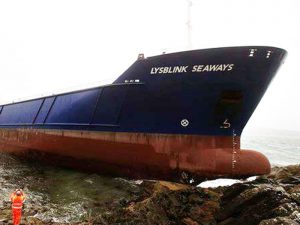
It comes from the U.K. Marine Accident Investigation Branch and concerns the grounding of a vessel in which, according to the full report, “the inventory of the vessel’s bonded store records that it was regularly replenished with spirits, wine and beer, and evidence of significant alcohol consumption by the crew should have alerted the owner to the likelihood that its alcohol policy was not being observed.”
The full report also notes that “during the evening, while off duty in his cabin, the chief officer made a private telephone call which caused him anxiety, after which he consumed about 0.5 liter of rum.”
Here’s the summary:
On February 18, 2015, while on passage from Belfast to Skogn, Norway the general cargo vessel Lysblink Seaways [owned by DFDS] ran aground at full speed, near Kilchoan, Ardnamurchan peninsula, West Scotland.
The vessel remained on the rocky foreshore for almost two days during adverse weather. This resulted in material damage to its hull and the double bottom was breached, including some fuel tanks, resulting in 25 tonnes of marine gas oil entering the water. After the salvage the vessel was declared a constructive total loss and scrapped
The MAIB investigation found that [the chief officer, who was] the officer of the watch (OOW) – who was the sole watchkeeper – had become inattentive due to the effects of alcohol consumption. The bridge navigational watch alarm system (BNWAS) had not been switched on and an off-track alarm on the Electronic Chart System (ECS) had been silenced. Although a radar watch alarm had sounded every six minutes, the OOW was able to reset the alarm without leaving his chair.
Safety Issues
Download the full report HERE