
Tuco books another wind service workboat order
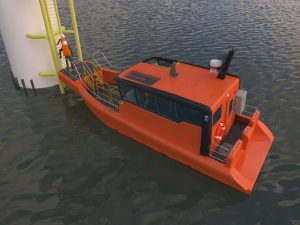
MAY 17, 2016 – Denmark’s Tuco Marine Group has won a new order for an 11m wind farm service boat from its ProZero series of fast rescue boats, daughter craft and workboats.
MAY 17, 2016 – Denmark’s Tuco Marine Group has won a new order for an 11m wind farm service boat from its ProZero series of fast rescue boats, daughter craft and workboats.
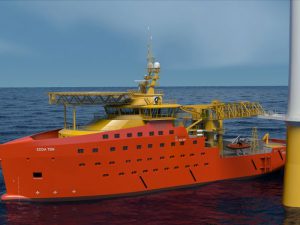
MAY 9, 2016 — Norway’s Østensjø Rederi is to order a second Service Operation Vessel (SOV) to DONG Energy at Spanish shipbuilder Astilleros Gondan. It will be a sister vessel to the
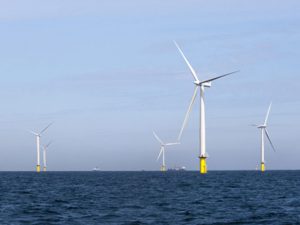
MAY 5, 2016 — U.K. headquartered ABS Group Ltd. has received a contract to provide project certification services from DONG Energy Wind Power A/S (DONG Energy) for the planned Hornsea Offshore Wind
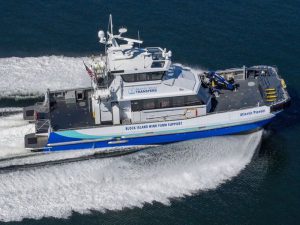
APRIL 22, 2016 — IMTRA, New Bedford, MA, has delivered a number of equipment items for the first U.S.-flagged offshore wind farm crew transfer vessel (CTV), Atlantic Pioneer, recently delivered by Blount
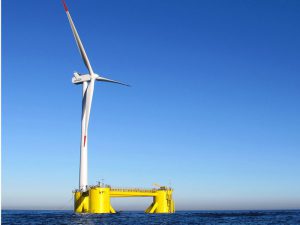
APRIL 14, 2016 – Classification society Bureau Veritas has given Approval in Principle (AIP) to the WindFloat Floating Offshore Wind Turbine (FOWT) foundation. Designed by Principle Power, Inc., WindFloat consists of a
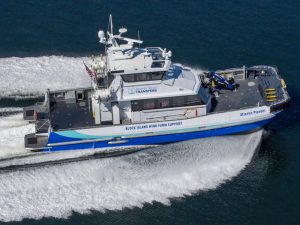
APRIL 13, 2016 — Blount Boats, has delivered the Atlantic Pioneer, America’s first U.S. Flagged Crew Transfer Vessel (CTV) from its Warren, RI, shipyard. It will begin service for Atlantic Wind Transfers
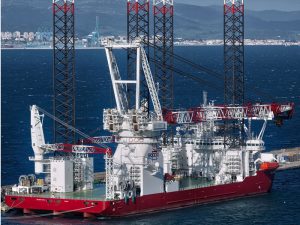
FEBRUARY 23, 2016 — Gibraltar shipyard Gibdock has completed the afloat mobilization of Seajacks Scylla, the largest wind farm installation jack-up ever built. Following delivery to Great Yarmouth, U.K., headquartered Seajacks by
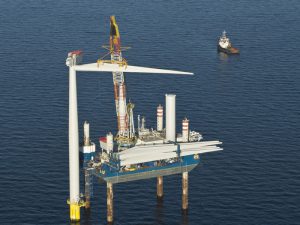
FEBRUARY 4, 2016 – Danish offshore windfarm installation specialist A2Sea reports that, due to harsh weather, its jack-up installation barge Sea Worker capsized Tuesday night while still grounded after a January 27
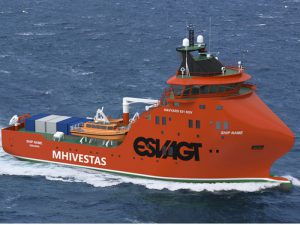
Situated 50 km off the Belgian coast the Nobelwind project, together with the existing Belwind 1 project, will require a purpose built service operation vessel (SOV) to support the technicians working in the wind park.
Norway’s Havyard Design & Solutions has been commissioned to design the vessel and supply an equipment to the shipbuilder, Turkey’s Cemre Shipyard. which is set to deliver the vessel in the second half of 2017.
The vessel’s Havyard 831 SOV design is based on a ship and service concept, developed by Esvagt in synergy with MHI Vestas & Havyard Design, that draws on several years of experience in servicing wind farms further offshore.
For the past five years, Esvagt has provided the base for MHI Vestas Offshore Wind technicians servicing the 165 MW Belwind 1 project, and the new contract continues that partnership.
The new purpose build SOV will be 58.5 m in length, with a beam of 16.6 m and will be able to support up to 22 technicians in single cabins. It will be equipped with Esvagt’s unique safe transfer boats (Esvagt STB) to transfer technicians, tools and spare parts to the turbines.
“The market for big service vessels for offshore windfarms is a relatively new one, and, in cooperation with Esvagt, we have entered this market at an early stage,” says Gisle Vinjevoll Thrane, Senior VP Sales, Havyard Design & Solutions. “The windmills used to be serviced by small, fast-moving boats that transported personnel and equipment daily to and from the shore. More and more wind farms are now serviced by bigger ships where the service personnel work and live on board for prolonged periods and access the windmills by means of a gangway installed on the mother ship or small boats launched from the mother ship. This is a safer and more profitable way of servicing the wind farms, particularly those far offshore.”
“The Havyard 831 SOV was developed to fill a new niche in this market, namely smaller wind farms,” says Mr. Thrane. “The new design is smaller than the ships built so far. It is compact and efficient, but at the same time has ample capacity to transport service personnel and equipment. This design will make it profitable to service even smaller wind farms, and we see a potential to deliver many designs to this segment.”
The Havyard 831 SOV has a spacious and comfortable interior with sufficient capacity to accommodate wind farm service personnel in addition to the ship’s own crew. It has also been designed with good storage capacity for equipment and tools below deck and for containers on deck.
The ship is equipped with three small boats that can be launched to transport service personnel to the windmills.
The diesel-electric propulsion system ensures economical and environmentally friendly operation, both in transit and when the ship is in position at the wind farms. The hull has been designed to ensure low fuel consumption and to move in a way that ensures maximum comfort for the crew and service personnel on board.
The ship has sufficient fuel capacity etc. for at least 30 days’ operation between port calls.
Havyard has a long relationship with Cemre Shipyard. The Turkish yard has delivered the hulls for more than 30 of the newbuilds Havyard has delivered since 2005. In recent years, the shipyard has also delivered completed newbuilds for Norwegian and other customers, including cargo vessels, fishing vessels and seismic support vessels.Havyard says that the close cooperation built with Cemre through the hull deliveries will continue and develop now that the yard is to build its first Havyard design vessel.
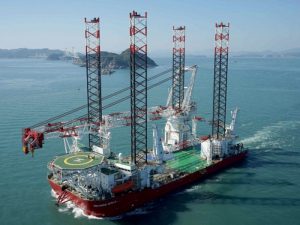
Built for Great Yarmouth, U.K., based Seajacks International, the jack-up vessel is based on the Gusto MSC NG14000X design and has more than 8,000 metric tons of available variable deck load. Equipped with a 1,540-metric-ton Huisman leg-encircling crane and a usable deck space in excess of 5,000 sq m the unit is outfitted with 105-m legs with the ability to install components in water depths to 65 m in North Sea conditions.
The rig is capable of meeting the installation needs of jumbo-monopiles, jackets, and turbines of future wind farms in deeper waters farther from shore.
“Industry growth depends on innovation and new designs,” says ABS Chairman, President and CEO Christopher J. Wiernicki. “As a technology leader, ABS is pleased to work with Seajacks as it develops and launches vessels with increasingly greater capabilities.”
Seajacks CEO Blair Ainslie credits the strong working relationship among the project participants for the successful delivery of this unit.
“The cooperation among Seajacks, ABS and SHI was vital to the success of this newbuild effort,” he says. “As we bring new designs to the market, we rely on partners who are willing to take on projects like this one that break new ground in the industry.”
Since 2009, Seajacks has invested in five self-propelled jackup units, all of which have been classed by ABS. The Seajacks Scylla is a milestone for the company as it is considered to be the most technically advanced installation vessel in the market.
The Seajacks Scylla complies with ABS classification requirements for self-propelled jack-up units, including DPS-2 for dynamic positioning capability; ACCU, which applies to automatic centralized control unmanned units; and CRC for crane register certificate.
In early December, Seajacks Scylla will begin her journey from South Korea to Europe on-board the heavy load carrier vessel, HLV Osprey, and is expected to arrive in Rotterdam around the end of January. Seajacks operations teams will then prepare the vessel for her first project next spring.