Strait of Hormuz: How long until trapped ships can evacuate conflict zone?
Written by Nick Blenkey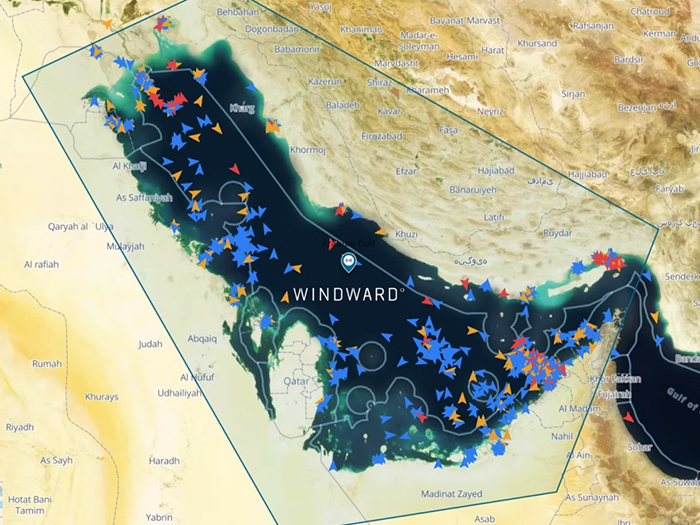
Image: WindwardAI
The announcement of a ceasefire in the U.S.-Israeli conflict with the Iranian regime has raised hopes of the Strait of Hormuz reopening and normalcy returning to world shipping routes. Those hopes look to be a long way from happening yet.
Right now, as reports from Windward AI make clear, the Strait is operating pretty much as an Iranian-operated toll canal. And the Iranian position as truce talks starts is pretty much that it would like things to stay that way. The New York Times reports Iranian foreign minister, Abbas Araghchi as writing that shipping would proceed, but under the control of “Iran’s Armed Forces,” who would determine who passes, and when.
Ship-broker SSY has confirmed to BBC Verify that vessels in the Gulf have received the following message:
“Attention all vessels. Attention all vessels. Attention all vessels in Persian Gulf and Oman Sea. This is the IRGC Navy Station. Transiting the Strait of Hormuz remains closed and you need permission from the IRGC before sailing through the strait. Any vessel trying to travel into the sea will be targeted and destroyed.”
Not surpprisingly, shipowners are cautious about returning to the Strait.
“We welcome the announced ceasefire and the public statements that commercial passage through the Strait of Hormuz may again be possible – albeit for now for a limited period,” says Maersk. “Information and details available remain very limited and we are working with urgency to obtain further clarity.
“The ceasefire may create transit opportunities, but it does not yet provide full maritime certainty, and we need to understand all potential conditions attached. The safety of our seafarers, vessels and cargo remains Maersk’s highest priority.
“Any decision to transit the Strait of Hormuz will be based on continuous risk assessments, close monitoring of the security situation, and available guidance from relevant authorities and partners.”
EVACUATION THE PRIORITY
Realistically, industry hopes are mostly on getting trapped ships and seafarers out of the region.
“For the health and wellbeing of seafarers and the global shipping industry, I welcome the ceasefire announced in the Middle East,” said IMO Secretary General Arsenio Dominguez. “I am already working with the relevant parties to implement an appropriate mechanism to ensure the safe transit of ships through the Strait of Hormuz. The priority now is to ensure an evacuation that guarantees the safety of navigation.”
BIMCO INSIGHTS
Two BIMCO experts gave their views on the issues
Chief Safety & Security Officer, Jakob Larsen:
Will ships trapped in the Persian Gulf seek to leave immediately, or will they likely await further clarification of the ceasefire deal?
- Ships trapped in the Persian Gulf will be interested in leaving as soon as it is safe to do so.
- The shipping industry is currently awaiting technical details from the U.S/ and from Iran on how to transit the Strait of Hormuz safely.
- Leaving the Persian Gulf without prior coordination with the U.S. and Iran would entail heightened risk and would not be advisable.
- Also, to avoid unnecessary navigational risks, an uncoordinated exit is not advisable.
What are the risks involved when transiting the Strait of Hormuz?
- If too many ships attempt to transit at once, due to the confined nature of the Strait of Hormuz, there is a heightened risk of navigational hazards like grounding or collisions.
- Iran has announced that they want to be in control of transits in the Strait. However, Iran’s military command structure has been severely impacted by attacks in recent weeks which could lead to misunderstandings between the Iranian authorities approving transits and the Iranian military formations that control the weapons. Such misunderstandings could potentially lead to unintended targeting and attacks on ships approved for transit.
- Reportedly, Iran still has significant amounts of weapons to control shipping through the Strait, including antiship missile, drones, fast attack craft, coastal artillery, and mines.
Do you expect navies to commence escorting of merchant ships?
- In the short term, navies are not expected to escort merchant ships. There is still too much uncertainty regarding the practical implementation of the ceasefire, and any setback in negotiations could lead to a resumption of hostilities. In that case, warships in the Strait of Hormuz would be quite vulnerable to Iranian attack.
- At a later stage, if the ceasefire firms up, escorting might become an option to provide a level of assurance to seafarers on transiting ships.
BIMCO Chief Shipping Analyst, Niels Rasmussen, said that, assuming that passage through the Strait is considered safe, the following could be expected:
- Ships so far trapped within the Persian Gulf will likely be looking to leave soonest possible.
- As far as possible, they will load cargoes prior to leaving but only if loading does not jeopardize the chance of leaving within the two weeks.
- Unless the two-week window is quickly lengthened, I doubt there will be a large influx of ships into the Persian Gulf. Partly because many ships have already sailed to other regions and partly because they do not want to risk being trapped after the two-week window closes.
- Even if we return to normal after the two weeks, oil exports will be impacted for some time as production needs to be restarted at several fields and as damage to infrastructure needs to be repaired.
Categories: News, Safety and Security

![American Maverick [Photo: American Cruise Lines]](https://www.marinelog.com/wp-content/uploads/2026/06/American-Maverick-Christening_Newport_RI-300x225.jpg)