U.S. maritime pushes back on Trump’s sweeping 60-day Jones Act waiver
Written by Nick Blenkey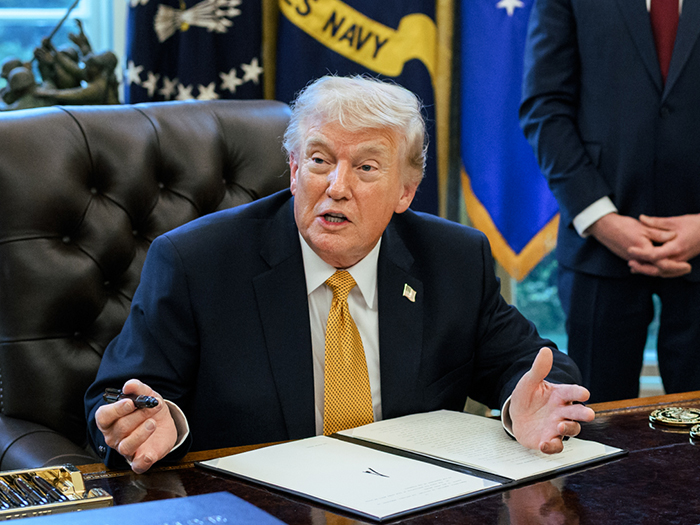
Photo: White House
The 60-day Jones Act waiver announced by White House press secretary Karoline Leavitt yesterday (see our earlier report) appears to be an extremely broad one
The American Waterways Operators reports that the waiver, covering the transportation of energy resources, fertilizer and fertilizer feedstocks, is being granted under the authority of 46 U.S. Code Section 501(a).
This waiver authority, notes AWO, differs from the 501(b) authority used to issue Jones Act waivers in 2021 and 2022. Section 501(b) requires, among other things, that the U.S. Maritime Administration survey the market and determine whether Jones Act-qualified vessels are available to perform the requested transportation.
By contrast, 501(a) requires a waiver to be issued when the Secretary of War determines it is necessary in the interest of national defense to address an immediate adverse effect on military operations. It does not involve a survey of available U.S. vessel capacity.
A statement released by AWO says:
“The Jones Act is fundamental to America’s supply chain reliability and national security, and this broad 60-day waiver of this vital law puts both at risk. The breadth of this waiver is especially concerning, as it will unnecessarily impact transportation markets where domestic vessel capacity is not lacking. Allowing foreign vessels to transport cargo on U.S. waterways will introduce the price volatility of today’s international market into our domestic commerce, creating instability in our thriving domestic supply chain and undermining American jobs while having no appreciable effect on the price of gasoline.
‘At a time of heightened concern about terrorist threats on American soil, the Jones Act also serves as a security bulwark against foreign-flag vessels with foreign crews transporting critical cargo between America’s inland and coastal ports, and ensures that American mariners remain the indispensable eyes and ears supporting the U.S. Coast Guard’s homeland security mission.
“Our nation counts on the Jones Act mariners of the American tugboat, towboat and barge industry to power the American economy and help keep our communities and waterways safe. Waiving the Jones Act does not serve those interests.”
MARITIME LABOR “ALARMED” BY TRUMP WAIVER
A coalition of U.S. maritime labor organization today expressed alarm regarding the Trump
Administration’s decision to issue the sweeping 60-day waiver.
A statement from the coalition (the American Maritime Officers; American Radio Association; International Organization of Masters, Mates and Pilots; Marine Firemen’s Union; Marine Engineers’ Beneficial Association; Maritime Trades Department, AFL-CIO; Sailors’ Union of the Pacific; Seafarers International Union; and the Transportation Trades Department, AFL-CIO) said:
“America’s maritime labor unions are deeply concerned about the Administration’s broad Jones Act waiver, which undermines our national security, weakens military readiness, and hands critical maritime work to foreign vessel operators. Jones Act waivers are intended to meet a strict legal standard and are traditionally granted only in narrow, clearly defined national security emergencies where U.S.-flag capacity is unavailable. Maritime labor has supported narrowly tailored Jones Act waivers in the past when they were obviously justified in the national interest, but this sweeping action does not meet that standard.”
“At a time of heightened global instability where American sailors are being targeted in the Persian Gulf and surrounding areas, opening U.S. waterways to foreign adversaries through an expansive Jones Act waiver further jeopardizes America’s safety and security in open waters. Such action only permits more abuse of our nation’s cabotage laws and sends a damaging signal about the nation’s commitment to sustain a strong U.S. maritime industry and workforce.”
“To be clear, this decision will not provide meaningful relief at the gas pump. It has been plainly shown that the primary driver of gasoline prices remains the global cost of crude oil, and multiple analyses demonstrate that domestic shipping accounts for less than one cent per gallon. Any marginal savings will not reach consumers but will instead reward foreign shipping interests at the expense of American workers.”
“Maritime labor calls on the Administration to reverse course and work with stakeholders on real solutions that address energy costs without sacrificing American jobs, national security, or the long-term strength of the U.S. maritime industrial base.”
OMSA COMMENTS
The Offshore Marine Service Association (OMSA) said the Trump Administration’s temporary 60-day waiver of the Jones Act now forces foreign shippers and long-time opponents of the law to prove their repeated claims that outsourcing American maritime workers from domestic jobs will meaningfully lower costs for American consumers.
“The United States has spent generations building a maritime industrial base that supports national security, homeland security, domestic energy production, and good-paying American jobs,” said Aaron Smith, president of OMSA. “As this temporary waiver moves forward, policymakers and the public will be able to see firsthand whether replacing American workers with foreign crews delivers the benefits critics of the Jones Act have long promised. Those of us in the domestic offshore maritime industry know these promises will be proven false.”
“Similar claims have been made in the offshore energy sector where foreign vessels already take jobs from U.S. vessels. In our markets, these foreign operators and their foreign crews have not translated into meaningful savings for consumers,” Smith added.
OMSA also called on federal agencies to ensure foreign vessels operating under the waiver meet the same standards and obligations required of the U.S.-flag vessels.
“As foreign vessels are allowed to operate in domestic trade during this period, they should be held to the same level of oversight that American vessels meet every day,” Smith said. “We expect the U.S. Coast Guard to inspect and regulate these vessels with the same scrutiny applied to U.S. operators, and the Internal Revenue Service to ensure that companies benefiting from this waiver meet the same tax obligations as American companies.”
Categories: Uncategorized
![Don Davis [Photo: OCIMF]](https://www.marinelog.com/wp-content/uploads/2026/06/don-davis_md-300x225.jpg)