tug

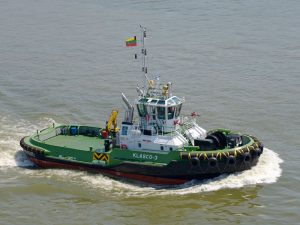
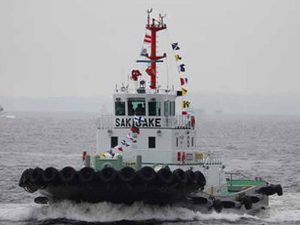
NYK takes delivery of Japan’s first LNG fueled tug

NYK has chartered the tug to Wing Maritime Service Corporation, another wholly owned subsidiary that operates 20 tugboats at the ports of Yokohama, Kawasaki, and Chiba and which will operate the Sakigake mainly in  Yokohama and Kawasaki. It is the second environmentally-friendly tugboat to be operated by Wing Maritime which took delivery of the hybrid tug Tsubasa in March 2013.

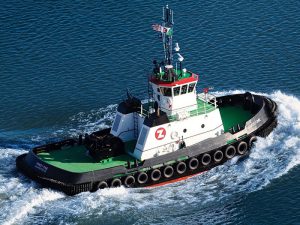
The Sakigake is equipped with twin Niigata 6L28AHX-DF dual-fuel engines, each developing 1,618 kW. They are the prime movers for a the 360-degree steerable Niigata Z-Peller propulsion system.
The DF engines can use either of LNG and diesel oil, depending on conditions. Compared with conventional tugboats that use marine diesel oil, Sakigake emits about 30 percent less carbon dioxide, 80 percent less nitrogen oxide, and absolutely no sulfur oxide when using LNG as fuel.

NYK says that the small size of most tugboats, the limited amount of space, and the large variation in engine power make it difficult to create an LNG fueled tugboat. Keihin Dock was able to achieve the desired level of environmental performance while maintaining the same hull form and steering performance of existing tugboats. To do this, the shipbuilder made full use of its knowledge and technical strengths, and worked closely with both Niigata Power Systems and Air Water Plant & Engineering Inc.  to develop equipment for supplying LNG.

LNG will be supplied by Tokyo Gas Co and delivered to the vessel from a tanker truck at a pier in Yokohama, with a successful trial fueling being carried out in July.

The project received subsidies from Japan’s Ministry of Economy, Trade and Industry and the Ministry of Land, Infrastructure and Transport, which support projects promising energy-saving logistics and innovative maritime transport improvements. ClassNK also provided joint research support.

The NYK Group has already ordered the world’s first LNG-fueled car carrier, in addition to an LNG supply vessel, and the group is set to participate in the LNG bunkering business.
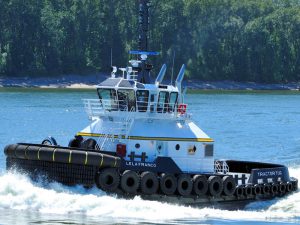
Second “enhanced” RAmparts tug joins Harley Marine

The Lela Franco, named in honor of the  wife of HMS founder Harley Franco, is a sister ship to the Michelle Sloan delivered earlier this year. Designed by Robert Allan Ltd., both tugs were built at shipbuilder Diversified Marine Inc.’s Portland, OR, shipyard.

The Lela Franco is the sixth tractor tug HMS has added to its fleet in under two years, improving its ship assist and tanker escort capability and bringing more horsepower to the U.S. West Coast. Like its twin sister the Michelle Sloan, it is an enhancement of HMS tugs the Tim Quigg and John Quigg, built in 2004 also by DMI. These enhanced designs developed by Robert Allan Ltd. feature a wider hull, increased bollard pull performance, improved crew accommodations, and a modified skeg.

Particulars of the Lela Franco are as follows:

  • Length overall: 80′-0″
  • Beam, molded, extreme:36′-0″
  • Depth, molded (hull):16′-8″
  • Maximum draft:17′-5″
  • Gross Tonnage: <200 GRT (US Tonnage)

The tug was designed and constructed to satisfy all applicable USCG rules and regulations and meets or exceed classification society minimum scantling requirements. Tank capacities are as follows:Fuel Oil:          32,800

On trials, the vessel achieved an average bollard pull, ahead, of 69.0 short tons and a maximum of 71.3 short tons, Astern, average bollard pull was 65.4 short tons and maxium was 67.4 short tons.  Free running speed, ahead, was 12.5 knots   

The vessel has been outfitted to the highest standards for a normal operating crew of two, with accommodations for up to six persons. The Master’s cabin is located on the main deck, with two additional double crew cabins located on the lower accommodation deck. There is also a galley and mess room located on the main deck.

The deck machinery comprises a Markey DEPC-48 render-recover type ship assist hawser winch on the bow, spooled with 500′ of 9″ line, and a Markey DEPC-32 towing winch aft with a capacity of 250′ of 6-1/2″ line. In addition, a capstan is installed on the fore deck to facilitate line handling operations.

The raised forecastle and elevated wheelhouse ensure good all-round visibility of the working decks and when handling large barges with high freeboard. The higher freeboard feature also provides a high standard of seakeeping when working in exposed waters, but is configured so as not to impede the ability of the tug to work closely under the flare of the newer generation of large ships.

Main propulsion power for each tug is provided by a pair of CAT 3516C diesel engines, each rated 2,575 bhp at 1,600 rpm, and each driving a Rolls-Royce US 205 Z-drive unit, with a 94.5″ diameter fixed pitch propeller.

The electrical plant consists of two (2) identical CAT C6.6 diesel gen-sets, each with a power output of 125 ekW, 60 Hz.

Ship-handling fenders at the bow consist of one tier of 36″ OD x 18″ ID cylindrical fender at the main deck level, with 12″ loop type Schuyler fenders between the main deck and the knuckle, 11″ laminated bow fenders below, and 12″ hollow D style fenders along the stem and skeg. Tires and 8″ hollow “D” fender provide protection at the main and forecastle sides and sheer lines, and 12″ loop type fendering is used at the stern.

llela francoGA

Gulf Island delivers towboat to Marquette

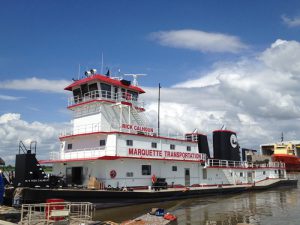
SEPTEMBER 8, 2015 — Gulf Island Marine Fabricators, Houma, LA,  last moth delivered the  180′ x 48′ x 11′ 6”  towboat Rick Calhoun to Paducah, KY, headquartered tug and towboat operator Marquette