“Brent has been a key contributor to Bollinger’s success in leading our proposal and estimating efforts on the major governments programs the company has pursued over the years,” said President and CEO Ben Bordelon.
“His leadership and management skills will assist in guiding the continuous success of our engineering department.”Mr. Blackburn has over 16 years of experience in the U.S. shipbuilding and maritime industry. He joined Bollinger in 2004 working in various key engineering, estimating, and proposal roles mainly focusing on the company’s government programs.
Mr. Blackburn’s career began as a Project Engineer in Bollinger’s engineering group and he has risen steadily through the engineering and technical design departments. In 2014, he was promoted to Technical Manager, a position that solidified and proved his abilities, skills, and overall knowledge in managing projects and priorities.
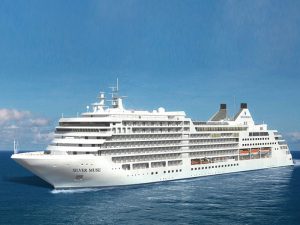
At 40,700 gt and accommodating 596 passengers in all-suite accommodations, Silver Muse will be an evolution of the 36,000 gt, 540 passenger Silver Spirit, delivered in 2009 by Fincantieri’s Ancona shipyard.
The delivery of the ship is scheduled for spring 2017.
Yesterday’s keel laying ceremony included the tradition of welding a coin into the keel of the ship, though Silversea took things a step further by welding eight coins into the keel of Silver Muse.
Each coin represents one of the seven continents that Silversea ships sail to, along with a specially designed commemorative Silver Muse coin. The coins are:
A South African rand
An Australian dollar
A U.S. half dollar
A Brazilian real
An Italian euro
A Singapore dollar
A commemorative Antarctica trust coin
A specially designed Silversea Silver Muse commemorative coin
The ceremony was attended by Silversea CEO Enzo Visone and Fincantieri shipyard director Raffaele Davassi.
“Today marks a significant milestone for Silversea with the birth of our newest ship,” said Mr. Visone. “We proudly sail to all seven continents, discovering new destinations and ports with our intimate, boutique vessels, and we are now one step closer to introducing Silver Muse to the fleet.
“With an unprecedented variety of dining options and a design across the ship that encourages open-air cruising, guests will be able to enjoy magnificent destinations as never before. Silversea looks forward to working closely with Fincantieri throughout the construction phase of Silver Muse and in the run-up to her launch in spring 2017.”
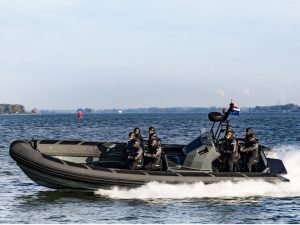
The RHIB 1050 was developed at Damen Shipyards Hardinxveld, a long time RHIB supplier to the Royal Netherlands Navy.
“This is not your average RHIB,” says Roel Foolen, the shipyard’s Newbuild Project Manager. “For starters, it’s Lloyds approved. The hull is made of glass reinforced epoxy as opposed to polyester and provided with Lloyd’s approved closed cell, foam core.”
“Further to this, we are also able to provide training in its use,” adds Mr. Foolen. “Damen has many years’ experience in building boats for navies and other defence and security bodies.”
Damen’s use of epoxy for the hull will see the RHIB 1050 produced at the group’s specialist composites yard in Antalya, Turkey.
The RHIB will be produced in series with a standard hull, open to flexible, client-specified outfitting requirements.
Ergonomics are a strong theme running throughout the design. Damen developed the layout using a mock-up console, constantly tweaking the positioning of instrumentation, seating and controls until completely satisfied with comfort levels. Consequently, the wheel and throttle are perfectly aligned with the suspension seating and handles and grips are located strategically throughout the RHIB.
“We’ve aimed to cover every detail – for example including steps to facilitate easy, fast exit of the RHIB in boarding ops and integration of hoisting eyes into the bollards, simultaneously removing a trip hazard and taking advantage of every available bit of space,” says Mr. Foolen.
The RHIB uses D-shaped tubing, rather than the conventional cylindrical tubing.
“Doing this allows us to combine the console and the engines into a single, space saving unit,” says Mr. Foolen.” Usually this would not be possible as such a unit would impede access to the fore of the vessel. However, with a section of tubing removed, there is still space for on board personnel to pass safely and comfortably fore to aft.”
The vessel is easy to maintain. For example, its two 350 liter fuel tanks are located beneath the ten deck-based seats which are fitted to a dedicated hatch so that, in the event the tanks require removing, the seating is simply lifted clear.
Similarly, the entire console unit is hinged at the aft so that it can be very easily moved clear when access is necessary to the RHIB’s two 370 hp Volvo Penta engines. The mast is also hinged so that it can be quickly folded away for transport height.
“As well as easy maintenance, the RHIB 1050 is also low maintenance,” says Mr Foolen. “We’ve used high-end materials and taken every step to ensure components are protected. Console instrumentation is located behind a heated, watertight window for example. And all electrics are housed in a dedicated, heated and ventilated compartment inside the dry storage area.”
The stern platform, as well as being ideally situated for diving and man overboard operations, works in combination with the tube ends to form a protective barrier for the stern drives.
At the front of the vessel, the nose is flattened to serve as a fender during boarding operations and the tubing is fitted to the vessel with aluminum extrusions, not glue. This not only offers a better grip, but also makes it easier to remove and replace when necessary.
How about performance?
“During seatrials, the handling, maneuverability and balance have proven to be excellent,” says Mr. Foolen. “It’s very safe also, very forgiving and perfect in rough, harsh water. She’s quick too – able to sail at speeds of over 50 knots.”
Damen is currently building a second RHIB 1050, which will feature two 400 hp outboard engines.
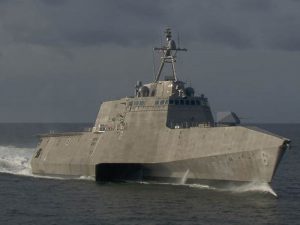
In a stock exchange announcement, the company noted that in its FY2015 results it had reported experiencing schedule and margin pressure on Littoral Combat Ship (LCS) 6, the first that it is building as the prime contractor.
“Austal is building multiple LCS in parallel,” said the announcement, “with the impact of cost and schedule performance on LCS 6 continuing to impact LCS 8 and LCS 10 – both of which are in an advanced state of completion.
“Austal’s ability to apply lessons learnt and productivity enhancements from LCS 6 to vessels in advanced construction, namely LCS 8 and LCS 10, has been more limited than anticipated. As a result, FY2016 earnings from Austal’s U.S. shipyard are expected to be lower than in FY2015, with U.S. shipbuilding EBIT margin expected to be in the range of 4.5% to 6.5%. [Its U.S, shipbuilding EBIT margin was 5.2% in 2015 and 6.6% in 2014]
“Austal’s other major vessel program at its U.S. shipyard, the Expeditionary Fast Transport program (formerly called the Joint High Speed Vessel), has reached construction program maturity, with shipbuilding margin stable”.
Austal CEO Andrew Bellamy said that, while there were flow on effects from LCS 6 onto LCS 8 and 10, vessels at earlier stages of construction would benefit from the lessons learnt on LCS 6 to increase future US shipbuilding margin.
“The LCS program is maturing more slowly than we had expected, however we are working hard to manage the risks and expect an improvement across the program after delivery of LCS 10,” Mr. Bellamy said. “The ongoing strong performance of the US$1.6 billion Expeditionary Fast Transport program at our U.S. shipyard is a great illustration of the efficiencies we can deliver once a vessel program reaches the mature production phase and we are confident the LCS program will be no different.
“Austal has a strong balance sheet and is generating good cash flow, which is enabling further investment in the business during the 2016 financial year to best position the company to win additional contracts and service work to build our order book, revenue, and earnings into the future.”
The False Claims Act suit alleges that Bollinger misrepresented the longitudinal strength of patrol boats it delivered to the Coast Guard that resulted in the boats buckling and failing once they were put into service. Bollinger Shipyards is located in Lockport, Louisiana.
“Those who expect to do business with the government must do so fairly and honestly,” said Principal Deputy Assistant Attorney General Benjamin Mizer, head of the Justice Department’s Civil Division. “We expect the utmost integrity and reliability from the contractors that design and build equipment that is essential to public safety and our national defense.”
In 2002, the U.S. Coast Guard contracted to lengthen the Coast Guard’s existing fleet of 110-foot patrol boats to 123 feet and to make other modifications. Bollinger was the subcontractor that performed the 123-foot patrol boat design and conversion work. An essential element of the conversion was that the modified boats have sufficient longitudinal strength to meet the performance requirements set forth in the contract.
The United States alleged Bollinger provided the Coast Guard with engineering calculations that falsely represented the longitudinal strength of the boats and was two times greater than their actual longitudinal strength. The United States alleged Bollinger ran the calculations three times and only provided the Coast Guard with the highest and most inaccurate, of the three calculations. The United States further alleged Bollinger also failed to follow the quality control procedures that were mandated by the contract that would have ensured against such engineering miscalculations.
The case was handled jointly by the Civil Division’s Commercial Litigation Branch and the U.S. Attorney’s Office of the Eastern District of Louisiana.The claims resolved by the settlement are allegations only, and there has been no determination of liability.
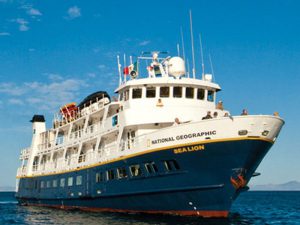
Today, Lindblad Expeditions Holdings, Inc. (NASDAQ: LIND) reported that it has signed definitive agreements with Nichols Brothers Boat Builders for the new build of two U.S. flagged coastal vessels. The 100 guest ships will be built at the Nichols Brothers shipyard on Whidbey Island, WA. The first completed ship is scheduled to be delivered in the second quarter of 2017 and the second vessel is scheduled to be delivered in the second quarter of 2018.
Lindblad had previously signed a non-binding letter of intent with Nichols Brothers for these new builds and paid a $4 million non-refundable slot fee during the third quarter of this year to reserve the shipyard’s capacity, which will be charged against the second vessel’s cost.
The definitive agreements provide for Nichols Brothers to construct the two new build vessels at a purchase price of $48.0 million and $46.8 million, respectively, payable monthly based on the value of the work performed (offset by the $4.0 million slot fee previously paid).
Jensen Maritime is serving as the naval architect on the project with interior design work provided byTillberg Design International. Building of the vessels will commence this year.
“These new ships mark an exciting step in the long-term growth of the company, and enables us to capitalize on the substantial demand for our expeditions. With our significant resources we can continue to deliver on our promise of expedition travel at its best, and can now expand our unique offerings in the Americas where we have very strong demand,” said Sven Lindblad, President and CEO of Lindblad. “We are pleased to be working with Nichols Brothers in Washington State on this project given their long history in shipbuilding, including having built our current U.S. flagged ships, the National Geographic Sea Lion and National Geographic Sea Bird.”
“This is an important milestone in the company’s history as we enter the 50th Anniversary of the birth of expedition travel begun by my father, Lars-Eric Lindblad, with the first laymen expedition to Antarctica in 1966,” Mr. Lindblad added.
Some key features of the new vessels:
50 cabins: 22 with balconies, and eight that can be configured into four adjoining cabins for families.
all public spaces are designed for maximum viewing with easy, quick access to decks for inevitable announcements from the bridge of a phenomenal sighting.
outdoor walkway around the entire sun deck, which will feature an al fresco bar and grill, in addition to the restaurant and a lounge with bar and facilities for presentations.
fleet of sea kayaks, paddle boards, and specially designed landing craft – all of which are geared to get guests out and into the wild, remote places being explored.
fully equipped fitness room and a wellness spa.
state-of-the-art expedition technology, including a remotely operated vehicle (ROV), video microscope, and a hydrophone and bow-cam designed for immediate bow deployment to hear and film, for instance, humpback whale vocalizations and see bow-riding dolphins.
full warm and cold water diving gear and underwater cameras for the Undersea Specialist to bring back rare imagery of the undersea world.
state-of-the-art A/V system for the highest quality presentations, including National Geographic photography instruction.
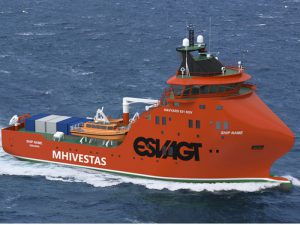
Situated 50 km off the Belgian coast the Nobelwind project, together with the existing Belwind 1 project, will require a purpose built service operation vessel (SOV) to support the technicians working in the wind park.
Norway’s Havyard Design & Solutions has been commissioned to design the vessel and supply an equipment to the shipbuilder, Turkey’s Cemre Shipyard. which is set to deliver the vessel in the second half of 2017.
The vessel’s Havyard 831 SOV design is based on a ship and service concept, developed by Esvagt in synergy with MHI Vestas & Havyard Design, that draws on several years of experience in servicing wind farms further offshore.
For the past five years, Esvagt has provided the base for MHI Vestas Offshore Wind technicians servicing the 165 MW Belwind 1 project, and the new contract continues that partnership.
The new purpose build SOV will be 58.5 m in length, with a beam of 16.6 m and will be able to support up to 22 technicians in single cabins. It will be equipped with Esvagt’s unique safe transfer boats (Esvagt STB) to transfer technicians, tools and spare parts to the turbines. “The market for big service vessels for offshore windfarms is a relatively new one, and, in cooperation with Esvagt, we have entered this market at an early stage,” says Gisle Vinjevoll Thrane, Senior VP Sales, Havyard Design & Solutions. “The windmills used to be serviced by small, fast-moving boats that transported personnel and equipment daily to and from the shore. More and more wind farms are now serviced by bigger ships where the service personnel work and live on board for prolonged periods and access the windmills by means of a gangway installed on the mother ship or small boats launched from the mother ship. This is a safer and more profitable way of servicing the wind farms, particularly those far offshore.”
“The Havyard 831 SOV was developed to fill a new niche in this market, namely smaller wind farms,” says Mr. Thrane. “The new design is smaller than the ships built so far. It is compact and efficient, but at the same time has ample capacity to transport service personnel and equipment. This design will make it profitable to service even smaller wind farms, and we see a potential to deliver many designs to this segment.”
The Havyard 831 SOV has a spacious and comfortable interior with sufficient capacity to accommodate wind farm service personnel in addition to the ship’s own crew. It has also been designed with good storage capacity for equipment and tools below deck and for containers on deck.
The ship is equipped with three small boats that can be launched to transport service personnel to the windmills.
The diesel-electric propulsion system ensures economical and environmentally friendly operation, both in transit and when the ship is in position at the wind farms. The hull has been designed to ensure low fuel consumption and to move in a way that ensures maximum comfort for the crew and service personnel on board.
The ship has sufficient fuel capacity etc. for at least 30 days’ operation between port calls.
Havyard has a long relationship with Cemre Shipyard. The Turkish yard has delivered the hulls for more than 30 of the newbuilds Havyard has delivered since 2005. In recent years, the shipyard has also delivered completed newbuilds for Norwegian and other customers, including cargo vessels, fishing vessels and seismic support vessels.Havyard says that the close cooperation built with Cemre through the hull deliveries will continue and develop now that the yard is to build its first Havyard design vessel.
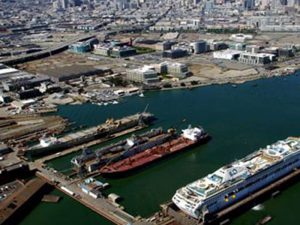
Work by the shipyard will include clean and gas free tanks, voids, cofferdams and spaces, deck non-skid renewal, ballast tank preservation, cylinder head and liner overhaul, main engine overhaul, heating, ventilating, and air conditioning support, degaussing system repairs, annual lifeboat certification, galley ventilation system cleaning, docking and undocking, propeller system maintenance and boss cap replacement, bow thruster maintenance, overhauling sea valves, and underwater hull cleaning and painting.
The contract includes options which, if exercised, would bring the total contract value to $16,566,073.
Work will be performed in San Francisco and is expected to be completed by April 1, 2016.
Fiscal 2016 maintenance and repair funds in the amount of $16,501,090 will be obligated in 2016.
The contract was competitively procured, with proposals solicited via the Federal Business Opportunities website and two offers received.
The Navy’s Military Sealift Command is the contracting activity (N32205-16-C-4308).
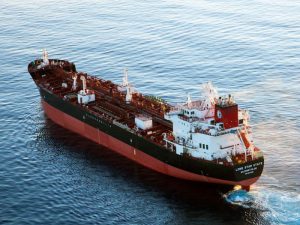
The Jones Act tanker is the first of a five-tanker contract between NASSCO and APT, covering design and construction of five 50,000 deadweight-ton, LNG-conversion-ready product tankers with a 330,000 barrel cargo capacity.
In addition to being LNG conversion ready, the 610 ft long ECO class tankers are a new “ECO” design, offering significantly improved fuel efficiency and the latest environmental protection features including a Ballast Water Treatment System.
Helping achieve the fuel savings are a G-series MAN Diesel & Turbo ME slow-speed main engine and an optimized hull form.
“The delivery of this new vessel symbolizes the future of American shipping: innovative, cost-effective, and green. The Lone Star State, along with the four others we are currently building for APT, will be among the most fuel-efficient and environmentally-friendly tankers—anywhere in the world,” said Fred Harris, president of General Dynamics NASSCO. “These tankers are 33 percent more fuel efficient than the previous five tankers built by NASSCO for APT. We are proud to be leading the charge in building these next generation of tankers.”
Between 2007-2010, NASSCO built five similar State Class product tankers for APT.”We are very excited to be taking delivery of the Lone Star State. This state-of-the-art tanker is a welcome addition to our growing fleet and will provide safe, reliable and efficient transportation service to our customers for many years to come,” said Robert Kurz, vice president of Kinder Morgan Terminals and president of American Petroleum Tankers. “We thank NASSCO for their tremendous support in achieving this important milestone.”
The ships have designed by DSEC, a subsidiary of Daewoo Shipbuilding & Marine Engineering (DSME) of Busan, South Korea. The design incorporates improved fuel efficiency concepts through several features, including a G-series MAN Diesel & Turbo ME slow-speed main engine and an optimized hull form. The tankers will also have the ability to accommodate future installation of an LNG fuel-gas system.
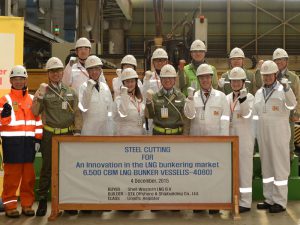
The steel cutting ceremony took place at the shipyard December 4, with representatives from Shell and the shipbuilder in attendance.The new LNG bunker vessel will be based at the port of Rotterdam in the Netherlands, and will load from the new LNG break bulk terminal currently under construction by the Gas Access to Europe terminal. Once ready, it will deliver to LNG-fueled vessels in northwest Europe. The vessel is also seagoing and, therefore, able to bunker customers at other locations.
Shell says the vessel will be “pioneering in design.” It will have a capacity to carry 6,500 cu. m of LNG fuel and will be highly efficient and maneuverable. Featuring an innovative transfer system and sub cooler unit, it will be able to load from large or small terminals and able to bunker a wide variety of customer vessels.
Finland’s Containerships Ltd Oy will be the launch customer for the vessel’s services, after signing an LNG supply agreement with Shell on November 24.
As we reported earlier, Containerships Ltd Oy is to charter the two 1,400 TEU LNG fueled containerships currently being built for Nordic Hamburg Group at China’s Yangzhou Guoyu Shipyard .
The vessels will receive LNG fuel from Shell at the port of Rotterdam, after the LNG bunker vessel becomes operational in mid-2017.”This is a significant landmark in bringing this innovative LNG bunker vessel with cutting-edge technology to reality,” said Dr Grahaeme Henderson, Vice President of Shell Shipping & Maritime.
“I am delighted to be working with STX on this project and Shell is proud to be leading in the development of LNG fuel in shipping.””The supply agreement between Shell and Containerships is another example of the marine LNG fuel supply chain coming together,” says Lauran Wetemans, Shell’s General Manager Downstream LNG. “Working together with customers like Containerships is critical to encourage the use of LNG as a fuel in the marine sector, and we’re committed to helping make the transition to LNG.”