icebreaking

Marcon brokers sale of icebreaking deck cargo barge

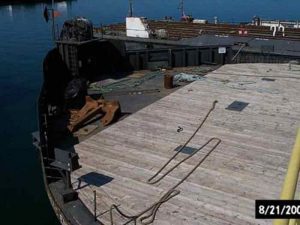
NOVEMBER 23, 2016 — Marcon International, Inc., Coupeville, WA, reports the sale of the 205.0′ x 90.0′ x 15.0′ depth former ice-strengthened, icebreaker/cargo barge Arctic Endeavor from Crowley Marine Services of Seattle,

  • News

MAN engines selected for Australian antarctic ship

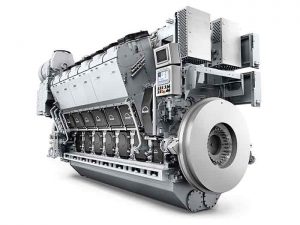
NOVEMBER 21, 2016 — MAN Diesel & Turbo has been selected to supply the main engines to a new, icebreaking, supply-and-research vessel for the Australian Antarctic Division (AAD). The two 16V32/44CR main

  • News

Canada looks for ideas on interim icebreaking capacity

NOVEMBER 17, 2016 — The Government of Canada today published an RFI seeking “information regarding the potential pricing and availability of interim measures to provide icebreaking and towing services.” It looks a

  • News

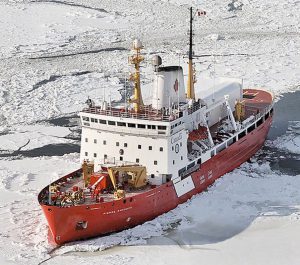
ABB to upgrade 38 year old Canadian icebreaker

APRIL 22, 2016 — ABB is to modernize a Canadian Coast Guard icebreaker, installing the latest hardware and software onboard the 38 year old Pierre Radisson under a C$3 million contract awarded

  • News

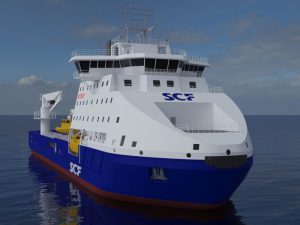
Russian customers keep Arctech Helsinki busy


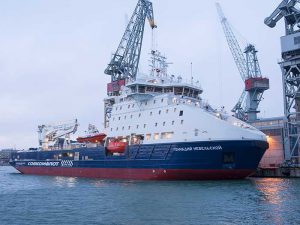
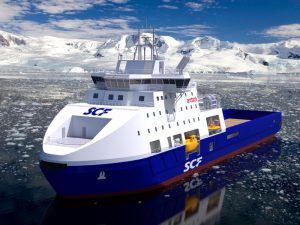
The icebreaking supply vessels are being built for Sovcomflot, Russia’s largest shipping company.

Last week’s keel laying saw the 221 first block of the first ship placed in the building dock as the starting point of the hull assembly.

The vessel will be capable of breaking through ice as thick as 1.5 meters and will be outfitted for emergency evacuation, rescue and fire fighting operations, oil spill response and platform support activities.

Once delivered, the vessel will serve in the Sakhalin-2 region energy production sites by transporting supplies and people between land bases and production platforms and protecting the production platforms from the impact of ice in the Sea of Okhotsk.

Sakhalin Energy Investment Company Ltd. (SEIC) operates the oil and gas field.

“Arctech has successfully built many similar kind of vessels for use in the rough weather conditions of the Sakhalin area. The series of vessels currently being built and designed at Arctech will further secure the energy production in the area,” says Esko Mustamäki, Managing Director of Arctech Helsinki Shipyard.

Measuring 100 m x 21.7 m, the vessel will be delivered to the client in the summer of 2016.

It vessel will be equipped with advanced Nordic environmental technology, such as a catalytic converter exhaust system and solutions for limiting underwater noise levels.

As well as increasing capacity for oil spill response, as well as emergency evacuation, in the the Sakhalin area, the vessel will be able to safely transport deck cargo, loose cargo, and liquid cargo in the integrated tanks below deck, and to carry production platform crew members as passengers regardless of weather and ice conditions.

The vessel has accommodations for 70 people – 28 crew members and 42 specialized staff members.

Baltic Icebreaker

The Baltic icebreaker Murmansk was delivered to Russia’s Vyborg Shipyard JSC, which will deliver it to customerRosmorport by year’s end.

The 119.8 m x 27.5 Murmansk is the second in a series of three vessels that the Russian Ministry of Transport ordered in 2012 from Vyborg Shipyard.

The basic design of the vessel and purchasing of major components was handled by Vyborg Shipyard. Arctech was responsible for the construction, outfitting and testing of the powerful vessel.

The main tasks of the vessel are icebreaking and assisting of heavy-tonnage vessels in ice, towing of vessels and other floating structures year-round in ice and open water.

The vessel will also be used for fire fighting on floating objects and other facilities, assisting vessels in distress in ice and open water and also for cargo transportation. The vessel is able to operate in temperatures as cold as -40°С and the maximum icebreaking capability is 1.5 m.

Murmansk 700

  • News

Australia names preferred tenderer for new icebreaker

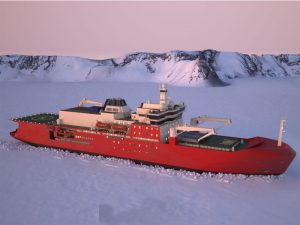
Computer–generated images and video of the new ship were showcased October 29 at an event attended by Prime Minister Malcolm Turnbull MP, at the AAD’s headquarters in Kingston, Tasmania.

The icebreaker, designed by Danish naval architect firm, Knud E. Hansen, will be built by DMS Maritime’s subcontractor Damen Schelde Naval Shipbuilding at Damen’s Galati, Romania, shipyard with commissioning expected in October 2019. DMS Maritime would then operate and maintain the vessel in support of the Australian Antarctic program on a long-term basis.

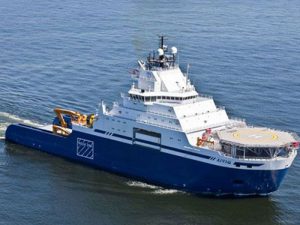
Replacing the Aurora Australis, which has been in service since 1989, the new icebreaker will be faster, larger, stronger and offer increased endurance.

According to a fact sheet released by the Australian Antarctic Division, the new icebreaker will have an icebreaking capability of 1.65 meters at 3 knots compared to the existing vessel’s 1.23 meters at 2.5 knots.

The vessel will supply Antarctic research stations with cargo, equipment and personnel, and will serve as a research ship with extensive laboratory facilities on board and a multi-beam bathymetric echo sounder to enable seafloor mapping,

The vessel is expected to accommodate 34 DMS Maritime crew and up to 116 AAD scientific personnel, and has the ability to embark up to four helicopters, two landing craft and a dedicated science tender. Its physical specification is expected to be 156 m in length and 23,400 tonnes displacement.

Media Factsheets 2


  • News

BV to class Yamal project LNG carriers

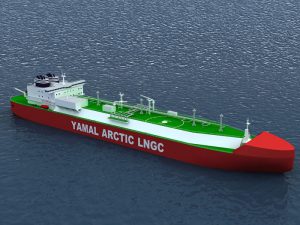
The 172,000 cu m LNG ships will be capable of operating in second year ice up to 2.5 m thick.

Yamal LNG has awarded Sovcomflot, MOL, Teekay and Dynagas one, three, six and five vessels respectively. They will be built to dual Bureau Veritas/Russian Register class.

Philippe Donche-Gay, Executive Vice President and head of BV’s Marine and Offshore Division says, “We have made extensive investments in research into ice loads and navigation in ice, working with major Russian institutions and Asian shipyards. This effort, coupled with our world-leading expertise in large LNG carriers gives us a strong technical base to class these highly sophisticated vessels.”

The 300 m vessels each have four GTT NO 96 membrane type LNG cargo tanks.

The tull form is designed with a moderate ice bow forward and a heavy ice-breaking profile aft. The ships are dual-acting, navigating in light ice or open sea bow first, then navigating astern to break heavy ice. The astern ice breaking mode is assisted by the unique podded propulsion system which consists of three pods delivering around 45 MW of power.

Separate engine rooms housing the diesel generator power plants will be encased in a double hull to give protection from the ice and a high level of redundancy.

The ships will be built to Russian Register Arc7 standard, equivalent to an intermediate level between Polar Class 3 and Polar Class 4 of Bureau Veritas rules, for year-round operation in second-year ice with old ice inclusions with ice thickness of 2.5 m.

The vessels will be highly winterized with Bureau Veritas winterization notation COLD (-45,-52) which means that the hull is prepared for operation in -45 Celsius ambient temperature and the equipment should be able to work at -52 Celsius.

Safety of the vessels and care for the environment will be enhanced by a forward and aft ice belt to add strength to the hull in key areas and a very detailed fatigue life analysis to ensure the structure can with withstand the expected extreme stresses for the life of the vessel. Bureau Veritas’ IceSTAR tool is being used to assess the hull ice loads.

  • News

APS tank level systems chosen for Sovcomflot newbuilds


The vessels are being built for Russia’s Sovcomflot and will serve in the North East Sakhalin Offshore region oil and gas field.

Designed to measure levels in ballast and service tanks and the vessel’s draft, TSS/BMS4 is a next generation electro-pneumatic system developed by API featuring improved modular design, enhanced capabilities and reduced costs.

The level measurement principle of TSS/BMS4 is based on periodic purging of compressed air from the system to the tank bottom through an air tube and measurement of the settled air pressure in the tube.