![Port Canaveral’s mobile harbor crane offloads a container from the M/V Whale Orca as part of a new international container service [Photo: Canaveral Port Authority]](https://www.marinelog.com/wp-content/uploads/2026/07/x1000w-Whale-Orca-MHC-Container-Lift-NCB6-SM-4-lower-res-300x225.jpg)
Ingalls expands distributed shipbuilding strategy to amphibious ships
Written by Nick Blenkey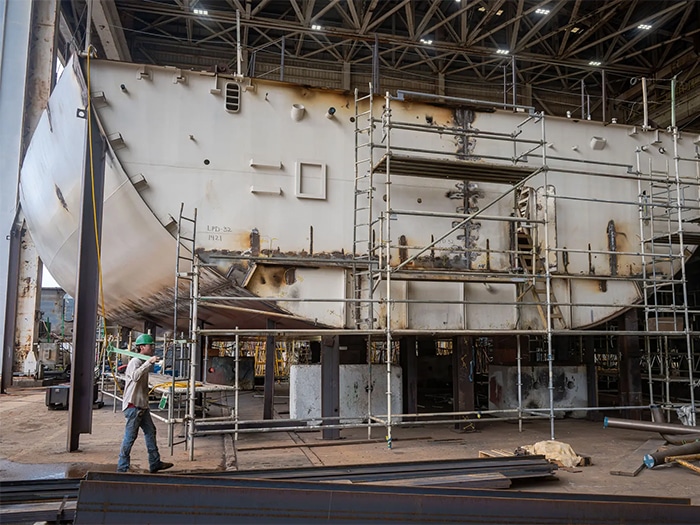
Photo: HII
HII’s (NYSE: HII) Ingalls Shipbuilding division has expanded its distributed shipbuilding strategy to include modular unit construction for the U.S. Navy’s amphibious transport dock program, beginning with Philadelphia (LPD 32). This expansion builds on the success of the distributed shipbuilding strategy in HII’s destroyer program.
“Expanding distributed shipbuilding into the LPD program is a critical step in scaling capacity to meet rising fleet demand,” said Brian Blanchette, Ingalls Shipbuilding president. “By shifting selected structural units to trusted partners, just as we’ve successfully done in the Flight III destroyer program, we’re enabling more parallel construction and freeing our Ingalls team to focus on the complex assembly and integration work that only a major shipyard can perform.”
Ingalls is extending distributed construction to amphibious ships, with eight structural units for Philadelphia (LPD 32) awarded to two partners and already in early production. This approach builds on the efficiencies demonstrated in the Flight III destroyer program, where partner‑built units for Thad Cochran (DDG 135) arrived ahead of the ship’s October 2025 keel authentication and supported early‑sequence work. Ingalls aims to replicate those efficiencies across the amphibious shipbuilding line.
Looking ahead, says HII, distributed shipbuilding remains central to meeting Navy fleet demand. Last year, HII doubled its distributed shipbuilding workload, and the company plans to increase outsourced shipbuilding hours by another 30% in 2026, with amphibs representing a significant share of that growth.
Categories: News, Shipyard News

![Shortly after execution of the contracts on July 22, HMBS Rolly Gray, a Damen Stan Patrol 4207 offshore patrol vessel, was lifted from the water at Damen Shipyards in Gorinchem, the Netherlands, to commence its scheduled refit and maintenance program. [Photo: Damen]](https://www.marinelog.com/wp-content/uploads/2026/07/Damen-to-refit-four-Royal-Bahamas-Defence-Force-vessels-31-300x225.jpg)
![Units fabricated by Ferguson Marine were loaded onto Coastworks barge for transport to BAE Systems. [Photo: Ferguson Marine]](https://www.marinelog.com/wp-content/uploads/2026/07/FMPG-x-BAE-July-2026-4-300x225.jpg)