VIDEO: First look at Molslinjen’s 1,500 passenger battery-electric ferries
Written by Nick Blenkey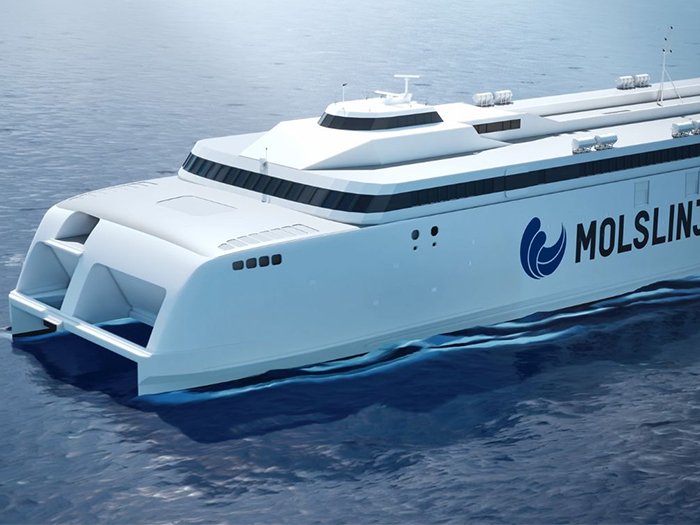
Image: Incat Tasmania
The boundaries of how large, fast and long range battery-powered vessels can get keep getting extended and Incat Tasmania, Wärtsilä and Denmark’s Molslinjen have now released a new collaborative video highlighting one of the most significant electric ferry projects underway worldwide,
Premiered at the 2026 Shippax Conference in Italy, the video gives a first look at the technology and innovation behind three 129-meter battery-electric ferries currently under construction at Incat’s Hobart, Tasmania, shipyard. Once delivered, the vessels will be the largest electric ferries operating in Europe.
The project brings together leading expertise in shipbuilding, propulsion technology and ferry operations, demonstrating what is now possible at scale as the industry accelerates toward low-emission maritime transport.
“This project shows that large-scale, high-speed electric ferries are no longer a future concept, they are being delivered today,” said Robert Clifford, chairman of Incat Tasmania. “Previously, electric ferries have been limited to short, low-speed routes. What we’re delivering now is a new class of vessel – high-speed, high-capacity, low-emission ferries capable of operating on some of the world’s busiest routes.
“At Incat, we’ve spent decades pushing the boundaries of what’s possible in shipbuilding. Today, we’re applying that experience to lead the transition to electric, working alongside world-class partners to deliver vessels at a scale the industry hasn’t seen before.
“What this project demonstrates is not just what can be built, but what can be achieved when shipbuilders, operators and technology partners work together to deliver the future of maritime transport.”
Molslinjen CEO Carsten Jensen said the project is a critical step in the company’s decarbonisation journey and a major advancement in ferry operations.
“This is a landmark project for Molslinjen and for the passengers we serve,” Jensen said. “These vessels will operate at speeds of up to 40 knots, carry up to 1,500 passengers and be capable of rapid turnaround through high-capacity charging in port – delivering faster, cleaner and more efficient transport across the busy Kattegat route. Working with Incat and Wärtsilä, we are demonstrating that sustainable ferry transport can be delivered at scale, without compromising performance, reliability or passenger experience.”
Roger Holm, Wärtsilä Marine’s president & Wärtsilä Corporation EVP, said the collaboration highlights the importance of integrated technology solutions in enabling the transition to sustainable shipping.
“The shift to electric propulsion requires close collaboration across the entire maritime chain,” Holm said.
“Through our partnership with Incat and Molslinjen, we are delivering advanced, fully integrated energy and propulsion systems that make high-speed, large-scale electric ferry operations possible.
“Achieving this level of performance – including speeds of up to 40 knots on fully electric vessels of this size – represents a major step forward for the industry and sets a new benchmark for sustainable ferry transport.”
The construction of the three vessels forms part of the largest electrification project at sea, with all three ferries currently under construction in Hobart.
Once complete, the vessels will enter service in Denmark, supporting Molslinjen’s commitment to sustainable, high-performance transport while connecting communities across one of Europe’s busiest ferry corridors.