VIDEO: First Anemoi rotor sails fitted on bulker pass 8-year milestone
Written by Nick Blenkey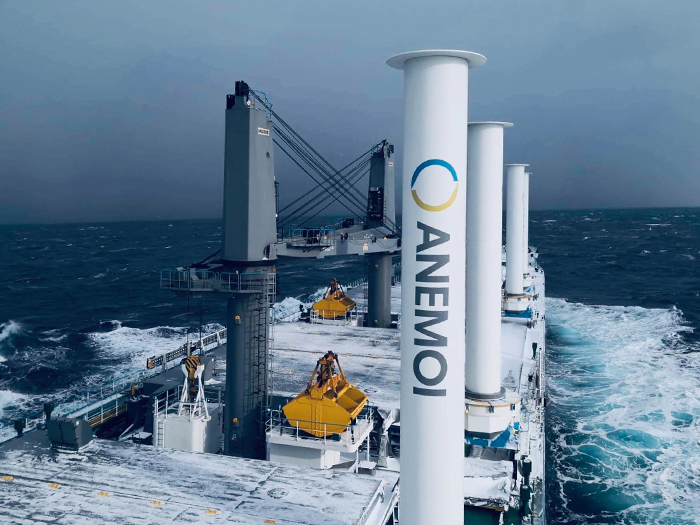
Photo: Anemoi
Anemoi Marine Technologies has marked a major milestone. M/V Afros, the world’s first bulk carrier fitted with Anemoi rotor sails, has successfully completed its second intermediate survey after more than eight years of continuous operation.
Carried out by Lloyd’s Register at Jiangsu Watts Energy & Engineering in Qidong, China, last month, the survey confirmed that the vessel’s four rotor sails remain structurally sound and free of operational issues, providing independent verification of the long-term durability and reliability of Anemoi’s rotor sails over an extended operational lifecycle.
Installed in January 2018 on-board the 64,000 DWT geared Ultramax bulk carrier, owned by Blue Planet Shipping, the system has since provided eight years of real-world evidence that wind-assisted propulsion systems (WAPS) can deliver sustained fuel savings, emissions reductions and high operational availability in everyday commercial service.
Anemoi says that the Afros‘s eight-year milestone is one of the most significant long-term operational proof points yet achieved in the WAPS sector, demonstrating that rotor sails can perform reliably across a vessel’s lifecycle while integrating seamlessly into standard trading patterns.
“The successful completion of Afros’ second intermediate survey is a landmark moment not only for Anemoi, but for the wider wind propulsion sector.,” said Nick Contopoulos, co-founder and chief commercial officer at Anemoi. “Independent confirmation from Lloyd’s Register after more than eight years of operation demonstrates that Anemoi rotor sails are not simply an innovative decarbonization concept, they are a durable, practical and commercially deployable technology for the global fleet. This level of long-term operational validation significantly reduces uncertainty for shipowners considering wind-assisted propulsion and reinforces the role rotor sails can play in improving vessel efficiency and supporting compliance with tightening emissions regulations.”
According to Anemoi, over 154 voyages, the rotor sails on the Afros have delivered 1,340 tonnes of fuel savings and 4,980 tonnes of well-to-wake CO2 reductions, while maintaining greater than 95% operational availability since installation. The system has also completed about 200 port calls, demonstrating strong compatibility with commercial trading requirements and port operations.
These results are particularly significant given that the rotor sails installed on Afros were much smaller than those that Anemoi deploys today, measuring just two meters in diameter and 16 meters in height. When scaled to the five meter diameter, 35 meter high rotor sails used on current projects, the Afros results equate to approximately 1.33 tonnes of fuel saved per sail per operating day, closely matching the performance being achieved on Anemoi’s latest installations. The company says that this strong correlation demonstrates that the savings proven on Afros scale reliably to larger commercial systems, providing further validation of Anemoi’s current rotor sail technology.
As a result of the efficiency gains achieved, Afros reduced its IMO Energy Efficiency Existing Ship Index (EEXI) rating by approximately 4.2%, extending compliance with international energy efficiency requirements and enhancing the vessel’s regulatory profile.
“Since it entered service, Afros has served 32 different charterers, which shows that its rotor sail system is welcomed by commercial customers and has been no hindrance to operating on the spot market,” said Nikos Apodiakos, Blue Planet Shipping’s managing director. “We are naturally pleased with the clean bill of health for the rotor sail system and positive about earnings and emissions saving potential for the remainder of the vessel’s active life.”

The Afros installation also pioneered Anemoi’s longitudinal rail deployment system, enabling itsrotor sails to be repositioned during cargo handling operations so that the geared bulk carrier retains full cargo flexibility. This deployment concept has since been adopted on current Anemoi projects, underlining the lasting relevance of the original Afros installation. The vessel has traded with 32 different charterers since entering service, underscoring that the installation of rotor sails has created no barriers to spot market employment while improving vessel energy efficiency performance.
“One of the key issues with any maturing technology is its long-term durability and reliability in real-world conditions,” said John Prosilias, lead client relationship manager at Lloyd’s Register. “We are therefore very satisfied to report no issues during our recent survey of the rotor sails on M/V Afros, which represents an important example of successful long-term operation of wind-assisted propulsion systems.”
With more than eight years of independently verified operational history, says Anemoi, Afros now stands as one of the maritime industry’s clearest demonstrations that WAPS have moved beyond pilot-stage deployment into proven long-term commercial operation.