Navy releases its FY 2027 Shipbuilding Plan
Written by Marine Log Staff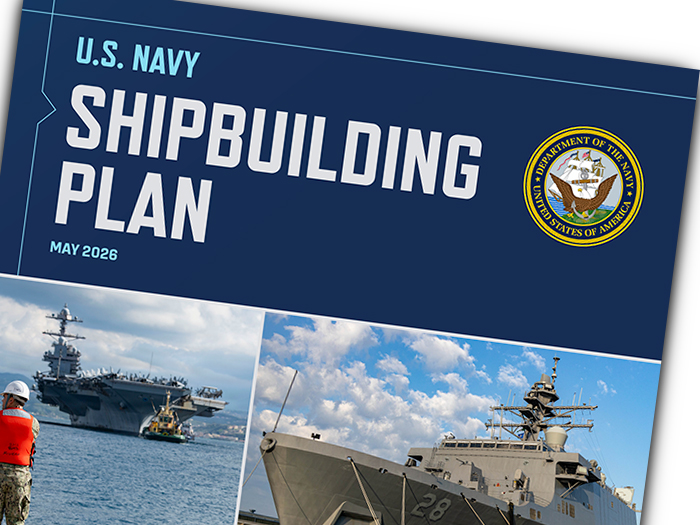
The Department of the Navy has released its Fiscal Year 2027 Shipbuilding Plan, outlining the Administration’s long-term strategy to expand fleet capacity, strengthen the maritime industrial base, and deliver a more capable, ready, and lethal naval force.
“The United States is at a strategic inflection point, and rebuilding American maritime dominance requires urgency, accountability, and sustained commitment,” said Acting Secretary of the Navy Hung Cao. “This Shipbuilding Plan provides a roadmap for the Golden Fleet, to grow a larger, more capable Fleet while revitalizing the industrial base, strengthening our workforce, and ensuring our Sailors and Marines have the platforms they need to defeat any adversary for decades to come.”
The Navy says that the plan reflects a shift toward disciplined execution, industrial base revitalization, and delivery of a more capable, ready, and lethal naval force. The plan prioritizes a balanced high-low mix of platforms and emerging capabilities, strengthens workforce and shipyard capacity, and reinforces accountability to deliver ships on time.
The plan also reflects lessons learned from current operations, evolving global threats, and the need to rapidly adapt force design and acquisition approaches.
The Department noted that the plan includes adjustments to future force structure priorities and select future platforms, informed by operational assessments, industrial base analysis, affordability considerations, and Department-wide strategic planning. The Department says that it will continue refining future force structure and shipbuilding requirements in close consultation with Congress and stakeholders.
“The President’s budget request for fiscal year 2027 makes a $65.8 billion generational investment in U.S. Navy shipbuilding. This plan details these investments and the Administration’s 30-year investment plan to expand our nation’s Navy shipbuilding capacity and deliver the Golden Fleet,” said Jason Potter, Performing the Duties of Assistant Secretary of the Navy for Research, Development and Acquisition (ASN RDA). “At the same time, the Navy is holding industry more accountable for both meeting contractual requirements and making capital investments to support this expansion. We are laser-focused on growing the fleet and delivering the ships that our Sailors and Marines depend on.”
SHIPBUILDING
Here are some extracts on what the plan says about shipbuilding:
“The Navy’s acquisition system grew administratively, but eroded operationally. Requirements expanded during execution, mature designs were modified and evolved by the Navy, and cost estimates and construction schedules were overly optimistic. As a result, schedules slipped, costs compounded, and the American taxpayer absorbed the bill while Sailors, Marines, and the Department of the Navy’s readiness are left materially impacted.
“The Government Accountability Office, Congressional Research Service, and our own internal reviews have identified these issues repeatedly for more than three decades. Those lessons learned are the foundation of this plan. Carrying forward what works and correcting what does not. This also means taking a full lifecycle view from initial procurement through sustainment and reforming acquisition practices that have historically deferred cost and readiness risk into the out-years.”
“The Fleet of the Future is a high-low mix of platforms. It must also be a buildable and sustainable combination of platforms that are maintained to end of their service life. High-end platforms remain essential, but they must be complemented by systems that can be produced at volume and adapted in real time. That includes a range of unmanned systems operating everywhere from the seabed to space, fully integrated with current force structure. The high- low mix is how we increase new market entrants and competition within the industrial base.”
“Today, roughly 10% of shipbuilding work is performed at distributed sites. Our goal is 50%. New hulls will prioritize modular, digital designs that enable distributed shipbuilding across multiple yards and suppliers. Modular construction expands production capacity, reduces bottlenecks, and accelerates delivery by leveraging industrial capability across the country, not just at a handful of legacy shipyards. It also provides flexibility to ensure we are not locking capability into a single hull, but building systems that can evolve, integrate, and expand across the Fleet.
“Every state in the nation has a role. We are expanding opportunities for the manufacturing base from coast to coast across the industrial heartland to support the Fleet of the Future. This is how we move from stagnation to growth, from delay to delivery, and from a constrained industrial base to one capable of building the Fleet of the Future at the pace and throughput the nation requires.”
- The full Fiscal Year 2027 Shipbuilding Plan is available HERE
Categories: News