NTSB: O-ring seal failure caused $5.5M engine room fire
Written by Nick Blenkey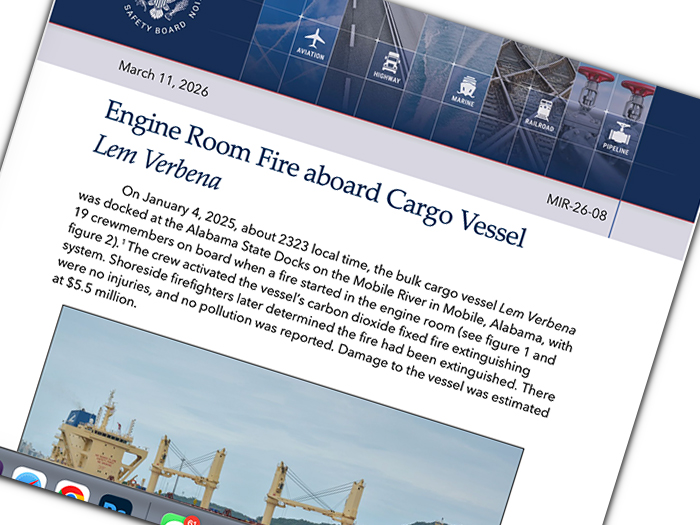
The National Transportation Safety Board (NTSB) has found that an O-ring seal failure caused a January 24, 2026, engine room fire on the 2020-built, 655-foot, ultramax bulk carrier Lem Verbena while it was docked at the Alabama State Docks on the Mobile River in Mobile, Ala., with 19 crewmembers on board.
The fire started at about 11.23 p.m. local time and the crew activated the vessel’s carbon dioxide fixed fire extinguishing system. Shoreside firefighters later determined the fire had been extinguished.
There were no injuries, and no pollution was reported. Damage to the vessel was estimated at $5.5 million.
The NTSB determined that the probable cause of the fire was the failure of an O-ring seal on the composite boiler burner unit oil fittings block due to the radial misalignment of the two fuel ports on the block modules, causing pressurized diesel fuel to atomize and ignite on a nearby hot surface.
In its full report, the NTSB notes that the vessel, owned by owned by Banc of America Leasing & Capital LLC and operated by Lemissoler Shipmanagement, had an engine room was comprised of two levels: the upper engine room and the lower engine room.
The Lem Verbena‘s boiler created steam using two methods: a furnace heated by a burner unit fired from diesel oil, and waste heat from the main engine or the No. 2 and No. 3 diesel generator exhausts, which ran through vertical tubes within the boiler (the no. 1 diesel generator was not part of the boiler system). A portion of the No. 2 and No. 3 generator exhaust pipes ran directly below the burner unit in the engine room upper platform and through metal grating before it entered the boiler.
ANALYSIS
In its analysis, the NTSB report notes that after the fire, the Lem Verbena operating company and Coast Guard investigators found that an O-ring on the oil fittings block upper module of the boiler’s burner unit had become pinched on the fuel port for the lower module.
“This O-ring,” says the report, “intended to provide a seal between the corresponding fuel ports on the lower and upper modules (when bolted together) to contain pressurized fuel as it moved through the system to the burner unit igniter. O-rings are designed to protect against leaks by lying flat and becoming compressed between two machinery surfaces that are secured together, typically containing a material under pressure. If any portion of the O-ring does not lay flat between the two surfaces, full compression of the O-ring cannot be achieved. This weakens the seal created by the O-ring and increases the likelihood of failure.
“In this case, a portion of the O-ring on the upper module overlapped into the fuel port on the lower module, preventing the O-ring from lying flat and providing an adequate seal. This was because the two modules’ ports were not aligned radially and created an uneven clearance gap when the ports were bolted together. This gap could not be seen or detected when the ports were bolted together.
Investigators could not determine whether the block modules had been disassembled since they were manufactured or initially installed on the vessel.
“Additionally, because of a software settings error discovered on the boiler unit’s SD card, the fuel pump did not shut down between cycles as intended and the pinched O-ring was exposed to constant pressure. The operating company found that the O-ring’s exposure to hot, pressurized fuel caused accelerated degradation of the O-ring, ultimately causing the seal to fail. Over time, the pinched portion of the O-ring was weakened until its seal failed under the fuel pressure in the ports. Because the fuel pump remained running even if the boiler burner was not firing and, thus, the fuel system was always pressurized, pressurized fuel about 43 pounds per square inch would have atomized around the boiler and ignited on a nearby hot surface, causing the fire.
“Due to a lack of evidence, the exact ignition source and sequence (what caused the ignition and how the fire spread) could not be determined. However, post-fire damage assessments showed the most significant fire damage on the fuel-handling side of the burner unit and the immediately adjacent area. Significant fire damage was also found in the engine room upper platform, a deck below the boiler. Possible ignition sources in those areas included the boiler and burner unit, which may have still been hot from a previous cycle (completed about 5 minutes before the fire), or the running No. 2 generator’s exhaust, which ran into the boiler from directly below it. While the exhaust was covered with protective lagging, it is possible that the atomized fuel contacted an unprotected section of the exhaust pipe and ignited.”
PROBABLE CAUSE
The NTSB determined that the probable cause of the fire on the bulk carrier Lem Verbena was the failure of an O-ring seal on the composite boiler burner unit oil fittings block due to the radial misalignment of the two fuel ports on the block modules, causing pressurized diesel fuel to atomize and ignite on a nearby hot surface.
- Read the full NTSB report HERE.
Categories: News, Safety and Security
![Scillionian IV at the Piriou shipyard in Vietnam. [Photo: Isles of Scilly Steamship Group]](https://www.marinelog.com/wp-content/uploads/2026/07/C439-launching-53-300x225.jpg)
![Sleipnir [Photo: Heerema Marine Contractors]](https://www.marinelog.com/wp-content/uploads/2026/07/sleipniratsea-300x225.jpg)