Onboard carbon capture as a transitional option for shipping
Written by Marine Log Staff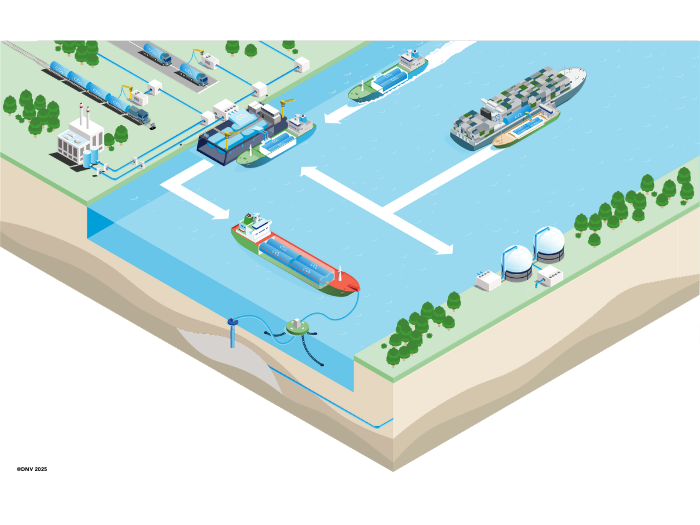
Sponsored Content: As pressure mounts on shipowners to reduce emissions while maintaining operational flexibility, onboard carbon capture is drawing serious attention across the maritime sector. Many vessels will continue operating on carbon based fuels for years to come, even as alternative fuels scale and infrastructure develops. That reality is prompting a closer look at technologies that can reduce net CO₂ emissions without requiring an immediate and costly fuel transition.

In this Q&A, Heather Ervin speaks with Craig Koehne, regional president of the Americas for DNV Maritime, about the technical maturity, regulatory hurdles and infrastructure needs shaping onboard carbon capture systems. From post combustion retrofits to integrated pre combustion concepts and shoreside CCUS networks, Koehne outlines where the technology stands today and how it may fit into a broader decarbonization strategy for the global fleet.
Heather Ervin (HE): From DNV’s perspective, what is driving the growing interest in onboard carbon capture for shipping?
Craig Koehne (CK): Many ships will continue to run on carbon‑based fuels for some time because low and zero-carbon fuels are still scarce and come with higher delivered costs. Growing interest in onboard carbon capture can be linked to owners looking for a transitional option they can implement on existing ships while alternative fuel pathways scale. Onboard carbon capture systems (OCCS), connected to a verified ship‑to‑shore chain of custody, can offer an additional pathway to reduce net CO₂ emissions while fuel supply and infrastructure mature.
Interest is also influenced by broader developments in carbon capture beyond shipping. We see carbon capture and storage (CCS) progressing globally, with the United States having long experience and other regions now moving to scale technology, infrastructure, and policy frameworks. This broader momentum is reinforcing CCS as part of emerging carbon management systems rather than purely a niche solution. For shipowners, this raises questions about if and how maritime applications could eventually connect to these value chains. But it is very important to note that key barriers remain, particularly around regulation and infrastructure, and that onboard carbon capture should be viewed as one element in a wider portfolio of decarbonization measures rather than a standalone answer.
HE: How do post-combustion and pre-combustion onboard carbon capture systems compare in terms of maturity and suitability for different vessel types?
CK: Post‑combustion and pre‑combustion onboard carbon capture systems are at different stages of development and tend to align with different vessel concepts and decision contexts. Post‑combustion systems are further along in development. They build on amine‑based systems adapted from land use and fit conventional engine rooms, which is why they tend to be the near‑term choice for retrofits.
Pre‑combustion approaches are linked to fuel enhancement with hydrogen, or fuel reforming and fuel cells. It suits LNG‑based newbuild concepts where hydrogen use and carbon separation can be combined, but it is less proven in commercial operation across the fleet today.
Capture and conditioning of CO2 require energy, which affects net emissions abatement. Space is another factor influencing where and how capture units, treatment equipment, and temporary storage can be accommodated onboard. Space is constrained on a bulk carrier or a cruise ship. LNG carriers can exploit cooling loads and deck area. Tankers may exploit deck area for placing the treatment skids and Type-C storage tanks. RoPax designs carry additional constraints around layout and weight limitations. Different factors will vary across different vessel designs and operational profiles, which means onboard carbon capture needs to be evaluated on a case-by-case basis rather than assumed to be broadly applicable across the fleet.
HE: Onboard carbon capture is often described as a way to continue using conventional maritime fuels. How realistic is it as a near- to mid-term decarbonization option?
CK: Onboard carbon capture has moved beyond a purely conceptual stage. Pilot projects have demonstrated that the technology is technically feasible in a maritime environment, and in in a few recent cases the full ship‑to‑shore value chain have been demonstrated, with results documented by the Global Centre for Maritime Decarbonization. These projects show that CO₂ can be captured onboard, handled, and transferred into downstream pathways under controlled conditions.
At the same time, two structural challenges remain. The first is regulation: Today there is still limited clarity on how captured CO₂ transferred to downstream value chains should be accounted for and credited under maritime and climate regulations. The second challenge is infrastructure: This is not limited to port facilities for offloading CO₂ but extends to the wider carbon capture and storage ecosystem, which is still at an early stage of development in most regions. The United States is a partial exception, given its more established CCS infrastructure, but the extent to which maritime applications could connect to these systems has not yet been assessed.
HE: What are the main design, space, and operational challenges involved in integrating carbon capture and CO₂ storage systems onboard ships?
CK: The challenge is integrating onboard the capture, treatment, liquefaction, and storage plants without disrupting vessel processes or operational limits, while ensuring emission reduction at most operating modes of the ship.
Exhaust cleaning must be designed so that engine back‑pressure stays within limits, while CO2 product treatment and storage must have dedicated safeguards for gas detection, leak control and emergency shutdown.
Space is at a premium, since capture skids, liquefaction equipment, and Type-C storage tanks may compete with cargo capacity, depending on the vessel general arrangement and intended emission reduction performance. Tank location and foundations may also affect stability, which makes OCC more suited for larger tankers and LNG carriers that tend to have more usable deck space, while bulker and passenger designs face tighter power and layout constraints. Large containerships can exploit their variable loading factor and their big electricity propulsion capacity to optimize the system’s CO2 emissions reduction capacity.
Depending on the technology type, day‑to‑day OCCS operations must account for energy demand and consumables. Systems design must account for low‑temperature hazards around liquid carbon dioxide handling storage, calling for safety procedures and appropriate seafarer training.
HE: How important is the development of shoreside CCUS infrastructure to the success of onboard carbon capture, and where are the biggest gaps today?
CK: A ship can only capture as much carbon as it has room to store. Amongst the biggest hurdles of scaling up the technology is the lack of a global network of ports where ships can offload captured CO2. Many hubs will need dedicated offloading systems, intermediate tanks, and clear operating procedures that fit port rotations.
There is also a clear regulatory gap. Even where capture onboard and handling ashore are technically feasible, regulation has not yet caught up to consistently recognize, credit, and account for captured CO₂ once it leaves the ship. Clear rules are needed on chain of custody, product specifications, verification, and permanence, including how emissions reductions are allocated once CO₂ is transferred to a downstream transport, storage, or utilization process.
In the Americas, the prospect is encouraging since carbon handling on land and storage developments are established and advancing. We need scaled-up reception capacity, new business models and services that connect vessels to those networks. Local governments have the opportunity to create additional initiatives that can further drive CCUS deployment that might also enable economic growth, energy security, and competitiveness.
HE: Looking ahead, what role do you see onboard carbon capture playing in meeting global shipping decarbonization targets?
CK: It may help parts of the existing fleet reduce net emissions where fuel switching is constrained, but its contribution will depend on parallel progress in regulation and end‑to‑end CCUS infrastructure. Ultimately, it sits alongside energy efficiency and alternative fuels as part of a broader portfolio, not as a standalone pathway.
Categories: Environment