VIDEO: New NWF study highlights the advantages of inland waterways employment
Written by Nick Blenkey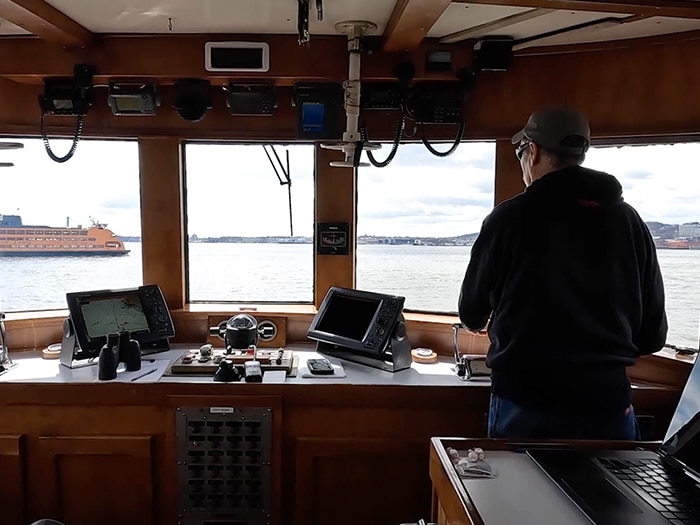
creengrab from NWF video
The National Waterways Foundation (NWF) has commissioned and released a new study, “Evaluating Employment by Inland Waterways Operators,” conducted by the Center for Ports and Waterways, Texas A&M Transportation Institute.
A video and a brochure that highlight the advantages of working in the inland waterways industry were also developed in conjunction with the study and will be provided to school guidance counselors around the country.
Supply chain disruptions since the COVID-19 pandemic have intensified the focus on transportation workforce availability and employment conditions. The new NWF study examines employment characteristics of the inland waterways industry, comparing it to the rail and trucking sectors, while quantifying the economic impact of inland waterways jobs on the national economy.
Compared to employment in the trucking and rail sectors, waterways positions require no prior experience, and offer advancement based on merit, the opportunity to acquire additional certifications, and reliable scheduling of work periods. The trucking sector currently faces a critical driver shortage, high turnover rates, irregular work schedules, and health issues arising from the sedentary nature of the job. Railroad jobs have similar issues with irregular, unpredictable work schedules, and have faced significant reductions in the workforce in recent years.
Inland waterways employment also offers several other advantages, including safety, compensation, work-life balance, and job security. Inland waterways transportation is significantly safer than rail or trucking, with 1/25th the fatalities of rail operations, and 1/120th the fatalities of trucking operations. Median compensation for inland waterway transportation jobs exceeds trucking wages and is near rail wages, while offering a more predictable work schedule, with lower turnover. The sector also offers job security as these jobs cannot easily be automated, and demand for these positions is expected to continue to grow in the future.
An IMPLAN-based economic impact analysis was conducted to determine the impacts of waterways employment on the national economy. Bureau of Labor Statistics (BLS) data including employment numbers and wages were used as inputs into the IMPLAN model. Inland waterways jobs have a total economic output, including direct, indirect, and induced impacts, of $36.1 billion annually, contribute $10.2 billion to labor income, and support 127,500 jobs. Additionally, inland waterways employment contributes $4.2 billion in tax revenue nationally.
“National Waterways Foundation is proud to have commissioned this study by Texas Transportation Institute that finds inland waterways employment offers several advantages over similar jobs in other transportation sectors, Our industry also generates substantial national economic benefits while providing entry-level positions that can develop into skilled careers without requiring a college degree,” said Cherrie Felder, Chair of the National Waterways Foundation. “NWF’s work continues to create conversation around the criticality of the U.S. inland waterways, which is the most energy efficient, safe, and environmentally sound surface mode to transport America’s critical commodities,” she continued.
- Download the study HERE
Categories: Inland and Coastal, News, Video

![Steerprop has signed a repeat contract with Turkey’s Med Marine shipyard to deliver the propulsors for a third RAscal 2100 harbour tug designed by Robert Allan. [Image: Sterprop]](https://www.marinelog.com/wp-content/uploads/2026/07/TUG_MED-A2150_profile-300x225.jpg)