House and Senate committees pass WRDA 2026
Written by Marine Log Staff
Image (C) Architect of the Capitol
On July 14, the House Transportation and Infrastructure Committee unanimously approved H.R. 9497, the Water Resources Development Act (WRDA) of 2026. On July 15, the Senate Environment and Public Works Committee also voted unanimously to pass S. 4949, the Senate version of the WRDA.
The Soy Transportation Coalition (STC) notes that Congress aspires to pass WRDA legislation every two years, which it has successfully done since 2014. WRDA bills provide authorization for improvements for the nation’s inland waterways, ports and harbors, flood management, and other areas of water resources infrastructure.
“In this era of extreme partisan acrimony, it remains encouraging that Congress continues to demonstrate an ability to work in a bipartisan manner and pass legislation that helps maintain and improve our maritime assets for the benefit of American farmers and the broader economy,” says the coalition. Following the two key committee approvals, both pieces of legislation will need to be passed by the full House and Senate. Any differences between the two bills would then need to be reconciled via a conference committee. The full House and Senate would then need to revisit and approve the conference report before it would ultimately head to the President for signature.
Each link in the soybean supply chain is accompanied by a cost per bushel to transport the product from one location to another. When adding each of these costs – truck, rail, barge, ocean, etc. – a total transportation cost emerges. The higher that cost number is, the more our transportation system becomes an obstacle to farmer profitability. The lower that cost number is, the more our transportation system facilitates farmer profitability. Therefore, the goal of the Soy Transportation Coalition (STC) when formulating its transportation strategy is to promote “subtraction math” vs. “addition math.”
“Every initiative we promote and pursue should contribute to the ultimate outcome of subtracting the number of cents per bushel or ton of transporting soybeans and soy products,” says the coalition. “When we do so, U.S. soybean farmers are better positioned to be profitable. We therefore applaud the passage of a biennial WRDA legislation since it better positions the U.S. soybean farmer to benefit from a well-maintained and capitalized system of inland waterways (including locks and dams) and ports.”
COLUMBIA RIVER CHANNEL
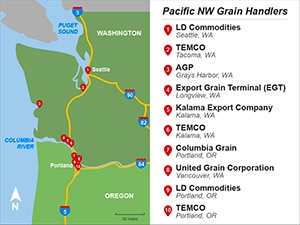
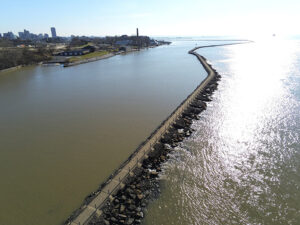
A particular issue of importance to soybean farmers that was included – though with different legislative language – in both the House and Senate versions is an effort to maintain the Columbia River shipping channel – the segment of the river from Portland to the Pacific Ocean – at its current depth of 43 feet
The Pacific Northwest (PNW) is the second leading export region (after the Mississippi Gulf region) for U.S. soybeans. A considerable volume of those PNW exports departs from a collection of terminals located along the Columbia River (see graphic). To maintain the shipping channel at 43 feet over the next 20 years, the U.S. Army Corps of Engineers and Columbia River ports are finalizing a Dredged Material Management Plan (DMMP). A part of the DMMP involves the utilization of confined aquatic structures for in-water disposal of dredged material given the scarcity of disposal sites adjacent to the river. However, these structures will involve a significant cost, which unless addressed by Congress, will severely limit the port authorities along the Columbia River shipping channel being able to maintain the river at 43 feet.
According to the ports, every foot of reduced water depth will decrease cargo volume on ocean vessels by $1 million. The STC and other agricultural organizations supported the effort by the Columbia River ports to have the federal government assume more of the cost of constructing the confined aquatic structures for dredging activities. While the precise language related to this issue differs between the House and Senate versions, both take meaningful steps for the federal government to assume more of the costs of maintaining this shipping channel that has significant impact on the national economy, including the soybean industry.
LOCK AND DAM PROJECTS
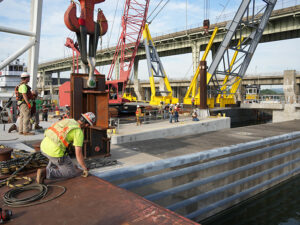
“Both the House and Senate versions also include language related to more effective project delivery for U.S. Army Corps of Engineers projects,” says the Soy Transportation Coalition. “Making meaningful progress in this area is a significant priority for stakeholders, including soybean farmers. A number of current lock and dam construction projects are experiencing cost overruns in excess of 200%. This is unacceptable. Our nation will never have the funding available to maintain our inventory of locks and dams as long as these cost overruns are commonplace. Having robust levels of investment in these projects are essential, but it is even more critical to practice better stewardship of existing taxpayer dollars.”