![Artemis EF-12 Pilot: the world’s first fully electric hydrofoil pilot boat [Photo: Artemis Technologies]](https://www.marinelog.com/wp-content/uploads/2026/06/Artemis-Technologies-Launches-the-Worlds-First-100-Electr1-2-300x225.jpg)
Kongsberg Maritime to lead AWESOME new wind propulsion project
Written by Nick Blenkey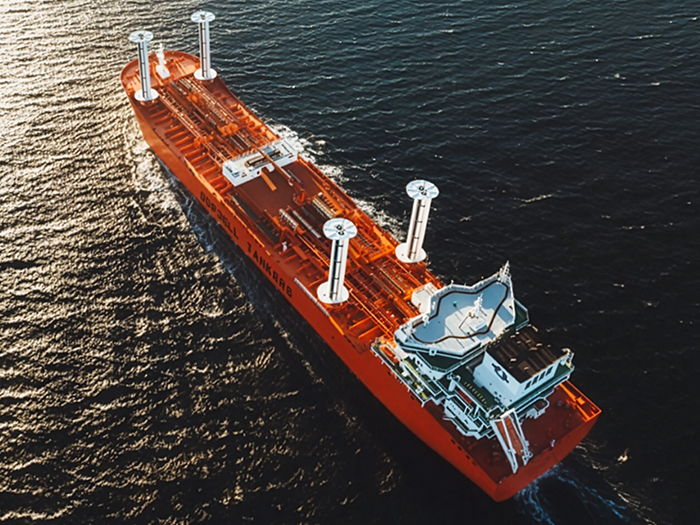
Bow Horizon [Image: Kongsberg Maritime, courtesy of Ruben Soltvedt]
Wind-assisted propulsion works, but how well? An EU project aims to find out. Supported by 14 European partners, Kongsberg Maritime is to lead a new Horizon Europe project called AWESOME (Advanced Wind Energy System Optimization & Monitoring for Efficiency). The aim is to deliver validated tools, standardized methodologies and real-world performance data to reduce uncertainty around wind-assisted propulsion systems (WAPS). This would enable shipowners and regulators to make informed decisions, lowering investment risk and accelerating the adoption of cost-effective emission reduction solutions in shipping.
The project brings together industry, clusters and research institutions to support the transition to low- and zero-emission shipping. AWESOME tackles technical, operational and regulatory barriers that still limit wider deployment of wind propulsion.
“Wind-assisted propulsion is one of the most attractive pathways to compliant, cost-effective shipping. We believe AWESOME represents a major step forward in scaling this technology”, says Kjerstin Kleyne Braaten, SVP emerging solutions at Kongsberg Maritime.
By combining transparent performance verification with holistic control and automation, the project will enable fleets to meet emerging frameworks such as FuelEU Maritime and future IMO standards. This allows shipowners to postpone the adoption of costly low carbon fuels.
Reducing risk and scaling solutions
Adoption of WAPS has been slowed by uncertainty over performance, cost and operational impact. AWESOME will tackle these challenges by delivering validated performance data and decision-support tools that strengthen confidence in investment decisions.
A central element of the project is the use of two full-scale demonstrators—one retrofit and one newbuild. The retrofit case, one of Odfjell’s chemical tankers, will show how WAPS can be integrated into existing vessels, while the newbuild, Neoliner Origin (Neoline), will demonstrate how the technology can be optimised from the design stage.
Neoliner Origin: The world’s first hybrid commercial RoRo sailing vessel is designed around two 76-metre Solidsail rigs from Chantiers de l’Atlantique.
Together, says Kongsberg Maritime, these vessels will allow the consortium to validate performance models, test advanced methods for measuring thrust and energy savings, and assess long-term operational behaviour under real operating conditions. These demonstrators will provide robust real-world data across vessel types and operating conditions, helping the industry reduce risk and accelerate deployment at scale.
“Wind-assisted propulsion is already delivering real results for Odfjell. Through projects like AWESOME, we are building on our long-term efforts to reduce emissions by turning operational experience into knowledge that can be scaled across the industry.” says Jan Opedal, manager project at Odfjell. “We see considerable potential in wind, and initiatives like this are key to unlocking it by improving insight and reducing uncertainty.”
Supporting industry uptake and regulation
“Europe is currently a global leader in wind assisted propulsion technologies. The AWESOME project is another important step to increase European leadership, by pooling public and private resources, ensuring large scale deployment of wind assisted propulsion. This will not only result in lowering emissions, but in being able to sail as economically as viable with sustainable alternative fuels as well”, says Jaap Gebraad, Secretary General, Waterborne Technology Platform.
AWESOME will also support wider industry uptake by improving how WAPS performance is measured, documented and recognised. In parallel, the project will generate knowledge relevant to crews, operators and future regulatory development.
About the project
AWESOME brings together 15 leading European partners spanning the full maritime value chain. This broad partnership supports an end-to-end approach, from design and simulation to onboard control, crew training, performance verification and market uptake.
Technology developers and system integrators:
Kongsberg Maritime (Norway) (Coordinator), Syroco (France), bound4blue (Spain, Chantiers de l’Atlantique (France)
Shipowners and operators:
Odfjell SE (Norway), NEOLine (France)
Research partners:
SINTEF Ocean (Norway), SINTEF Digital (Norway), NTUA (Greece), MARIN (Netherlands)
Design and engineering:
Mauric (France)
Classification and verification:
DNV (Norway & Germany)
Center for decarbonization and dissemination: Maritime CleanTech (NO)
The vessels
Odfjell chemical tanker Bow Olympus: Odfjell’s 49,000 DWT chemical tanker has been retrofitted with four 22-metre eSAIL suction sails from bound4blue. The vessel has already demonstrated fuel savings of around 20% on selected voyages, making it a strong platform for improving WAPS control, onboard monitoring and crew training.
Neoliner Origin: The world’s first hybrid commercial RO/RO sailing vessel is designed around two 76-meter Solidsail rigs from Chantiers de l’Atlantique. With a target of up to 80% lower emissions, it represents a new generation of wind-powered deep-sea cargo transport.
Categories: News