Consortium launches AI-powered retrofit platform for shipping
Written by Marine Log Staff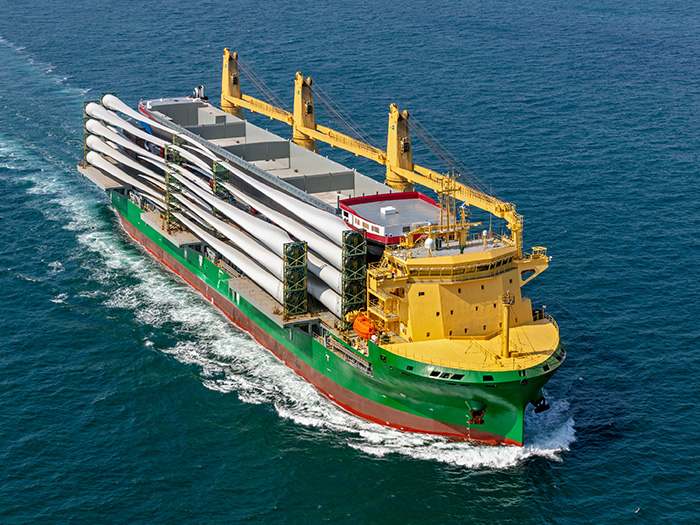
Heavy lift vessel. (Photo Credit: Columbia Shipmanagement Ltd.)
A new European partnership is set to help shipping companies navigate one of the industry’s biggest climate challenges: how to decarbonize the existing fleet quickly, safely, and cost-effectively.
The new FIT-HORIZONS project is bringing together 19 leading maritime companies, researchers, universities, software developers, and technology providers from across Europe to develop an intelligent and flexible retrofit design environment for low- and zero-emission shipping.
Coordinated by SINTEF Ocean and funded by the European Union with nearly €4 million, the project aims to simplify and accelerate retrofit decisions for shipowners by combining advanced simulation tools, AI-supported modeling, and operational data into one holistic design framework.
Practical tools for decarbonization
The maritime sector currently accounts for around 3% of global CO2 emissions. While new zero-emission vessels are entering the market, most ships operating today are expected to remain in service for decades. Retrofitting the existing fleet is therefore essential to achieving international climate targets.
“Shipping needs practical pathways to decarbonization now, not only in the future,” says the coordinator of FIT-HORIZONS, Dr. Kourosh Koushan, special advisor at SINTEF Ocean. “FIT-HORIZONS will help the industry make better retrofit decisions by understanding how different technologies interact onboard a vessel. Our ambition is to reduce uncertainty and accelerate the transition from analysis to implementation.”
The project will develop and validate a flexible design environment capable of evaluating multiple retrofit technologies simultaneously, including alternative fuels, electrification, wind-assisted propulsion systems, air lubrication systems, hull modifications, and energy efficiency solutions.
Rather than assessing technologies in isolation, the FIT-HORIZONS platform will analyze how combinations of technologies perform together under realistic operating conditions and across different vessel categories.
Six different vessel segments
The project will deliver six virtual demonstrations based on real operating vessels representing key European ship segments: inland waterways, short-sea shipping, long-distance shipping, ferries, cruise vessels, and offshore vessels.
By integrating machine learning, surrogate modelling, operational data, and high-fidelity simulations, the consortium aims to create a tool environment that can support more reliable, scalable, and commercially viable retrofit decisions across the maritime industry.
“Reconstruction of existing ships to include one or more new technologies is complex and commercially difficult to evaluate. The industry needs tools that make it easier to identify the most effective decarbonization routes for each vessel”, says Øystein Huglen, head of technology and innovation at Maritime CleanTech. They are in charge of maximizing industry impact and market uptake in the project.
Faster market uptake
The FIT-HORIZONS consortium builds on experience and knowledge developed through previous European initiatives, while introducing new AI-supported approaches for maritime engineering and retrofit optimization.
The flexible design environment developed in FIT-HORIZONS is expected to reach a technology readiness level of TRL 7-8 by the end of the project in 2029. The consortium will also develop recommendations for best practices, regulatory approval processes, and business models to support faster market uptake of retrofit solutions.
As new climate regulations, such as FuelEU Maritime and the EU Emissions Trading System increase pressure on shipping to reduce emissions, the project aims to provide shipowners and designers with practical tools to navigate an increasingly complex transition.
FIT-HORIZONS partners
SINTEF Ocean (Norway), Maritime CleanTech (Norway), Friendship Systems (Germany), Vard Design (Norway), Laskaridis Shipping Company (Greece), SimFWD (Greece), Consiglio Nazionale Delle Ricerche (Italy), Bound4Blue (Spain), Entwicklungszentrum für Schiffstechnik und Transportsysteme (Germany), Atlantec Enterprise Solutions (Germany), Alfa Laval Rotterdam (Netherlands), American Bureau of Shipping (Greece), Hurtigruten (Norway), Tidewater Rederi (Norway), Columbia Shipmanagement (Cyprus), Levante Ferries (Greece), University of Strathclyde (UK), Haeger & Schmidt Logistics (Germany), LMG Marin (France).
This project has received funding from European Union’s Horizon Europe Framework program under grant no 101270016.
Categories: News, Shipbuilding, Technology