![Secretary Duffy was joined by Great Lakes St. Lawrence Seaway Development Corporation Administrator Mike McCoshen, port leadership and Indiana Transportation Secretary Matthew Ubelhor. [Photo: Ports of Indiana]Secretary Duffy was joined by Great Lakes St. Lawrence Seaway Development Corporation Administrator Mike McCoshen, port leadership and Indiana Transportation Secretary Matthew Ubelhor. [Photo: Ports of Indiana]](https://www.marinelog.com/wp-content/uploads/2026/06/Group-photoduffytour-300x225.jpg)
OpenTug debuts Signal Optimization for marine logistics
Written by Marine Log Staff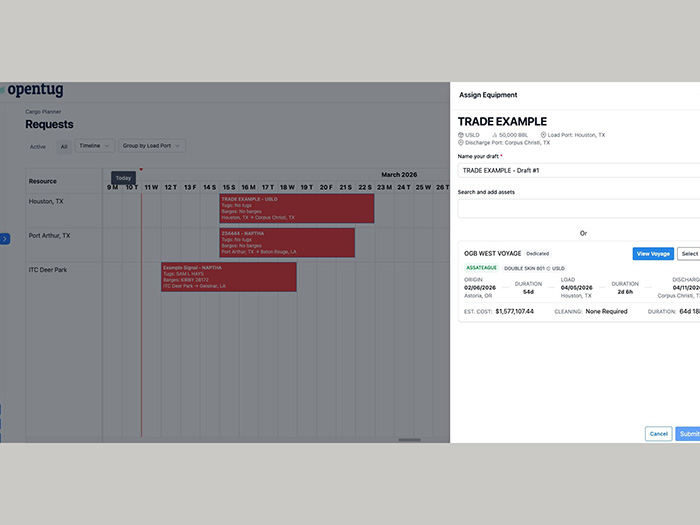
BargeOS Commercial Planning - Signal Optimization
OpenTug, the marine logistics platform set up to connect freight with barges and terminals nationwide, has announced Signal Optimization, a new BargeOS capability designed to help marine logistics teams plan demand by matching the right assets to the right movements at the right time.
Built for charterers, shippers, and commercial marine teams managing complex inland and coastal operations, Signal Optimization helps users capture inbound demand, evaluate equipment options, and make faster, more informed planning decisions in one workflow.
Signal Optimization is part of BargeOS Commercial Planning, where users can ingest demand requirements such as refinery and plant schedules, trade signals, and delivery windows, then compare available equipment based on operational and commercial factors including contract terms, repositioning time, cargo compatibility and cleaning requirements, and estimated cost.
“Marine planning teams are often making high-stakes decisions across disconnected systems, spreadsheets, and inboxes,” said Jason Aristides, co-founder and CEO of OpenTug. “Signal Optimization brings those inputs together so teams can evaluate options faster, improve asset selection, and move with greater confidence.”
Signal Optimization allows marine customers to:
- Capture and organize inbound demand from internal teams and external stakeholders
- Compare asset options against operational and commercial constraints
- Assign equipment to each signal while supporting load and delivery windows
- Connect planning decisions directly to downstream quoting and voyage workflows
As part of the broader BargeOS platform, Signal Optimization fits into an end-to-end operating model that connects commercial planning with voyage management, invoice intelligence, and performance management. That means planning decisions do not stop at assignment. They can flow into quoting, voyage execution, operational visibility, and long-term performance analysis.
“Every shipment is planned before it is placed, but too much of that process still depends on fragmented information and manual judgment,” said Mike Baldwin, co-founder and COO of OpenTug. “Signal Optimization helps teams make those decisions with better data, better speed, and better operational context.”
OpenTug developed Signal Optimization to address challenges such as fluctuating schedules, changing delivery requirements, asset constraints, and pressure to improve margins without increasing manual workload. The tool connects demand planning with live operational data and downstream workflows, with the aim of helping commercial teams respond more effectively and better align planning with execution.
Signal Optimization is now in beta as a part of OpenTug’s BargeOS platform.
Categories: Inland and Coastal, News, Technology
![American Maverick [Photo: American Cruise Lines]](https://www.marinelog.com/wp-content/uploads/2026/06/American-Maverick-Christening_Newport_RI-300x225.jpg)