![WaiV Robotics says that it is the first company to solve fully autonomous UAV landings at sea. [Screengrab from YouTube video]](https://www.marinelog.com/wp-content/uploads/2026/06/droneplatform-300x225.jpg)
New Jan De Nul subsea trenching vessel will be built to Ulstein design
Written by Nick Blenkey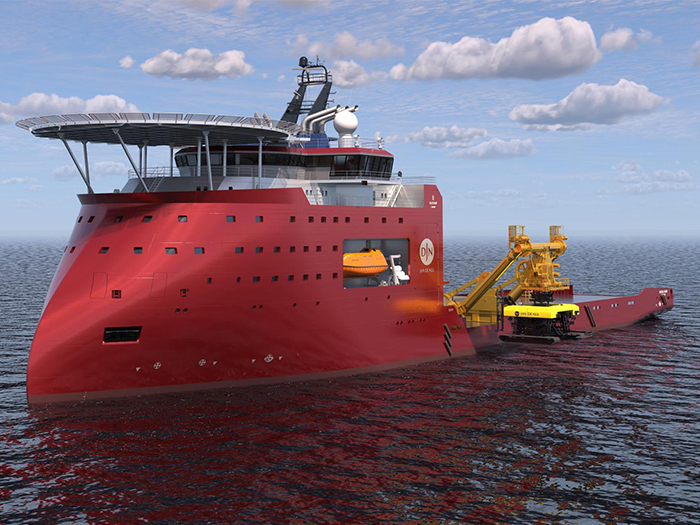
Image: Ulstein Design and Solutions
Jan De Nul has selected a customized vessel design from Ulstein Design & Solutions AS for the latest addition to its offshore fleet: a subsea cable trenching vessel that will be built at the CMHI shipyard in China and is scheduled for delivery in 2028.
Based on a robust and proven subsea vessel design featuring the Ulstein X-Bow, the custom-designed vessel will have a deck space and deadweight that will support extensive trenching operations. Subsea trenching is the process of creating a protective channel on the seabed to bury pipelines, power cables, and telecommunication lines.
“We chose Ulstein because of their proven vessel design, which provides a strong foundation to integrate all of our operational requirements,” says Muysewinkel Thomas, project manager vessel construction at Jan De Nul. “This collaboration allows us to combine reliability with tailored solutions for our operations. We look forward to a close and productive cooperation throughout the process. Together, we will deliver a state-of-the-art vessel fully adapted to the needs of our clients and crew.”
“We greatly appreciate the confidence Jan De Nul has shown by selecting Ulstein Design & Solutions. Jan De Nul is a new customer to us, and we look forward to contributing with a modern and operationally flexible vessel design,” says Rolf Petter Almli, sales manager at Ulstein Design & Solutions AS.
Ulstein’s vessel design is engineered for modularity, supporting a broad range of offshore sectors, including energy, construction, and deepwater operations. This version will be purpose-built for subsea trenching, ensuring precision performance. The Ulstein X-Bow hull design improves comfort, reduces wave resistance and fuel consumption.
Like all recent Jan De Nul vessels, it will be equipped with ULEv technology, with an advanced dual exhaust filter system that removes up to 99% of nanoparticles from emissions using a diesel particulate filter and a reduction system for nitrogen oxides (NOx). The system also significantly reduces exhaust gas pollutants. The engines of the vessel can run on biofuel and green methanol, reducing CO2 emissions. With the ULEv system, the vessel complies with strict European Stage V emission standards for inland waterway vessels, while NOx emissions are reduced to such an extent that this vessel meets the even stricter EURO VI emission limits.