Keel of future USS Philadelphia (LPD 32) laid at Ingalls
Written by Marine Log Staff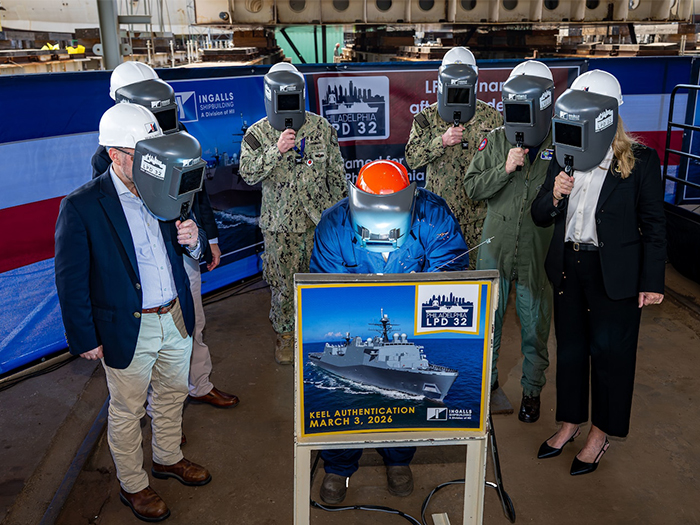
L to R: Brian Blanchette, president of Ingalls Shipbuilding and EVP at HII; Chris Kastner, president and CEO, HII; Captain Randy Slaff, Commanding Officer, Supervisor of Shipbuilding, Conversion and Repair, Gulf Coast;Cory Dillon, Ingalls structural welder, Captain Matt Tardy, USN Amphibious Warfare Program Manager, PEO Ships; Admiral Samuel Paparo, USN, Commander, United States Indo Pacific Command; Mrs. Maureen Paparo, sponsor and keel authenticator of LPD 32 [Photo: PEO Ships/Luis Solis]
PEO Ships reports that the keel for the future USS Philadelphia (LPD 32), a San Antonio class-amphibious transport dock ship, was authenticated at HII’s Ingalls Shipbuilding division, March 3.
The ship is named in honor of the city of Philadelphia and its maritime legacy. The city is the birthplace of the U.S Navy and Marine Corps and was home to the Philadelphia Naval Shipyard from 1801-1995, which constructed numerous Navy vessels.
Keel laying authentication ceremonies are a centuries-old tradition marking a significant construction milestone where a ship transitions from design to reality.
The keel of LPD 32v was authenticated when the initials of the ship’s sponsor, Mrs. Maureen Paparo, were welded onto a steel plate. Paparo is a Philadelphia native and the spouse of Adm. Samuel Paparo, the 27th Commander of U.S. Indo-Pacific Command. This plate will be permanently affixed to the ship’s hull, remaining with the vessel throughout its entire service life as a symbol of its beginning.
“The future USS Philadelphia honors one of America’s foundational cities and its continuous support of the Navy and the maritime domain,” said Capt. Matthew Tardy, program manager, Amphibious Warfare Program Office. “This keel laying marks the ceremonial beginning of construction and we look forward to delivering this ship to the fleet.
San Antonio-class amphibious transport dock ships (LPD) embark, transport, and land elements of a landing force for a variety of expeditionary warfare missions, humanitarian assistance, and disaster relief. They provide the Navy and Marine Corps with sea-based platforms that are networked, survivable, and built to operate with platforms such as air-cushioned landing craft (LCAC), modern helicopters, and vertical take-off landing craft (MV-22).
Categories: News, Shipyard News
![Scillionian IV at the Piriou shipyard in Vietnam. [Photo: Isles of Scilly Steamship Group]](https://www.marinelog.com/wp-content/uploads/2026/07/C439-launching-53-300x225.jpg)
![Sleipnir [Photo: Heerema Marine Contractors]](https://www.marinelog.com/wp-content/uploads/2026/07/sleipniratsea-300x225.jpg)