Port of Long Beach, MARAD partner on maritime nuclear energy
Written by Marine Log Staff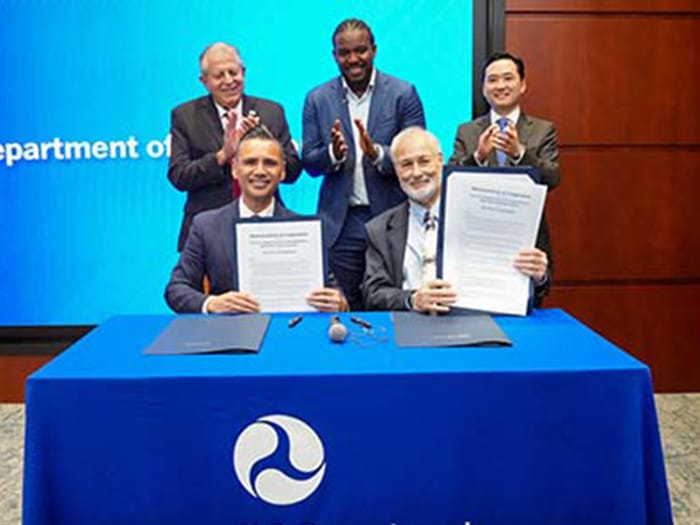
The Port of Long Beach became the first port in the nation to sign a Memorandum of Cooperation with the U.S. Department of Transportation’s Maritime Administration (MARAD) on Wednesday to advance work on development of small modular reactor (SMR) technology to power commercial vessels, ports and other maritime assets.
The agreement represents a significant milestone, making Long Beach the first U.S. seaport to formalize a partnership with MARAD to establish nuclear-powered vessels for commercial service.
“This first-of-its-kind partnership with MARAD allows us to leverage strong federal leadership and private sector innovation to catalyze SMR technology as we safely and securely support the next generation of shipping,” said Port of Long Beach CEO Dr. Noel Hacegaba. “We’re building the port of the future in Long Beach, where we’ve led in global trade by moving $300 billion in cargo annually to support 2.7 million American jobs, and we will continue our tradition of leadership as we partner to advance nuclear energy in maritime and beyond.”
“Under President Trump’s and Secretary Duffy’s leadership, MARAD is taking decisive action to revitalize U.S. shipbuilding and secure our national energy dominance,” said Maritime Administrator Stephen M. Carmel. “This milestone agreement with the Port of Long Beach brings cutting-edge Small Modular Reactor technology into active testing. It ensures our maritime supply chains stay operational under any contingency while training the next generation of high-skilled American mariners.”
“This Memorandum of Cooperation with MARAD positions the Port of Long Beach to help develop energy sources for the goods movement industry while maintaining our role as the premier gateway for trans-Pacific trade,” said Long Beach Board of Harbor Commissioners President Frank Colonna. “This aligns well with our track record of testing and demonstrating innovative new technologies at the Port of Long Beach.”
The agreement builds on momentum from MARAD’s May 7, 2026, Request for Information, issued in the Federal Register, seeking industry input on the development of a U.S.-built, scalable and commercially viable SMR for the nation’s marine transportation system. It also complements the Port’s new lease agreement with BlueCore Energy Inc., which allows the company to assemble, test and store maritime power modules, adding private-sector expertise to this the partnership with an American energy and technology company on the forefront of SMR development.
Demand for reliable electricity sources is forecast to grow substantially as the port pursues a goal to double container volume by 2050. Under the agreement, the port and MARAD will collaborate with the U.S. Coast Guard, the Department of Energy and the Nuclear Regulatory Commission to help define the operational protocols, safety standards and inspection processes needed to support the safe arrival and servicing of SMR-powered vessels at U.S. ports, as well as to develop and share other best practices. The agreement is nonbinding and does not commit either party to funding, procurement decisions or the adoption of any specific technology.
The Port of Long Beach is home to two MARAD Ready Reserve vessels, the S.S. Cape Island and S.S. Curtiss, and is also designated as one of 18 designated Commercial Strategic Seaports in the U.S., supporting military readiness and supply chain continuity during national emergencies.
Categories: Coastal, Ports & Terminals
![Steerprop has signed a repeat contract with Turkey’s Med Marine shipyard to deliver the propulsors for a third RAscal 2100 harbour tug designed by Robert Allan. [Image: Sterprop]](https://www.marinelog.com/wp-content/uploads/2026/07/TUG_MED-A2150_profile-300x225.jpg)
![Going forward, all operations of the combined operation will be conducted under the Moran Towing Corporation name. [Photo: Moran Towing]](https://www.marinelog.com/wp-content/uploads/2026/07/MichaelS-300x250.jpg)
![Joe Starck [Photo: LinkedIn]](https://www.marinelog.com/wp-content/uploads/2026/06/JoeStark-300x225.jpg)