
Op-Ed: AI and the future of international marine transportation
Written by George Livingstone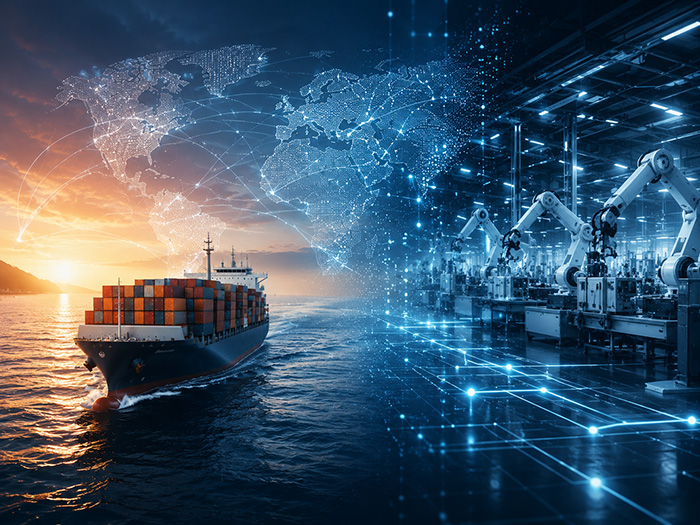
Image credit: Open AI
I must admit to being late for the AI party, and I suspect I’m not alone—being 68 has something to do with it. Full disclosure: my expertise is marine transportation is operating vessels (retired San Francisco Bar Pilot), but the transformational aspect of AI and how it might relate to global trade has piqued my interest.
My first introduction to AI came in 2023, when I read the New York Times best seller, The Coming Wave by Mustafa Suleyman (co-founder of Deep Mind). It was an excellent read and highly recommended. The book asserts we are on the precipice of a new era defined by artificial intelligence, quantum computing and synthetic biology that will fundamentally change every aspect of human life from how we produce energy to how we fight wars. Consider the war in Ukraine and drones as just one example. Everything will change, from national security to economic competition to health care and living.

Chuck Brooks, Forbes Magazine contributor, recently wrote we are in a new age of quantum computing, calling it the Quantum Frontier Era. The changes in quantum computing are astonishing, what was science fiction ten years ago is reality today. Quantum computers use qubits to process information in ways classical bits cannot, enabling solutions to problems previously insurmountable for even the most advanced supercomputer. But it is the combination of quantum computing and AI that is the most astonishing innovation. He argues it may end up being as disruptive as steam power was during the Industrial Revolution.
A recent article in the Economist said Jack Clark, co-founder of Anthropic, thinks the latest generation of AI models may be the last ever made by humans. Clark thinks there is a 60% chance that by the end of 2028, an AI system will be capable of creating its own successor with no human involvement. Known as recursive self-improvement (RSI). It would be a closed loop where upon one model produces version two, which produces version three, etc. Improvement and speed grow with each version.
What about the combination of quantum computing, AI, and computer aided design (CAD)? I am no more expert in CAD than quantum computing or AI, but I do know that, at present, there are limitations to what CAD can produce. What happens in the very near future, if the combination of CAD and quantum computing and AI allows for the production of a host of complete products? Products produced within national boundaries. If true, what does that mean for global trade and international marine transportation?
Long-established ocean trade routes have shaped global commerce as we know it. In this system, low-cost manufactured goods move from Asia to the Americas and Europe, while a smaller volume of trade flows in the opposite direction. In the United States, this pattern is evident in international intermodal transportation: goods arriving from Asia at major ports are distributed nationwide by rail, truck, and air.
A truly global enterprise of trade where reasonably priced products produced in Asia are used by western economies. It’s immense and is fundamental to the present-day global economy. What if the future is upon us? No one has a crystal ball; there is no way to see the future of marine transportation. I believe, however, we in international marine transportation may be in the best place to think and debate on the matter.
Imagine a future that finds ocean trade shifting from very large volumes of manufactured products to primarily moving raw materials, oil & gas, agriculture along with smaller ships moving locally manufactured products primarily within regional boundaries? Why? Because manufacturing will have become mostly local. Wealthier nations with an established AGI and quantum computing base may end up capable of making what the national consumer would need within national boundaries. If true, it will be transformational and destructive.
No more international EAST-WEST trade routes or significantly reduced. No more need for economies of scale regarding Ultra Ultra Large Container Vessels for example. One can imagine continued trade involving large tank and bulk ships, but much becomes national, regional, and local. In the United States, due to its wealth and innovation, manufacturing of goods would still be occurring through out a very large country. This would require the usual movement of goods by truck, train, plane, and ship. Ships would still be required to move from one port to another, but trade would be primarily within the national boundary. Ship size would be smaller except for the energy trade that would still require large volumes to be transported over longer distances from source countries to user countries.
One could foresee some finished goods traded within regions to countries that lack the resources to build their own quantum computing and AI-driven manufacturing base. That would reverse today’s trade pattern, and similar models could emerge worldwide. Nations unable to develop the required AGI and quantum computing capabilities would be especially vulnerable.
If the above has merit, it does not mean the end of ships transporting goods and products, but it may mean the end of global trade routes as we know them. Additionally, would it not argue for a robust national maritime strategy that includes ship building, manning, education and training?
Present world trade is ingrained into our collective maritime psyche. If change comes it will be transformational, disruptive, and destructive, all at once. The time to talk about it was four years ago, better late than never.
Categories: Op-Eds, Shipping, Technology