![A dual-fuel combustion strategy developed in a Caterpillar marine engine at DOE’s National Transportation Research Center at Oak Ridge National Laboratory shows methanol can efficiently power inland and coastal vessels.[Photo: Genevieve Martin/ORNL, U.S. Dept. of Energy]](https://www.marinelog.com/wp-content/uploads/2026/06/A-dual-fuel-combustion-strategy-developed-in-a-Caterpillar-marine-engine-300x225.jpg)
Public, private sector collaboration keep freight moving on inland waterways
Written by Marine Log Staff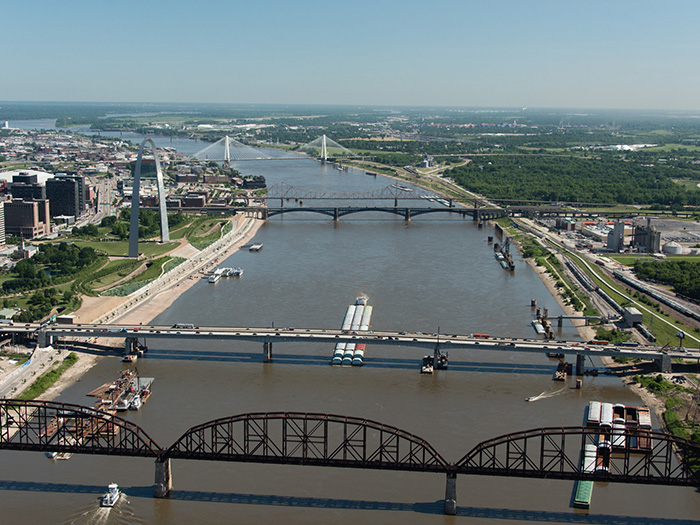
Barge traffic on the Mississippi River at St. Louis.
Ongoing collaboration between industry and government partners is essential to maintaining safe, reliable and efficient freight movement along the Mississippi River system, particularly as operators navigate dynamic river conditions, infrastructure demands and evolving supply chain needs.
This collaboration and the shared priorities it supports were the focus of a FreightWeekSTL 2026 panel discussion examining how public and private sector partners work together to keep freight moving across the inland waterways. Titled Behind the Barges: How the Mississippi River Stays Open for Commerce, the session featured Randy Chamness, vice president of vessel operations for American Commercial Barge Line (ACBL), and Bradley Krischel of the St. Louis Engineer District.
Chamness provided an overview of ACBL’s extensive network, which includes 3,200 barges and 2,000-plus employees, noting that the St. Louis region plays a central role in its operations. He said approximately 70% of the company’s fleet moves through the area, underscoring its importance as a key hub for inland freight movement.
Krischel highlighted the critical role the Corps plays in maintaining one of the nation’s busiest freight corridors, managing approximately 300 miles of the Mississippi River in the bi-state St. Louis region. He emphasized that keeping the federally authorized 9-foot-deep, 300-foot-wide navigation channel open requires constant focus.
“The river’s very dynamic; it’s always changing,” Krischel said. “It takes constant monitoring and a proactive approach to keep traffic moving safely and efficiently through the region.” He said those actions include targeted dredging to remove sediment buildup, maintaining and repairing river training structures that help guide the flow and self-scouring the channel to provide adequate depth, as well as installing and maintaining revetments to stabilize its bank lines. In some extreme cases, he said they have even completed rock removal at the bottom of the river.
Both panelists emphasized that close coordination between industry and government partners is fundamental to system performance. Chamness described the ongoing effort focused on anticipating challenges and prioritizing solutions before they disrupt operations.
“It’s really a year-round partnership,” Chamness said. “A lot of the work is done in the off season, planning, collaborating and communicating on how we can work together in these trouble areas to keep the channel open.”
Krischel added that this collaboration is supported by shared data and communication tools, such as the Weekly Navigation Channel Conditions Status Report, that create a unified understanding of system conditions across stakeholders. “It’s consistent two-way communication with the people who are actually out on the river every day,” Krischel said. “The private sector brings that real-time operational awareness that is combined with our system management, so we’re in a much better position to keep the system moving safely and efficiently.”
The discussion also addressed how increasingly volatile river conditions—including swings between low water, flooding and seasonal ice—are impacting operations and requiring new approaches. Krischel said the Corps is enhancing forecasting, data collection and monitoring capabilities to better anticipate and respond to changing conditions.
“It’s no longer enough just to react,” he said. “We have to stay a step ahead of what the system might be doing.”
Chamness echoed those challenges from an operational perspective, noting that rapid transitions between river conditions can create the greatest disruptions to navigation and cargo movement.
“The river is actually most dangerous when it’s in transition,” Chamness said, adding that’s when sediment is on the move and conditions change quickly, impacting the channel. He also pointed to the significant impact of recent ice events, which slowed operations, created network congestion and highlighted the need for continued coordination and preparedness across the system.
Looking ahead, both panelists emphasized the importance of targeted infrastructure investment to improve efficiency and reliability. Krischel highlighted ongoing work to construct a new 1,200-foot lock at Lock and Dam 25 near Winfield, Mo., which will reduce congestion and allow full tows to pass without having to be broken apart.
“That upgrade will reduce congestion, improve safety and enhance the overall efficiency of the system,” Krischel said.
Chamness noted that additional opportunities exist to improve system performance through deeper navigation channels and proactive dredging, which would allow operators to increase cargo loads and improve overall economics.
“That could have a significant positive impact on our industry,” he said. He also emphasized the importance of maintaining strong industry policies and workforce development efforts to sustain long-term growth.
The discussion was moderated by Mary Lamie, executive vice president of Multimodal Enterprises for Bi-State Development and head of the St. Louis Regional Freightway. She circled back to the theme of partnership in her closing comments.
“This has been a fascinating look at the relationship between industry and the Corps of Engineers and the collaborative approach they are taking to keep freight flowing on our inland waterways, support system resilience and enhance economic competitiveness,” said Lamie.