Windcat and Damen unveil Windcat Amsterdam
Written by Nick Blenkey![Windcat Amsterdam [Photo: Windcat/Damen]](https://www.marinelog.com/wp-content/uploads/2026/03/CSOV-Windcat-Amsterdam-1.jpg)
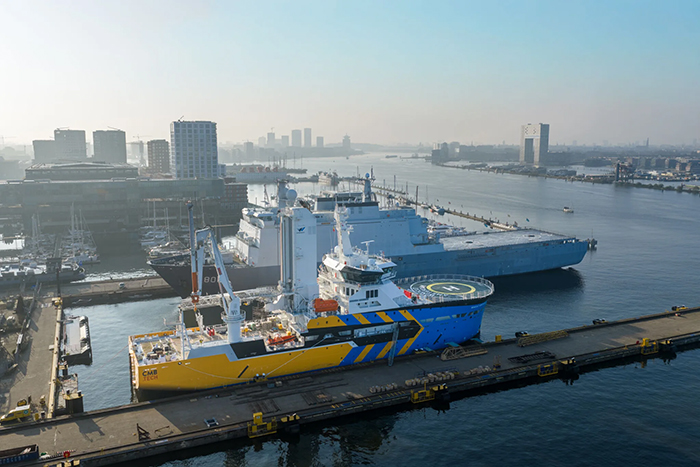
Windcat Amsterdam [Photo: Windcat/Damen]
Damen and CMB.TECH’s Windcat division report that Windcat Amsterdam has arrived in Europe. Developed in collaboration between Damen and Windcat it was constructed at the Ha Long Shipyard in Vietnam. It is the first Elevation series Commissioning Service Operations Vessel (CSOV) to arrive in European waters.
With a capacity for up to 120 people and featuring advanced low-carbon solutions that include a hydrogen-fueled auxiliary engine, Windcat Amsterdam strengthens Windcat’s growing offshore service offering in the European market.
Windcat Amsterdam will support construction, commissioning and maintenance activities at offshore energy projects, serving as a floating base for personnel and equipment, enabling safe and efficient access to offshore assets.
Home away from home
On board comfort is a key feature of the design, with spacious single and double cabins for up to 120 people, a fully equipped gym, entertainment areas and high-quality catering and housekeeping services. The interior has been developed in collaboration with experts to ensure a home away from home experience for offshore personnel.
Future-proof vessel design
Windcat Amsterdam is designed to operate with a significantly reduced CO2 footprint. It is equipped with the latest available technologies in terms of fuel efficiency and emission control. It has a hybrid battery-electric propulsion system and the entire energy system functions as a single integrated network. Four thrusters that can rotate 360° enable precise maneuverability and efficient operations. Collectively, these techniques are expected to reduce CO2 emissions by 30%.
Additionally, Windcat is building on the operational experience it has gained with its hydrogen-powered crew transfer vessels (CTVs). Their in-house hydrogen technology is also being implemented in the Elevation Series CSOVs. A dual fuel hydrogen engine will enable the auxiliary genset to run on hydrogen.
The hydrogen genset, storage and fuel supply system are ready for integration on the vessel once final approvals are in place.
Safe operability
Designed for offshore deployment of up to 30 days, the vessel is designed to deliver high operability and safety. The 3D motion-compensated gangway has a high vertical range allows crew to transfer safely between the vessel and offshore platforms, even in challenging sea conditions. The world’s first 10-ton 3D motion-compensated crane enables heavier platform lifts in rough sea conditions in a safe and easy manner. These features help maintain operations and reduce delays caused by changing weather conditions.
“Introducing our first CSOV to Europe is a proud moment for Windcat and for all partners involved, says Willem van der Wel, managing director at Windcat. “Introducing our first CSOV to Europe is a proud moment for Windcat and for all partners involved. Windcat Amsterdam sets a new standard in our fleet and in the industry and underscores our commitment to supporting Europe’s energy transition with reliable and future-proof vessels.”
“The arrival of Windcat Amsterdam in Europe is a special moment for both Damen and Windcat.,” says Joost van der Weiden, Damen sales director. “I’d like to use this occasion to offer my sincere gratitude to all involved in the project – from our customer to our suppliers, as well as all my colleagues who have contributed so much to the success of the CSOV series. In the coming years, these vessels will play an important role in supporting the offshore energy industry as it focuses on achieving increasing levels of efficiency.”
Categories: News, Offshore, Offshore Wind