Legal

Shipping fights proposed $26 billion a year CO2 tax


The aim of COP 21 is to achieve a new international agreement on the climate, applicable to all countries, with the aim of keeping global warming below 2°C. This will mean a big reduction in Greenhouse Gas (GHG) emissions. International shipping is a major generator of GHG and IMO, the UN agency that covers shipping, has been working steadily on measures to reduce them.

At COP 21, however, shipping will be in the cross-hairs of any number of interests that want to see it cut GHG even further and that will be pushing for various tough measures to see that this happens.

Even before COP 21 gets underway, an OECD think tank called the International Transport Forum has produced a policy brief calling for shipping to pay a carbon tax of around $25 per ton of CO2 generated. The policy brief doesn’t get into how the CO2 emissions would be measured or the tax collected, but it does suggest that the considerable revenues generated (around $26 billion a year) could go to the Green Climate Fund, which has been set up to finance climate mitigation projects in developing countries.

The International Chamber of Shipping (ICS), argues that the $25 a ton suggested by the International Transport Forum would be almost three times higher than the carbon price paid by shore based industries in developed nations. About 70% of the world merchant fleet is registered in UNFCCC “non-Annex I” developing countries, and maritime trade is of vital benefit to rich and emerging economies alike.

ICS emphasizes that shipping is committed to reducing CO2 and has a responsibility to contribute to the achievement of the United Nations 2°C climate change goal. But the UNFCCC recognizes that developed and developing nations should accept differing commitments, and shipping is no different, especially in view of its vital role in the movement of about 90% of global trade.

While China and India, for example, have already made positive CO2 reduction commitments to COP 21, says ICS, these will not deliver absolute CO2 reductions for several years. Some richer nations, however, consistent with the UNFCCC CBDR principle, have made more ambitious commitments. Shipping meanwhile has already reduced its total CO2 emissions by more than 10% (2007- 2012) and CO2 per tonne-mile by around 20% (2005 – 2015). It is therefore on course for carbon neutral growth.

“While shipping may currently have CO2 emissions comparable to a major OECD economy, it is inappropriate for the ITF to propose that the industry should be treated like an OECD economy,” said ICS Secretary General, Peter Hinchliffe.

The position of ICS remains that if IMO Member States should decide to adopt a shipping MBM (Market Based Measure) , the industry’s clear preference is for a fuel levy, rather than an emissions trading scheme or other complex alternatives that would distort global shipping markets. However, if a levy was developed by IMO, ICS believes that any money collected should be proportionate to international shipping’s share of the world’s total CO2 emissions (2.2% in 2012 compared to 2.8% in 2007), not the $26 billion dollars a year that a $25 per ton CO2 tax would raise.

Read the ITF Policy Brief HERE

Read the full ICS response HEREMBM
ABS offers guide for “SOx Scrubber Ready” ships


Instead, when ordering a newbuilding they may prefer to order a ship that is “SOx scrubber ready.”

Classification society ABS says that, Iin order to facilitate future modifications, ship buyers and shipbuilders must make a significant effort to figure out what features should be incorporated on a vessel and incorporate these in the shipbuilding contract.

To support shipowners taking this path, ABS has published the ABS Guide for SOx Scrubber Ready Vessels to support members and clients in preparing newbuilds for future outfitting with a SOx exhaust gas cleaning system (EGCS).

The guide supports the ABS classification notation for SOx Scrubber Ready Vessels by formalizing the process for clients who wish to plan for retrofit of a SOx scrubber at a future date by providing a detailed review and approval and an associated notation.

The SOx Scrubber Ready notation is in addition to ABS EGCS notations that may be assigned for vessels fitted with an exhaust emission abatement system, including SOx scrubbers, selective catalytic reduction systems and exhaust gas recirculation arrangements for NOx emission control, in accordance with the ABS Guide for Exhaust Emission Abatement.

More HERE and HERE


MarAd project to convert towboat engine to burn LNG

OCTOBER 8, 2015—The U.S. Department of Transportation’s Maritime Administration (MARAD) has announced that it will provide over $1 million to support the development of two new emission-reducing maritime solutions.  The first is

Sulfur in Danish air halved since ship fuel limits imposed


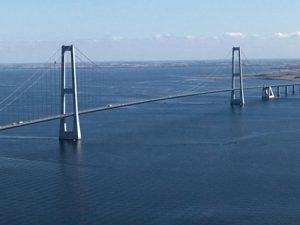
Evidence for the dramatic reduction comes from measurements taken by a technologically advanced “nose” or “sniffer” installed on the Great Belt Bridge to monitor ships’ compliance with the new rules. Installed by the Danish Ministry of the Environment and Food, the sniffercan detect the use of illegal fuels by ships sailing under the bridge. 

The first air measurements performed by the sniffer show that 98% of ships comply with the sulfur standards and, according to a new report by the Danish Center for Environment and Energy at Aarhus University (DCE), the total content of airborne sulfur has been reduced by up to 60% since the new year. 

“Sulfur and particles are harmful to people, so it is good news that the new environmental requirements are having an effect. As the first country in the world, Denmark has implemented new technology to monitor ships’ emissions and ensure full compliance with the requirements. Significant economic savings are possible by circumventing the law, so monitoring and enforcement are important to avoid harmful pollution from the ships and an unfair competitive situation for the law-abiding shipowners,” says Minister for Environment and Food Eva Kjer Hansen.

The additional costs of fuel depend on the size and speed of the ship, but they can be up to DKK 1 million for a round trip journey between the English Channel and Baltic Sea.

Monitoring at the Great Belt Bridge is not the only measure. A sniffer is also installed on a small plane that monitors ships sailing along major shipping routes through Danish waters. If the sniffer measurements show that a ship is using illegal fuel, the authorities at the next port are notified so that they can stop the violation.  

Chalmers University developed the sniffer technology. The Ministry of the Environment and Food is funding the monitoring efforts, which cost DKK 6.3 million. 

“The Danish shipowners fully support the new requirements and there is a positive, close cooperation regarding monitoring and enforcement between the Ministry of the Environment and Food and the Danish Shipowners’ Association, under the auspices of the Partnership for Green Shipping,” says Director General Anne H. Steffesen of the Danish Shipowners’ Association. “Effective international enforcement is crucial to the industry and ensuring equal competitive conditions for all. Remote monitoring from bridges and aircraft can be an important part of ensuring compliance with the rules – especially when stricter requirements take effect worldwide by 2025, making international enforcement even more important.”

A joint international effort to ensure that ships comply with environmental requirements is important. Therefore, Denmark is currently working in the EU and the UN International Maritime Organization to ensure effective and uniform monitoring and enforcement.

New Eco-Ships launched at Hyundai Vinashin for d’Amico

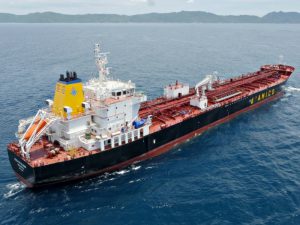
The energy efficient design of two vessels, the 39,000 dwt Ice Class handysize tanker Cielo di Ulsan, and the 50,000 dwt product tanker High Trader, allow them to already meet IMO standards that will come into force in 2025.

With the addition of the two ships, the DIS fleet now controls through ownership, charters and joint ventures 51.83 double-hull tankers, with an average age of 7.6 years. It owns 25.33 vessels and charters another 26.50. The two eco-ships, worth a total of over $62 million, are a part of $755 million investment plan that DIS started in 2012 and which includes, to date, a total of 22 high performance vessels, 10 of which have already delivered.

Marco Fiori, CEO, d’Amico International Shipping S.A., says, “We have added two more ships of great construction quality to our young fleet, which are capable of offering our customers safety, efficiency and profitability.”

Both of these new tankers are under time charter contracts to two major international oil companies, one lasting 30 months and the other three years, managing to anticipate the extraordinary global demand in the transport of refined petroleum products, today favored both by the transfer of refineries (from the main consuming regions to oil production areas) and the decreasing of crude oil prices.

The 183m x 29m Ice Class Cielo di UIsan is equipped to operate in temperatures as low as -20°C. It will operate in routes in Northern Europe, the Arctic and the Northern Sea. This is the first model of a group of four ships that will join the DIS fleet, resulting from the joint work of the company’s engineers and Hyundai Vinashin.

The 183m x 32m High Trader is the sister ship of two other vessels already delivered to DIS. One of its selling points is that it can guarantee an average savings of 6 tons of fuel per day (with ship fully loaded and a constant speed of 14 knots) and consequently a 20% reduction in CO2 emissions. Moreover, the profitability of the ship is driven by its great commercial versatility: High Trader can carry up to nine different types of cargo during the same trip. Cielo di Ulsan and High Trader are equipped with systems for the treatment of ballast water so as to minimize the impact on marine ecosystems and comply with IMO3 and IMO2 requirements.

DIS has an extensive newbuilding program underway, with 12 new eco-ships on order, including three Handysize, three Medium-Range and six LR1, tankers under construction.

“This extremely positive moment on the market,” says Fiori, “and increasingly close relations with major oil companies and multinational manufacturers of vegetable oils, which request our ships more and more often, confirm that DIS has taken the right route. With the addition of other 12 eco-ships currently under construction by 2018, we will further consolidate our competitive position on the global shipping market that today already sees us among the leaders.”


USCG issues new policy letter on BWM compliance


Blank Rome says that vessel owners and operators may realize a cost savings by a delayed compliance date, which would allow time for the approval of U.S. Coast Guard type-approved ballast water treatment systems before other systems are installed.

The firm says that owners and/or operators should therefore review the compliance dates for their vessels and consider applying for an extension if they will face a hardship coming into compliance with the Coast Guard’s Ballast Water Management rule in light of the fact that there are no type-approved systems as yet or any practical alternatives.

Issued September 10, 2015, revised Policy Letter 13-01 gives updated guidance to vessel owners and operators on BWM methods and streamlines the application process for vessel owners and operators to obtain extended compliance dates for implementing BWM methods, principally the installation of treatment systems.

Notable updates, says Blank Rome, include removing the five-year limit on cumulative extensions, clarifying “batch” and supplemental applications, deleting the requirement to submit vessel Ballast Water Management Plans with extension requests, and allowing extensions to vessels that choose to install Alternate Management Systems (AMS) accepted by the Coast Guard.
The Coast Guard has also provided template application forms and recommendations regarding applying for extensions.

Read the full Blank Rome Action Item HERE

Download the policy letter HERE

Asian owner opts for Optimar for BWTS retrofits


“This is a major contract, with a global leader in shipping,” says Optimarin CEO Tore Andersen. “Due to confidentiality clauses we can’t say who it is, but we can say that this firm, like many others we have reached frame agreements with, has chosen our system due to our unparalleled expertise in retrofitting and the reliable performance of our proven BWT solution.”

Optimarin says the contract was secured thanks to its retrofit expertise and market proven technology.

The first of the Optimarin units has already been installed, with two further systems following at the beginning of next year, and two more in spring 2016.

Goltens Green Technology, which entered into an agreement with Optimarin last year as a “preferred retrofit partner,” will manage all design and supervision from its Singapore office.

BWTS installation work will be performed at Chinese shipyards with Goltens using its proven retrofit process, employing precision 3D laser scanning and modeling as the basis for detailed design, prefabrication and streamlined system installation.

Goltens and Optimarin have joined forces on nearly 60 worldwide retrofit assignments so far and Mr. Andersen says this shared experience leads to fast-track, problem free installation, with most projects – where prefabrication and preparatory engineering work is completed – concluded within a week.

Optimarin, which fitted the world’s first commercial BWT system in 2000, has now fitted over 270 BWT systems worldwide, from an orderbook that has seen over 350 orders placed. The modular, reliable and easy to install and maintain nature of the system has made it, says Optimarin, the leading retrofit choice for vessels up to 60,000 dwt.

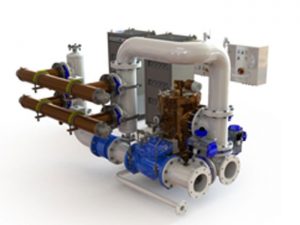
“Our solution combines simplicity with innovation, utilising a combination of automatic back flushing, self cleaning filters and UV irradiation to neutralise all organisms, bacteria and pathogens in ballast water,” Mr. Andersen comments. “We’ve been developing this technology for the past 21 years and that experience is a compelling proposition for owners and yards that, with the ratification of the IMO’s Ballast Water Management (BWM) convention on the horizon, need solutions that they can trust… and need them soon.

“This is particularly true in Asia,” he adds, “where we’re now working with shipowners of the stature of Pacific Radiance, Chellsea and EMAS, while winning newbuild contracts from yards such as ASL Shipyard, Jurong SY, Keppel Singmarine, China Merchant Heavy Industries and Oshima Shipbuilding.”The ten vessels, each requiring 1,000 cu.m/h system capacities, are managed from Hong Kong.

Optimarin recently completed work on extensive in-house testing facilities at its headquarters in Stavanger and its BWTS is currently undergoing a full program of USCG approval testing. It already has IMO approval, USCG AMS acceptance, and certification through DNV GL, BV, RMRS and CCS.

Bio-Sea BWTS chosen for 18,000 TEU containership

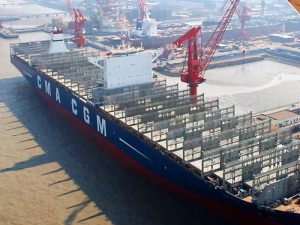
The U.K.-flagged Vasco de Gama has a length of 399 m and beam of 54 m.

Delivered July 27 (see earlier story) by China State Shipbuilding Corporation, it is thus largest containership ever delivered from a Chinese shipyard.

Bio-UV says it has been cooperating closely with a great number of partners, including the CMA CGM Group, in order to provide modular, reliable, innovative and energy saving ballast water management systems that are effective in all
water qualities.

The Bio-Sea system uses filtration and high power UV to treat ballast water without requiring any chemicals.

Press release BIO SEA CMA 4