Legal

CARB approves barge mounted alternative to shore power

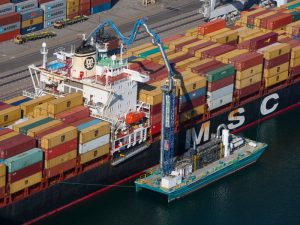
AEG’s Advanced Maritime Emission Control System (AMECS), essentially, takes a barge-mounted  scrubber system to the ship. Unlike existing shore power options, it does not require retrofits to each vessel.

“AMECS is a game-changer in the fields of emission control and air quality. Multiple AMECS units can remove thousands of tons of pollutants each year,” said Ruben Garcia, President of AEG. “These mobile barge-mounted systems use patented technology to attach to the auxiliary exhaust stacks of nearly any vessel entering port – at-berth or at-anchor – eliminating the need for expensive ship retrofits, and providing the public with cleaner air.”

AMECS is approved for simultaneous emission capture from two exhaust stacks of a single ship, with independently verified test results proving 90% to 99% reduction of the particulate matter (PM), nitrous oxides (NOx), and sulfur dioxides (SO2) found in diesel exhaust.

“CARB’s approval of AMECS as an alternative to the at-berth emissions reductions rule provides the flexibility our shipping lines need while protecting our environment and creating new jobs for our communities,” said representatives from the Port of Long Beach, a strong supporter of AMECS throughout its development.

In 2013, the Port of Long Beach provided about $2 million in seed money to help test the  AMECS system.

“We’re thrilled any time we can find more tools to reduce emissions and continue to improve community health. That’s why we fund projects like the demonstration and testing of these new technologies, through our Technology Advancement Program,” said Board of Harbor Commissioners President Lori Ann Guzmán. “We’ve made a lot of progress in reducing air pollution, and we are nurturing new technologies like these to help us do even more.”

DNV GL releases new guideline on cargo liquefaction

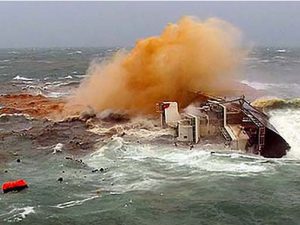
Many common bulk cargoes, such as iron ore fines, nickel ore and various mineral concentrates, may be subject to the phenomenon, in which a soil-like material is abruptly transformed from a solid dry state to an almost fluid state.

If liquefaction occurs on board a vessel, the stability will be reduced due to the free surface effect and cargo shift, possibly resulting in capsizing of the vessel. The ship structure may also be damaged due to increased cargo pressures.

DNV GL says there are some distinct and disturbing features of accidents caused by cargo liquefaction.

First, the accidents happen very fast. The period of time from when liquefaction is detected, if it is detected at all, until the vessel has capsized could in some cases be only a few minutes. This leaves very little time for remedial measures. It also leaves very little time for safe evacuation of the ship, and such accidents are often associated with tragic losses of crew members.

Second, an accident on one vessel is often followed by a new accident, or near-accident, on other vessels that have loaded similar cargo at terminals in the same area.

DNV GL’s new guideline aims to raise the awareness of the risks of liquefaction and describes mitigating actions to reduce these risks.

“Cargo liquefaction is probably now the most significant factor in lives lost at sea for bulk carriers,” says Morten Løvstad, Business Director of Bulk Carriers at DNV GL. “While the general safety level of modern bulk carriers has been significantly improved over the last decades, recent incidents have shown that cargo liquefaction remains a major safety issue. Since 2009, at least six ships of more than 40,000 dwt have been lost to suspected liquefaction of cargo. These incidents have shown that cargo liquefaction is an issue that has not been sufficiently dealt with, and concerned owners and operators have contacted us for support and advice.

“With this guideline we wanted to help our customers by not only increasing awareness and building competence around the phenomenon, but also to offer some strategies, both in design and operation, to reduce these risks.”

The guideline focuses on both the operational and design aspects of cargo liquefaction.

In daily operation, recommendations to reduce the risk of liquefaction include:

  • making sure that cargo is correctly identified and properly documented
  • ensuring the time interval between testing for moisture content and loading is no more than seven days and that retesting is done in the event of rain
  • appointing an independent surveyor and performing a can test or similar to verify the moisture contentloading in a non-homogeneous pattern
  • raising the center of gravity by ballasting the top wing tanks (provided loading condition and structural strength allows for it), and trimming as necessary to ensure cargoes are reasonably level

The design guidelines look at the potential of carrying cargoes with high moisture content onboard specially constructed or fitted ships, in compliance with the IMSBC Code. Such vessels can remain safe both from a stability and strength point of view even if the cargo liquefies or shifts.

“Under the IMSBC code such vessels must have permanent structural boundaries or specially designed portable divisions to confine any shift or liquefaction of cargo, but detailed requirements are lacking,” says Mr. Løvstad. “It is clear, however, that stability and structural strength have to be specially considered, and our guideline sets out criteria for them, based on DNV GL procedures and rules.”

The guideline also examines how and why liquefaction can occur, which bulk cargoes are subject to liquefaction risks, explains the Transportable Moisture Limit (TML) and presents the effect of liquefaction on a vessel. The aim of the guideline is to provide ship designers, shipyards, shipowners and other stakeholders in the shipping industry a basis to assess the risks and begin the process of making their vessels and their operational processes safer when it comes to the risks of liquefaction.

Access the guideline HERE

Assessing court’s ruling on VGP ballast water requirements

An “action item” alert from law firm Blank Rome sheds some light onto the significance of this decision.

Blank Rome notes that the Second Circuit Court of Appeals remanded the issue to the EPA to redraft the ballast water sections of the VGP.

The firm says that “the differences between the VGP ballast water provisions, International Maritime Organization (“IMO”) Ballast Water Management Convention, and U.S. Coast Guard’s ballast water regulations have posed a number of compliance challenges thus far, which may be further exacerbated by possible new VGP requirements. While substantive changes to the VGP ballast provisions, if any, are likely years away, shipowners and operators should be aware, closely monitor, and be prepared to comment on a new draft VGP in the future.”

“Most notably,” says Blank Rome, “the court stated that the EPA failed to adequately explain why stricter technology-based effluent standards should not be applied, failed to give fair and thorough consideration to onshore treatment options, and failed to adequately explain why pre-2009 Lakers were exempted. The court instructed the EPA to reconsider the VGP ballast water provisions in accordance with its ruling. In the meantime, the 2013 VGP will remain in effect.”

“The possibility that the EPA may alter its VGP ballast water provisions does, however, create uncertainty for those striving to comply with both the VGP and U.S. Coast Guard ballast water requirements,” notes Blank Rome. “The U.S. Coast Guard’s ballast water regulations, like the current VGP ballast water requirements, for the most part mirror the IMO Ballast Water Management Convention, though there are some differences. Ship owners and operators have struggled to understand and comply with these overlapping requirements. Any changes to the EPA’s ballast water requirements will require extensive discussion with the U.S. Coast Guard to ensure any new VGP ballast water requirements can co-exist with the U.S. Coast Guard and IMO regimes.

“The ruling does not impact the U.S. Coast Guard’s ballast water management system type approval process. That said, should the EPA create stricter technology-based effluent limitations (TBELs) than the U.S. Coast Guard and IMO standards, it will be even more challenging for vessels to comply with both the U.S. Coast Guard and EPA standards because the systems approved by the U.S. Coast Guard and required to be installed may or may not meet the stricter VGP TBELs. It is also unclear how the EPA would enforce stricter TBELs as the Coast Guard generally conducts the vessel inspections and passes information on possible violations to the EPA.”

Read the full text of the Blank Rome action item HERE

Southeast Asia maritime crime rate soars

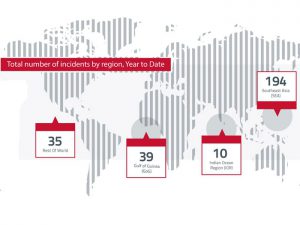
Dryad says that the apparent impunity of maritime gangs operating in the region has led it to call upon the three nations surrounding the Singapore Strait, in particular, to provide a permanent security presence to deter criminals and protect maritime trade.

The number of reported incidents in the region has jumped from 140 in the first nine-months of 2014 to 194 in the same period of 2015.

The main focus for criminal gangs in the region has been the petty theft of ships stores as gangs look to steal engine parts and high value machinery for resale on the black market.In total 14 vessels have been hijacked in Southeast Asia in 2015 to date, with only one product tanker, the MT Joaquim targeted for the purpose of cargo theft in the last quarter (Jul-Sep), when 3000 metric tonnes of fuel oil were stolen from the vessel.

Dryad Maritime analysts have identified the Singapore Strait as a key area for increased vigilance. Between January and September they recorded 90 instances of theft or attempted theft with more than 80% of these crimes occurring in the Traffic Separation Scheme (TSS) between Pulau Karimun Kecil and Pulau Besar during the hours of darkness.

The Malaysian Maritime Enforcement Agency (MMEA) and Indonesian authorities have made repeated announcements pledging to enhance patrol cooperation and coordination in the region, yet, according to Dryad analysts, there remains little by way of a regular presence in this particular area.

Dryad Maritime analysts warn that despite the slowdown in fuel siphoning incidents during the last three months, the final quarter of 2015 is likely to see a further increase in hijackings and petty theft.

Ian Millen, Dryad Maritime’s Chief Operating Officer, says:”In Southeast Asia, the final quarter of the last three years has seen the highest numbers of incidents per quarter and we see no reason why this will not remain the same this year; a year in which we’ve already seen the highest number of incidents in the first nine months. There is a pressing need for a joined-up security effort in the Singapore Strait and other areas. Without a high visual presence from security agencies, criminal gangs will continue to operate freely with little fear of capture or prosecution.”

Dryad contrasts the worrying increase in Southeast Asia maritime crime with the good news following BIMCO’s recent announcement on a planned reduction of the BMP 4 piracy High Risk Area (HRA).

Mike Edey, Dryad Maritime’s Head of Operations, says:”By complete contrast, the worrying figures in Southeast Asia come at a time when the combined efforts of the shipping industry, naval forces, armed guards and others have resulted in the first geographical reduction of the Indian Ocean High Risk Area (HRA). This is a testament to those who have taken a multi-faceted approach to containing the threat of Somali piracy and the first sign of a long-awaited period of de-escalation in the region. This will bring significant relief to the shipping industry who can, in some cases, transition to more cost-effective and dynamic methods of risk mitigation.”

You can access Dryad Maritime’s full Q3 analysis HERE

dryad graphic tall


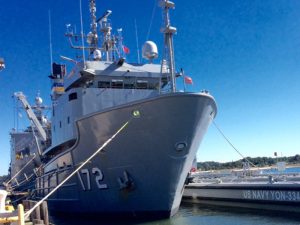
Navy tug on way to seek El Faro wreckage and VDR

The tug is deploying to a search area northeast of Crooked Island in the Bahamas island chain, which is the last known location of the vessel.

The initial search area is 100 square miles, and water depth is estimated to be 15,000 feet across the expected search area. Transit to this search area is expected to take four-to-five days due to weather.

Apache is equipped with several pieces of underwater search equipment, including a voyage data recorder locator, side-scan sonar and an underwater remote operated vehicle.

The Navy’s mission will be to first locate the ship and then, if possible, to retrieve the voyage data recorder (VDR) – commonly known as a black box.

The U.S. Navy operates some of the world’s most advanced underwater search and salvage systems. Though this equipment is typically used to search for and recover downed military ships and aircraft, the Navy has a long history in assisting other federal agencies in underwater search and salvage operations, including the search and recovery of TWA 800 and the space shuttle Challenger. In 2013, the Navy assisted the government of Australia in its search for missing Malaysian Airliner MH 370.

USN Apache is a fleet ocean tug operated by the Military Sealift Command. The ship provides towing, diving and standby submarine rescue services for the Navy.

The ship is 226 feet long and has a crew of approximately 22 civilian mariners and uniformed Navy personnel.
The crew will be joined by a team from the Navy’s Supervisor of Diving and Salvage.

Also on board is the NTSB Investigator-in-Charge, Tom Roth-Roffy, and representatives from the USCG, TOTE and ABS, all parties to the NTSB investigation (see new story).

Euro MPs want to fast track setting of shipping GHG target


Specifically, the resolution “calls for all the Parties to work through the International Civil Aviation Organization (ICAO) and the International Maritime Organization (IMO) to develop a global policy framework to enable an effective response, and to take measures to set adequate targets before the end of 2016 for achieving the necessary reductions in the light of the 2 °C target [for a limit on global warming].”

The resolution has drawn a very guarded response from European shipowners.

“We are happy to see that the European Parliament recognizes the importance of a global solution for international shipping and gives a vote of confidence to the IMO, which should be allowed to pursue its efforts,” said Patrick Verhoeven, Secretary General of ECSA, the European Community Shipowners Association. “We are however also concerned by the deadline adopted by MEPs on Wednesday. 2016 is right around the corner and as such it is rather unrealistic to expect the IMO to come up with a solution in a matter of months. A unilateral European push for a hard deadline may be counterproductive.”

ECSA calls IMO’s track record in developing technical CO2 energy efficiency measures for the maritime sector “impressive.”

Following the adoption of the amendments to MARPOL Annex VI, which came into force worldwide in 2011 and which now apply to about 95% of the global merchant fleet, international shipping is the only industrial sector already covered by mandatory and binding global measures, notes ECSA. IMO also recently adopted the Energy Efficiency Design Index (EEDI), which requires all ships constructed after 2025 to be 30% more efficient that those built in the 2000s, with further efficiency improvements going forward. Finally, the shipping industry itself, prompted by an increase in bunker prices, has made strides in increasing its energy efficiency and curbing its CO2 emissions.

As a result of recent efforts, the contribution of shipping to global CO2 emissions has in fact dropped, says ECSA.

According to the latest IMO Green House Gas study, published in 2014, international shipping (while transporting about 90% of world trade) produces about 2.2% of the world’s total CO2 emissions. This figure was 2.8% in 2007, and the total CO2 emissions from shipping went down by over 10% between 2007 and 2012. This was despite continuing growth in maritime trade which means that shipping is already delivering carbon neutral growth.

“The 2016 deadline is not consistent with the steps already taken at EU level” commented Benoit Loicq, ECSA Safety and Environment Director. “By pushing for an extremely tight deadline, the EU would essentially undermine the IMO procedure. If the EU would then focus on regional measures, it would be backtracking on its own policy.”

ECSA says the EU Monitoring, Reporting and Verification (MRV) Regulation is intended to be the first phase of a stepwise approach geared towards a global (read IMO) solution by allowing to determine the real contribution of shipping to global CO2 emissions.

“The course of action that has been agreed is to start with an accurate picture of the shipping industry’s CO2 emissions in 2018 (i.e. two years after the MEP-backed deadline),” says Mr. Loicq. “If we now backtrack and skip the data collection phase altogether, how would it be possible to set realistic and fair targets?”

Crowley in strategic partnership for BWTS retrofits

The agreement includes technical services, engineering, integration, commissioning, training, scheduled delivery and spare parts.

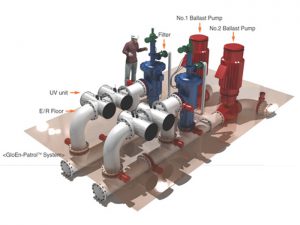
The GloEn-Patrol treatment system utilizes a filter to remove 50 micron or larger size organisms and medium-pressure UV lamps to disinfect smaller organisms.

GloEn-Patrol models treat from 50 to 6,000 cubic meters of ballast water per hour. They have IMO-type approval and certification from many classification societies including American Bureau of Shipping (ABS) and DNV GL, and U.S. Coast Guard Alternate Management Systems (USCG AMS) for non-hazardous areas such as engine rooms, and explosion proof models for installation in areas such as the main decks of articulated tug barges (ATBs) and tankers.  

“We found Panasia ballast water treatment systems to be a good operational and functional fit for our vessels, backed with a level of commitment and service we require,” said Bill Metcalf, Crowley vice president of strategic engineering. “Panasia and its management team is fully committed to our vessels’ safety and the environmental performance of our ballast water systems, and we are pleased to have them as our partner.”

Crowley says that DNV GL is completing the required tasks for the Panasia system to secure USCG type approval will provide its report by October, 2016.

DHI Group has been chosen for shipboard tests and Golden Bear Facilities has begun the work on the land-based tests, all under DNV GL’s guidance, and supervision to comply with the Environmental Technology Verification (ETV) Program.

New security door aimed at protecting ship from pirates


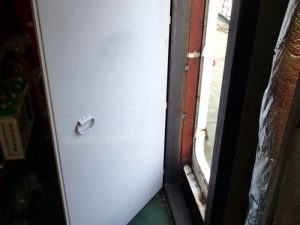
Whereas the Citadel Access Protection (CAP) SPS panels, which make up a door, are clamped in place from the inside to form a safe haven for the crew, these lockable doors are secured from the outside to protect sensitive areas of a vessel, in the event of hostile intruders.  With no visible lock, the SPS security doors have a detail free, clean flat surface.  SPS doors and panels provide six times the protection from impact loads, explosions and projectiles than equivalent steel and 75% more ballistics protection.

Ian Nash, Business Manager, SPS Marine and Offshore, says, “This innovation was in response to a client’s request to protect vulnerable areas.  The permanently fitted security doors take seconds to secure from the outside.  This allows the crew members to shut down areas of the vessel before taking refuge.  Eighty vessels have been fitted with SPS CAP security panels and doors to date.”

A recent order from Fleet Management Europe Ltd brings their total to five vessels under their management, which have been supplied with SPS CAP door panels.  More orders are expected to follow, says IE.

SPS CAP security doors and panels can be made to suit individual requirements—size, weight and door thickness can all be tailored.  By altering the thickness of the SPS panels (steel and polyurethane) their performance can be altered to meet specific safety criteria.

Silver Ships delivers multi-mission boat

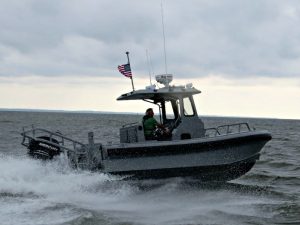
OCTOBER 14, 2015— Silver Ships, Inc., Theodore, AL, recently delivered a Freedom 21 all-aluminum patrol/rescue boat to the Southampton, NY, Bay Constables.  The 21-foot center console boat was designed and engineered for

Safety: The Unseen Killer


A shift in the approach to safety management of enclosed spaces on board ships is needed. Fifteen years ago, while working as an independent surveyor, I was carrying out a condition survey on board a bulk carrier. The scope of the survey included testing the emergency generator, located in the steering flat and accessed by an inclined ladder.

Accompanied by the superintendent and the chief engineer, we had no sooner reached the bottom of the space when the chief engineer urgently ordered us all out. By the time we had exited the space, within seconds, we were all in a state of dizziness and confusion, compounded by our inability to comprehend what had just occurred. Further investigation revealed that Freon gas had leaked from refrigeration machinery located in the steering flat and being heavier than air, had migrated into the emergency generator space, displacing breathable air. It was a lucky escape. Victims of asphyxiation in enclosed spaces deficient in oxygen will normally receive no such warning that anything is wrong or have the ability to quickly escape.

Should we have been aware that this emergency generator space, not being enclosed in the usually perceived sense of the word, was potentially dangerous for entry? Absolutely.

The International Maritime Organization (IMO) currently defines an enclosed space as having any of the following characteristics:

  1. Limited openings for entry and exit;
  2. Inadequate ventilation; and
  3. Is not designed for continuous worker occupancy, and includes, but is not limited to, cargo spaces, double bottoms, fuel tanks, ballast tanks, cargo pump-rooms, cargo compressor rooms, cofferdams, chain lockers, void spaces, duct keels, inter-barrier spaces, boilers, engine crankcases, engine scavenge air receivers, sewage tanks, and adjacent connected spaces. This list is not exhaustive and a list should be produced on a ship-by-ship basis to identify enclosed spaces.”

Most could be forgiven for not considering our generator space to fall within this definition, although it was clearly proven to present a danger in a particular circumstance.

Another very common example of confusion over what actually constitutes an “enclosed space” is the inconsistent perception of the dangers presented by CO2 fixed fire extinguishing system cylinder storage rooms. A leak in the system may accumulate in the space and displace breathable air if not thoroughly ventilated.

Carbon dioxide (CO2) rooms are frequently not identified as enclosed spaces on board and not provided with appropriate warning signs at the space access. Crew members may easily fail to appreciate that a CO2 room should properly be included within the aforementioned definition of an enclosed space.

No atmosphere hazard warning notice
The IMO list of enclosed spaces is not exhaustive, it is therefore important that ship managers and crew apply a wide interpretation as to what spaces on board each vessel could potentially be deficient in oxygen, and/or contain flammable and/or toxic gases or vapours, therefore requiring safety precautions to be observed prior to entry.

The dangers associated with enclosed spaces are well known yet deaths continue to occur.

Part of the issue may be misconceptions as to what spaces are or may become dangerous, and how they are identified. At present, there is no industry standard for the design and siting of warning notices and symbols that may be universally understood by ship and shore personnel. Indeed, on many ships, no attempt is made to provide any such labelling at points of access.

Cargo hold access – No warning notices
Warning notices alone will not overcome the problem as otherwise professional and well trained seafarers continue to enter enclosed spaces. In May last year, three crew members on board a cargo ship lost their lives after entering a cargo hold loaded with sawn timber, a cargo known to cause oxygen depletion.

Another part of the solution must also lie in improved levels of education and training of both ship and shore personnel. Reference is made to IMO Resolution A.1050(27) “Revised Recommendations For Entering Enclosed Spaces Aboard Ships” adopted in 2011. These recommendations provide, inter alia, that shipowners must adopt a comprehensive safety strategy to prevent accidents on entry to enclosed spaces, and that procedures for enclosed space entry are included among the key shipboard operations concerning safety of personnel and the ship. The recommendations also provide that no person should open or enter an enclosed space unless authorized by the master or the nominated responsible person, and unless the appropriate safety precautions laid down for the particular ship have been followed.

Despite the training requirements included in the above revised recommendations, IMO has recognized that more needs to be done to respond to the continuing loss of life from personnel entering shipboard enclosed spaces. This has taken the form of amendments to SOLAS regulation III/19 “Emergency training and drills”, which entered into force on January 1, 2015, and requires that enclosed space entry and rescue drills are to be conducted at two month intervals. The amendments include the following:

“3.6 Enclosed space entry and rescue drills

3.6.1 Enclosed space entry and rescue drills should be planned and conducted in a safe manner, taking into account, as appropriate, the guidance provided in the recommendations developed by the Organization [i.e. Resolution A.1050(27)] .

3.6.2 Each enclosed space entry and rescue drill shall include:

.1 checking and use of personal protective equipment required for entry;

.2 checking and use of communication equipment and procedures;

.3 checking and use of instruments for measuring the atmosphere in enclosed spaces;

.4 checking and use of rescue equipment and procedures; and

.5 instructions in first aid and resuscitation techniques.

4.2 Every crew member shall be given instructions which shall include but not necessarily be limited to:

.5 risks associated with enclosed spaces and on board procedures for safe entry into such spaces which should take into account, as appropriate, the guidance provided in recommendations developed by the Organization.

In addition to these welcome changes, the IMO has recently seen fit to rectify the anomaly that until now, no industry wide requirements have been in place, requiring all vessels to carry atmosphere testing instruments.

For all of this to be effective, it is necessary that ship staff, with the support of shore management, perform mandatory drills, training and actual entry procedures with a dedication and seriousness that reflects the dangers that attend enclosed space entry. A Permit to Work must be fully completed and signed off at the site of the task so that it is contemporary and reflects the actual hazard and safety needs of the operation. All too often, On every occasion before carrying out a job, pre-work meetings or “tool box talks” need to be arranged to identify who does what, the tools needed to identify the risks involved and what to do if something goes wrong.

Drills and training should be properly planned and be used as an opportunity to assess the challenges of rescue from the variously identified enclosed spaces on board. Training should also emphasize to crew the importance of raising the alarm when persons are found to be in difficulty within an enclosed space, and that any rescue is properly coordinated in accordance with practiced procedures.

Comprehensive record keeping and interactive post drill de-briefs will assist in identifying any weaknesses in procedures and promote crew ownership of the training program.

Last but not least, a zero tolerance culture to unplanned and unprepared entry into any enclosed space requires to be rigorously enforced and ingrained into all personnel, on board and ashore.

—By David Nichol, Risk Assessor, UK P&I Club