
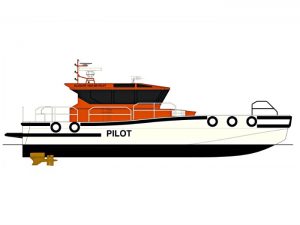
Major pilot boat contract for Maritime Partner
JANUARY 18, 2016—Maritime Partner AS, Alesund, Norway, has signed a contract with Buksér og Berging AS for the delivery of two 15m, 30-knot pilot boats, including an option for a further eight
JANUARY 18, 2016—Maritime Partner AS, Alesund, Norway, has signed a contract with Buksér og Berging AS for the delivery of two 15m, 30-knot pilot boats, including an option for a further eight

JANUARY 12, 2016 – Shipping and aviation may not have been explicitly included in the text of the Paris Agreement adopted at last month’s COP21 conference on climate change, but that does
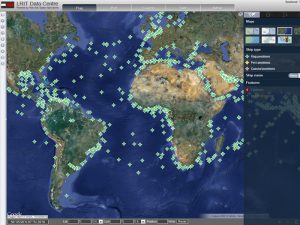
JANUARY 8, 2016 — London headquartered Pole Star Space Applications says that it been awarded a U.S. Coast Guard for the provision of LRIT ASP (Long-Range Identification & Tracking Authorized Service Provider)
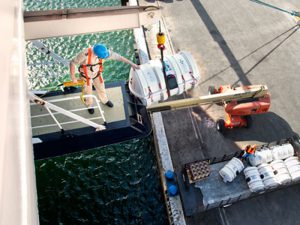
JANUARY 7, 2016 — Esbjerg, Denmark, headquartered marine safety equipment manufacturer and servicing provider Viking Life-Saving Equipment A/S is to establish a local presence in Korea through a joint venture agreement with

JANUARY 7, 2016 — Furuno issued a notice to customers this week saying that potential vulnerability to cyber attack had been found in its Voyage Data Recorder (VDR) products. Subsequently, it says,
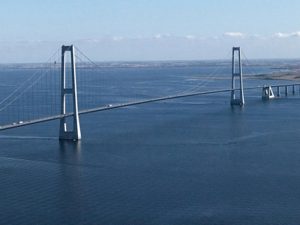
JANUARY 6, 2016 — The Danish Environmental Protection Agency and the Danish Maritime Authority have published an action plan for 2016 aimed at strengthening enforcement of regulations on ships’ sulfur emissions in

JANUARY 4, 2016 — Information technology (IT) and operational technology (OT) onboard ships are increasingly being networked together – and more frequently connected to the worldwide web, increasing the risk of unauthorized

DECEMBER 30, 2015 — The U.S. Coast Guard has issued a safety alert reminding recreational boaters and commercial vessel operators to use caution when operating their vessels near areas where dredging operations
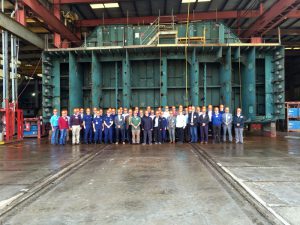
The barge is under construction at Conrad Shipyard in Orange, TX, which has just hosted a tour where 200 participants at a USCG Liquefied Gas Senior Executive Forum got a chance to see its progress.
Hull construction of the 2,200 m3 barge is near complete and abrasive blasting and painting is scheduled to begin in the coming weeks.
The barge’s LNG Mark III Flex cargo containment system, designed by Gaztransport & Technigaz (GTT), is scheduled to be installed immediately following the February launch.
The Bristol Harbor Group designed and ABS classed vessel will be outfitted with a 20 m bunker mast (custom fabricated by Conrad under GTT license) that will enable the barge to service a wide variety of vessels. It will also be equipped with six DH Industries StirLNG-4 cryocoolers sized to handle 125% of the vessel’s boil-off gas, along with other systems specifically designed for this vessel’s LNG bunkering application to deliver the coldest LNG to the end user.
The barge will be delivered to Jacksonville, FL in the third quarter of 2016 to service TOTE’s newbuild Marlin class LNG fueled container vessels and other LNG fueled vessels in and around the Port of Jacksonville and the Southeast.
CME is partnered with WesPac Midstream LLC (WesPac) and together with Pivotal LNG (Pivotal), a subsidiary of AGL Resources, will own and operate JAX LNG, a small scale liquefaction facility in the port of Jacksonville. The plant is planned to be commissioned during the first quarter of 2017 and will be capable of providing LNG to locations up and down the Florida and Georgia coasts.

Norway’s Optimarin, which claims to be on the brink of full USCG approval of its UV based system, says the decision is good news.
The Coast Guard has told UV system manufacturers that it will not accept the Most Probable Number (MPN) testing method in its approval process. The MPN methodology evaluates organisms on the basis of “viable/unviable,” with most UV systems depositing “unviable” organisms back into the water – meaning they are still alive but cannot reproduce.
The USCG says that FDA/CMFDA test, which judges life forms as “living/dead,” must be the standard for approval.
Optimarin says that having systems with USCG approval is imperative for any shipowner wanting to discharge ballast in U.S. waters after January 1,2016.
“This is a clear indication to the industry that USCG wants absolute certainty with regard to standards – they do not want living organisms deposited in their territory,” comments Tore Andersen, Optimarin’s CEO. “MPN is acceptable for IMO, but that won’t be any consolation to shipowners with global fleets that want the flexibility of sailing in and out of U.S. waters.”
Mr. Andersen notes that while the USCG is currently accepting vessels with approved Alternate Management Systems (AMS) based on testing by another flag state, can discharge ballast in that approval is good for only five years after the vessel’s compliance date.
“At that point, if they haven’t met the USCG’s own ‘instant kill’ standard, they will have to be changed,” says Mr. Andersen. “That’s a burden of potential cost and uncertainty that shipowners operating in today’s tight market shouldn’t have to contend with.”
He says that Optimarin, which has over 20 years of industry experience and installed the world’s first commercial BWT system in 2000, is the only UV manufacturer that is currently within “touching distance” of USCG approval.
Its technology successfully satisfying the FDA/CFMDA criteria during testing this year. Further tests in other water salinities are scheduled for spring 2016, after which point approval is expected later in the year.
Mr. Andersen says the system’s power is the key to its efficacy.
“Each of our system lamps has a 35 kW capacity, which is huge for a UV system. That power instantly kills invasive organisms and that’s exactly what USCG wants to see,” he says.
Optimarin has now sold over 350 of its systems to shipowners across the world, with more than 270 installed, over 60 of which are retrofits.
One major client of the business is Saga Shipholding. Optimarin signed a frame agreement with the open hatch bulk shipper in 2011 and has since gone on to install 26 systems, including eight newbuild installations, on a fleet that currently numbers 32 vessels. The remainder will receive their BWT units during 2016.
Eivind Holte, Senior Technical Manager Saga Shipholding (Norway), notes that Saga’s ships are frequent visitors to the U.S., servicing ports on both the West and East Coasts.
“I can’t overstate the importance of USCG approval to us,” he stresses, “it’s basically a ‘ticket to trade.’ We’re very happy that we chose Optimarin, for both their system’s technology and its compliance, with full USCG approval on the horizon.”
AMS accepted units, he says, present a “real risk.”
“They’re compliant now, but will they be in five years time? The cost of changing existing systems across a fleet to ensure compliance would be disastrous, just disastrous,” says Mr. Holte.
“Making the right choice for BWT systems is crucial,” he says. “Shipowners have to choose systems and suppliers they trust. We did, and that decision, now more than ever, looks to be completely correct.”