Op-Ed: Singapore Cruise Centre reimagines passenger operations with real-time data
Written by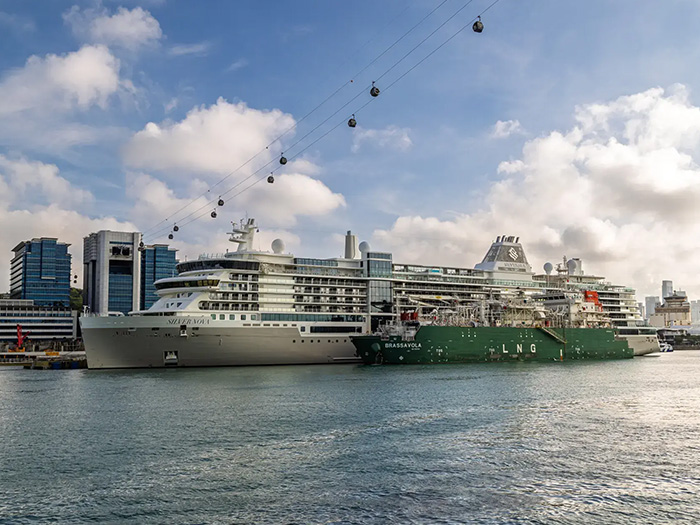
Photo Credit: Singapore Cruise Centre
Attributed to Lee Siew Kit, Vice President of Technology & IT, Singapore Cruise Centre
Singapore Cruise Centre is nearing the final phase of a five-year digital transformation aimed at improving passenger flow and operational efficiency through increased use of real-time data.
Central to the effort is a data integration platform built on event-driven architecture (EDA), which enables coordination across passenger movements, vessel schedules, baggage handling and terminal resources, while also connecting with external partner systems. The platform is intended to improve visibility across operations and support more consistent coordination among stakeholders.
The system also supports further development in areas such as predictive analytics, generative AI and digital twin applications. These tools are expected to help translate operational data into insights for planning, maintenance and decision-making.
Lee Siew Kit, vice president of technology and IT at Singapore Cruise Centre, discusses how the organization is applying data integration and analytics to maritime passenger operations.
For decades, maritime passenger terminals have been engineered primarily as physical infrastructure—piers, halls, counters, and queues—designed to move people and vessels safely from shore to sea, and vice-versa. Today, that paradigm is shifting. As passenger expectations rise and operational constraints tighten, the future of cruise and ferry terminals will be defined not by concrete and steel alone, but by data, integration, automation, and intelligence.
Singapore Cruise Centre (SCCPL) is nearing the final phase of a five-year digital transformation journey to modernize its terminals and operations. A clear imperative drives this transformation: to deliver seamless, end-to-end passenger experiences while managing rising manpower costs, limited berth capacity, and increasing operational complexity. More broadly, it reflects the growing need to digitalize the maritime passenger sector, an industry that must now operate with the same precision, responsiveness, and situational awareness as modern airports.
Navigating complexity through real-time data integration
One of the core challenges that SCCPL faced was fragmentation. Passenger journeys, vessel movements, baggage flows, and resource deployments were traditionally managed through siloed systems, batch-based integrations, and manual coordination. The fragmentation resulted in a struggle to keep pace with real-time operational variability, whether that was a delayed vessel, a sudden surge of passengers, or a last-minute change in staffing needs.
To address this, SCCPL adopted a real-time data integration platform, underpinned by Solace’s EDA technology, as the backbone of our digital transformation. Through this network of interconnected systems and applications, data flows continuously and securely across the enterprise and ecosystem. When an event occurs—an itinerary is booked, a departure time is updated, or a sensor triggers a vessel movement to and from a jetty—that event is published once and consumed by all relevant systems in real-time.
This shift to an events-powered integration network, or as we call an event mesh, has fundamentally changed how SCCPL operates. This unified data layer has empowered us to move from reactive management to anticipatory and responsive operations, unlocking new levels of efficiency, visibility, and coordination across terminals.
For instance, when a passenger checks in, their information is instantly sent to the immigration system. When the passenger approaches the self-service immigration gate, they can clear immigration using just their biometrics, no passport scanning required. This enables a seamless, contactless, and document-free immigration clearance experience, with the entire process completed in under five seconds.
At the heart of SCCPL’s operational model is the orchestration of multiple journeys through a rigorous four-stage data lifecycle: vessels, passengers, baggage, staff, and shared resources.
The process begins months in advance during the Seasonal phase, where historical data and forward-looking schedules support long-term capacity and berth planning.
This narrows into the Pre-Tactical phase in the days leading up to operations, as confirmed bookings and operator schedules are integrated to refine staffing rosters and resource allocations.
For the Tactical phase, real-time events from sensors, systems, and frontline agents drive dynamic decision-making. Passenger flows, queue lengths, equipment status, and vessel updates are continuously streamed, allowing resources to be redeployed instantly as conditions change.
Finally, the Post-Tactical phase leverages historical audit trails to reconcile billings, assess performance, and sharpen future planning.
This is a complex undertaking to orchestrate operations across the ferry and cruise environment reliably, but with Solace’s robust platform, we have transformed a once-siloed terminal infrastructure into a responsive, dynamic ecosystem, one that optimizes every movement from long-term forecast to final departure. Without such a solution, turning around a 300-seater ferry (comparable to an A359 aircraft) within 30 minutes, and optimizing berth and resource allocation, would not be possible.
Enhancing the ferry and cruise experience
The impact of real-time data isn’t limited to complex planning models but is equally powerful in day-to-day passenger communication. A simple but telling example is our Public Announcement (PA) system.
Previously, individual PA units periodically queried backend systems for updates, creating latency and inconsistencies. Today, any change, such as a ferry opening or boarding time update, is instantly published by the backend. All relevant PA units automatically subscribe to and retrieve the updated message, ensuring timely and consistent announcements across the terminal.
For passengers, this means clearer, more reliable information. For operators, it reduces manual intervention and ensures that communication keeps pace with live operations—an essential component of superior customer experience in high-throughput environments.
SCCPL is now better positioned to play a broader role within the maritime ecosystem. By standardizing data sharing with partners such as ferry operators and government agencies, we have laid the foundation for advanced use cases like our Maritime Passenger Terminal Digital Twin.
Through shared master vessel records, real-time vessel data (including location, speed, ETA/ETD, and load), operational alerts, and visual analytics from CCTV and video analytics systems, the Maritime Passenger Terminal Digital Twin can provide data-driven insights that improve risk management, optimize planning, and support safer, more efficient, and environmentally sustainable operations.
Another use case is the fly-ferry and fly-cruise integration, where seamless coordination between airports and maritime terminals is paramount. Through event-driven data exchanges, SCCPL supports the secure and timely transfer of passenger and baggage information across the entire journey, from flight arrival to ferry or cruise disembarkation (covering air, land and sea transfers), and vice-versa.
This includes the real-time transfer of passenger and baggage manifest lists, live location and status updates of passengers and bags in transit, and final reconciled manifest lists upon departure. Real-time data processing and instant communication capabilities ultimately reduce delays, minimize mishandling, and significantly improve transfer reliability and security for passengers navigating multiple modes of transport. This ecosystem-centric approach recognizes that terminal efficiency cannot be achieved in isolation. It depends on shared situational awareness and coordinated action across all stakeholders.
Building the foundation for AI-driven operations
Crucially, our move to real-time data integration also sets the stage for our long-term AI roadmap. As SCCPL works toward an Integrated Operations Command and Control Centre, event-driven architecture serves as the underlying platform that eliminates integration bottlenecks and enables AI to operate at full capacity.
Our AI roadmap unfolds in three phases:
- Internal Gen AI, which will enable us to easily retrieve operational knowledge of Concept of Ops (Con Ops) from policies, SOPs, checklists, and the data lake, improving compliance and execution
- Analytics with AI, where we then apply predictive and prescriptive analytics to come up with pre-emptive action plans, helping us anticipate and mitigate operational disruptions
- Digital Twin with Agentic AI, the final phase, which envisions a fully-integrated digital twin that fuses IT and OT data to provide complete ground situation awareness, support AI-augmented decision-making, automated workflows, checklists, reports, and escalation procedures, ensuring coordinated response across terminals, vessels, and partners
None of this is possible without real-time, reliable event data. With its successful deployment, we are well-positioned to move forward into the AI adoption phase, transforming operational data from static reports into proactive, actionable insights. This sets a new benchmark for AI-driven maritime passenger operations, paving the way for smarter, safer, and more seamless terminal experiences.
As we enter the final stretch of our transformation, one lesson stands out: digitalization isn’t just deploying more systems; it’s about connecting these systems intelligently. Real-time data, supported by EDA, has allowed SCCPL to turn data into action, complexity into clarity, and infrastructure into an adaptive platform.
For the maritime passenger sector, the path forward is clear. Those who invest early in integration strategies powered by real-time data will be best positioned to meet rising expectations and mitigate disruptions. At SCCPL, we see this not as the end of a journey, but as the foundation for the next generation of smart, resilient, and passenger-centric maritime operations.
Categories: Ferries, News, Op-Eds, Passenger, Technology

![Estonia’s first fully electric ferry will be built by Crist S.A. [Image: LMG Marin]](https://www.marinelog.com/wp-content/uploads/2026/05/LMG-Marin-visuaal-uuest-parvlaevast_talv-300x225.jpg)