Gunderson-built McMurdo docking pier arrives in Antarctica after epic tow
Written by Nick Blenkey
McMurdo docking pier (NSF DIscovery Pier) was towed from the Pacific Northwest by New Orleans-headquartered TradeWinds Towing’s tug Rachel. [Photo: Trade Winds Towing]
The McMurdo docking pier, (built as the barge NSF DIscovery Pier) constructed by Gunderson Marine & Iron (GM&I) for the U.S. Army Corps of Engineers, has successfully arrived at McMurdo Station, Antarctica following a 9,159 nautical mile voyage across the Pacific Ocean and Southern Ocean.
The 328-foot-long, 100-foot-wide pier will replace the traditional seasonal ice pier historically used at McMurdo Station. Designed by Glosten with a raked hull to ride on top of sea ice and engineered for long- term durability in polar conditions, the new pier will provide more reliable, lower- maintenance mooring infrastructure to support cargo operations at the largest research facility in Antarctica.
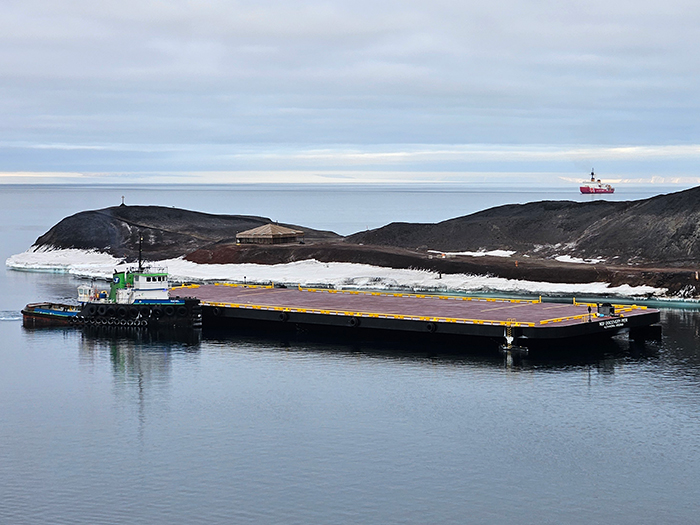
The pier, towed from the Pacific Northwest by New Orleans-headquartered TradeWinds Towing’s tug Rachel, was underway for 69 days, averaging 5.5 knots over the course of its journey. This total includes four days of route adjustments to avoid severe Southern Ocean weather systems. During the final leg of the voyage from New Zealand to McMurdo, the tow encountered seas reaching 30 feet, underscoring the extreme conditions the structure was engineered to withstand.
“This project reflects the capability and resilience of our workforce,” said Dee Burch, president of Gunderson Marine & Iron. “From engineering and fabrication in Portland to arrival at the edge of the world, this pier represents the strength of American shipbuilding and the commitment to supporting critical scientific research in one of the harshest environments on earth.”
The successful arrival marks a major milestone in the multi-year effort to modernize logistics infrastructure supporting U.S. Antarctic research operations.
TradeWinds Towing says that the voyage began on December 3, 2025, and included port calls in Honolulu, Hawaii; Pago Pago, American Samoa; and Lyttelton, New Zealand, before the final push south.
Preparation for the voyage began in late October 2025, with TradeWinds Towing and Gunderson Marine & Iron collaborating to meet all U.S. regulatory requirements and International Maritime Organization (IMO) SOLAS standards.
At the start of the voyage, the 1974-built Rachel became the first U.S. vessel to receive approval under the newly revised IMO Polar Code, which now applies to vessels over 300 gross tons. The certification required a comprehensive polar plan and risk analysis addressing navigation, extreme weather, engineering safeguards, tow-winch protection, and enhanced survival equipment.
The voyage demanded meticulous logistical planning, including compliance with New Zealand’s stringent biofouling regulations. The Rachel underwent a full diver-performed hull cleaning in Honolulu, while the NSF Discovery Pier qualified for an exemption due to its new-construction status.
Upon arrival in Lyttelton on Jan. 28, TradeWinds deployed management personnel to coordinate with the port authority for what could be a 40-day round-trip to Antarctica. Local officials noted that this was the first tug-and-tow configuration of its kind to enter the harbor in well over 15 years, drawing significant public interest.
Departure from New Zealand included boarding two ice pilots from SKUA Ice Pilots of Chile, as required by the IMO Polar Code, and close coordination with the USCGC Polar Star, the United States’ only Antarctic icebreaking cutter. Months of planning ensured a synchronized arrival following McMurdo Station’s annual hard-goods resupply vessel.
“As the RacheL entered the Screaming 60s,” says Tradewinds Towing, “Franklin D. Roosevelt’s words rang true: ‘A smooth sea never made a skilled sailor.’ The crew navigated days of steady 20- to 30-foot seas. Constant communication between TradeWinds management and the captain’s on-scene assessments ensured a safe and deliberate strategy through the region’s notorious conditions. Expert forecasting by the professional team at Locus Weather provided timely, precise updates to management and tug as conditions evolved across the volatile weather in the ‘Screaming 60’s/ and Southern Ocean as they transpired.
On Feb. 20, the Rachel entered the ice gate in the Ross Sea, and the crew spotted their first penguin on drift ice—an unmistakable sign that McMurdo Station was within reach. Escorted by the Polar Star the Rachel safely moored the new pier, NSF Discovery Pier to shore. This was carried out in conjunction with Gunderson Marine & Iron technical experts, the crew of the Polar Star, Navy Seabees, the U.S. Army Corps of Engineers, and representatives from the National Science Foundation (NSF).
TCaptain Justin Gustafson summed up the voyage: “I am proud to be a part of his historic voyage delivering the NSF Discovery Pier to McMurdo station. The voyage was a long trip for the pier, originating from Portland, Oregon. The Southern Ocean gave the relatively low freeboard of the barge a bit of a fight during the final leg of the voyage. Crossing safely through 30-foot seas, with the help of our shoreside team and weather services, we were able to properly plan around the weather for a large portion of the transit – holding position north of an advancing front for approximately four days. With the help of the Skua ice pilots and USCGC Polar Star we were able to avoid significant contact with sea ice during our final transit into McMurdo, with the Polar Star making a pass through an ice flow 15n m north of McMurdo.”
Categories: News