Aker Philly cuts steel for two more Kinder Morgan tankers

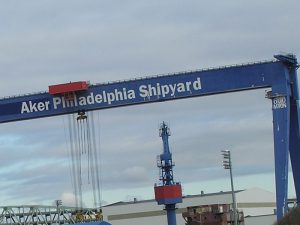
Construction on the two Jones Act vessels officially began in the shipyard’s fabrication shop when guest of honor Pennsylvania Lieutenant Governor Mike Stack pushed the button on the shipyard’s plasma cutting machine. The first steel plates that were cut will later become part of the engine room.

At the ceremony, the shipbuilder’s President and CEOI, Steinar Nerbovik, said: “With construction underway on these two product tankers, we celebrate the capstone of an exciting eight tanker series that is part of Philadelphia’s contribution to the energy landscape of this country. The 1,100 men and women working at the shipyard will be busy for years to come completing these tankers and the other vessels we have under contract.”

“We are very pleased to be working with the Aker Philadelphia Shipyard on the construction of four, LNG-conversion-ready tankers, and the start of construction of these two vessels marks a milestone for our expanding fleet,” said Robert Kurz, Vice President of Kinder Morgan Terminals and President of APT. “There continues to be a strong demand for domestic marine transportation of petroleum products and crude oil, and these tankers will provide Kinder Morgan with additional new tonnage to better service our customers.”
The next generation 50,000 dwt product tanker is based on a proven Hyundai Mipo Dockyards (HMD) design that incorporates numerous fuel efficiency features, flexible cargo capability, and the latest regulatory requirements. When completed, each of the 600-foot tankers will have a carrying capacity of 14.5 million gallons to transport crude oil or refined products.

Also under construction at the shipyard are three 50,000 dwt product tankers for Crowley with planned deliveries through 2016, the first two 50,000 dwt tankers for APT with planned deliveries in 2016 and 2017, and two containerships for Matson Navigation Company, Inc. with planned deliveries in 2018.
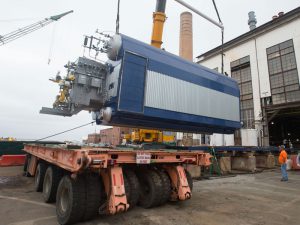
NNS switches its steam plant from HFO to gas

 The plant generates low-pressure steam to heat many of the shipyard’s facilities, to provide process heat and to support hotel services—including hot water, food preparation and galley services—to the ships undergoing construction and overhaul.

“We started researching and evaluating alternative options about four years ago with the goal of implementation by 2016,” said Bill Cash-Robertson, a Newport News Shipbuilding environmental engineer. “Not only does the conversion to natural gas make good business sense, it’s more efficient, it’s cleaner, and it’s safer to operate.”

The old system, which included three 70-year-old boilers, burned about 6 million gallons of heavy fuel oil last year, costing the shipyard about $15 million.

Plant Engineering Supervisor Ken Allmon, a member of the shipyard’s energy management team, said the new system will reduce greenhouse gases by 30 percent and save the shipyard several million dollars per year in lower utility costs.”The team is proud of our work to overcome technical challenges and implement a solution that is a win for everybody,” he said.

Will Koeck, the project’s construction engineer, said one challenge was to safely remove and install large boilers in a plant that had to continue operating during the conversion. “We met the challenge with careful coordination and planning, and we had the first new boiler in place making steam in December 2014,” he said.

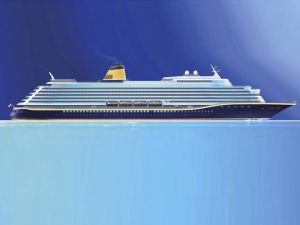
Saga Cruises orders 1,000 passenger newbuild at Meyer

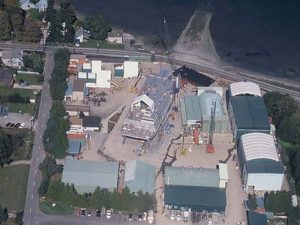
The dock is presently used for block construction and by reopening it the shipyard will be able to deliver three cruise ships, including the Saga newbuild. The cruise line’s memorandum of agreement with Meyer has an option for a second vessel for 2021 delivery.

The Meyer Werft ship will be Saga Cruises’ first newbuild.  Catering for passengers in the 50+ age group, the cruise line currently has two ships, the 446-passenger Saga Pearl II and the 706-passenger Saga Sapphire, both built in 1981. According to Daily Telegraph, demand for sailings on the ships is extremely high: they carried around 25,000 passengers last year, with a 75 per cent repeat passenger rate.

The new ship will be 234 m long by 30.8 m wide and will have 540 cabins, all with balconies and with about 15% designed for passenger cruising solo.

“This is an important milestone in the future of Saga Cruises,” said the line’s CEO, Robin Shaw. “We are happy to develop this vessel, tailored to our individual needs, and we’re delighted to be working with Meyer Werft, a recognized leader in cruise ship construction.”

Bulker sea trials confirm benefits of Kappel FP propeller

The ships — the Elsabeth C and Mirela — feature single MAN B&W 5S60ME-C8.2 engines delivering 8,050 kW SMCR @ 89 rpm. They are owned by Frontmarine, an associate company of Lemissoler Navigation of Cyprus, and were

Lemissoler reports that the Kappel propeller offers significant fuel savings compared to conventional propellers and, together with the new vessels’ design and lines as well as the silyl acrylate antifouling paint, contributed to favorable results from the first two vessels’ sea trials. It reports that both vessels consumed an average 23 mtns per day at a speed of about 14.2 knots in ballast conditions during the trials. The Elsabeth C also performed a successful crash-stop test that was notable for its lack of noise and vibration.

Thomas Leander, Head of Propulsion – PrimeServ Four-Stroke – Denmark, said: “A key point during the design stage was to address the problem experienced by similar vessels that experience an overly-small light running margin (LRM). Therefore, MAN Diesel & Turbo recently introduced new light running margins for all FP propellers and two-stroke engines of 4-10%. Furthermore, the propeller layout for these 58,500-dwt vessels is 3-4% higher than normally applied to these vessel types. In doing so, MAN Diesel & Turbo has managed to ensure safe and reliable operation, while improving the vessel’s efficiency and maneuverability during its entire lifetime.”

The MAN Alpha Kappel propeller was optimized out based on the stern and wake field for the newly designed 58,500-dwt vessel, with a 58,500-dwt stock propeller.

The Elsabeth C and Mirela were constructed by New Times Shipbuilding Co’s Jiangsu, China, shipyard . The remaining sisters are scheduled for delivery over the next 12 months.

lemisoler two 700

Incat Tasmania wins contract for new Sydney ferries

Announcing the result of the competitive tender for the contract, NSW Minister for Transport Andrew Constance called the ferries “a major step forward in the NSW Government’s plans to modernize and expand the ferry network. “


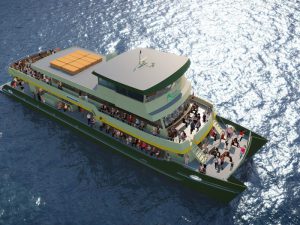
Externally, the ferries have a traditional design to look similar to the Sydney First Fleet vessels, however the 35 m, 400 passenger boats have greater capacity than the current fleet.

The interior will be more spacious with comfortable inside seating, outdoor viewing areas, a large walk around deck and additional features for passengers; including Wi-Fi access and real-time journey information, and charging stations for electronic devices.

The Sydney Ferries will service commuter and tourist travel on the inner harbor routes from Watsons Bay in Sydney’s east to Cockatoo Island in the west, stopping at the new Barangaroo wharf.

With the contract secured, the Incat team’s next task is to take the concept design to detailed construction drawings and vessel models, with construction of the first ferry to start early in 2016. The six will be delivered progressively from late 2016 and throughout 2017.

The Incat Tasmania Pty Ltd shipyard at Prince of Wales Bay in Hobart Tasmania has around 250 staff.

“This is a great opportunity for Incat’s highly skilled and experienced workforce to participate in the construction of ferries for the iconic Sydney fleet,” said the yard’s Managing Director, Simon Carter. ” An order such as this, where six identical vessels are to be built, is welcomed by the existing staff and provides an excellent opportunity for training new personnel.”

Incat has recently completed two fast ferries for London, England, operator Thames Clippers. They are currently on their way to London and due to enter service in October. Four fast ferries — two 24 m and two 33 m boats — are also under construction for Sydney company Manly Fast Ferry.

BAE Hawaii gets two Navy contracts worth $52.84 million

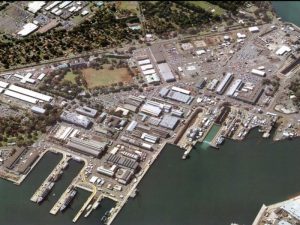
Yesterday, the ship repairer was awarded a $13,705,115 modification to previously awarded contract (N00024-14-C-4412) for fiscal 2015 and 2016 ship inter-availability planning that will see it provide administration, continuous maintenance planning and program management for continuous maintenance availabilities, emergent availabilities and windows of opportunity. Work will be performed at Pearl Harbor, Hawaii, and is expected to be completed by August 2016. Fiscal 2015 operations and maintenance (Navy) funding in the amount of $9,133,057 will be obligated at time of award and will expire at the end of the current fiscal year.

Today it got a a $39,144,842 modification to previously awarded contract N00024-14-C-4412 for scheduled drydocking selected restricted availability (DSRA) of USS Halsey (DDG 97). The scheduled DSRA is the opportunity in the ship’s life cycle primarily to conduct repair and alteration to systems and hull not available when the ship is waterborne. Work will again be performed in Pearl Harbor, Hawaii, and is expected to be completed by July 2016. Fiscal 2015 operations and maintenance (Navy) funding in the amount of $39,144,842 will be obligated at time of award and will expire at the end of the current fiscal year.

Pearl Harbor Naval Shipyard and Intermediate Maintenance Facility, Pearl Harbor, Hawaii, is the contracting activity for both contracts.

Damen delivers the second of two Mamola PSVs

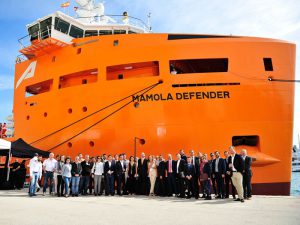
SEPTEMBER 24, 2015 — Following a naming ceremony in Barcelona, Spain, yesterday, Promar Shipping Services has taken delivery of Mamola Defender. the second of two Damen PSV 3300 platform supply vessels ordered

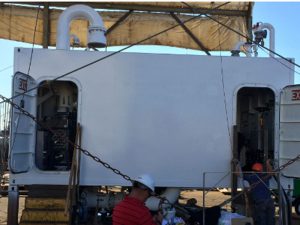
First Ballast Water Treatment Deck Modules delivered

SEPTEMBER 23, 2015 – Seattle, WA, based engineering consultancy Glosten reports that Marine Systems Inc. (MSI) has delivered a pair of Ballast Treatment System Deck Modules, designed for tank barge and ship

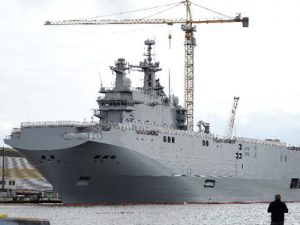
Egypt to buy Mistrals ordered by Russia from France

SEPTEMBER 23, 2015 —  A brief announcement from the Élysée Palace, the official residence of the President of France, said today that President Francois Hollande and Egyptian President Abdel Fattah el-Sisi had

Kirby back at Nichols for two twin screw tugboats

The two tugs just ordered will each be powered by twin Caterpillar 3516C engines delivering 2,447 bhp at 1,600 rpm with Reintjes reduction gears turning two NautiCAN fixed pitched propellers with fixed nozzles. The vessels will also have two C7.1 Caterpillar generators for electrical service.

Deck machinery includes one TESD-34 Markey tow winch, one CEW-60 Markey electric capstan, and one Smith Berger Tow Pin.

Keels will be laid for both vessels this fall with delivery of the first vessel from the shipyard scheduled for May 2017 and the second vessel scheduled for delivery in November 2017.

The tugboats will carry an ABS loadline, and will be compliant with USCG regulationsJensen Maritime Consultants of Seattle WA, will provide the ABS Class and functional design for the tugboats. , as required at delivery.

LOAD MORE