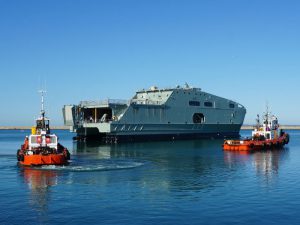
Australia names preferred tenderer for new icebreaker

Computer–generated images and video of the new ship were showcased October 29 at an event attended by Prime Minister Malcolm Turnbull MP, at the AAD’s headquarters in Kingston, Tasmania.

The icebreaker, designed by Danish naval architect firm, Knud E. Hansen, will be built by DMS Maritime’s subcontractor Damen Schelde Naval Shipbuilding at Damen’s Galati, Romania, shipyard with commissioning expected in October 2019. DMS Maritime would then operate and maintain the vessel in support of the Australian Antarctic program on a long-term basis.

Replacing the Aurora Australis, which has been in service since 1989, the new icebreaker will be faster, larger, stronger and offer increased endurance.

According to a fact sheet released by the Australian Antarctic Division, the new icebreaker will have an icebreaking capability of 1.65 meters at 3 knots compared to the existing vessel’s 1.23 meters at 2.5 knots.

The vessel will supply Antarctic research stations with cargo, equipment and personnel, and will serve as a research ship with extensive laboratory facilities on board and a multi-beam bathymetric echo sounder to enable seafloor mapping,

The vessel is expected to accommodate 34 DMS Maritime crew and up to 116 AAD scientific personnel, and has the ability to embark up to four helicopters, two landing craft and a dedicated science tender. Its physical specification is expected to be 156 m in length and 23,400 tonnes displacement.

Media Factsheets 2


Cape Town naming for offshore diamond mining support boat

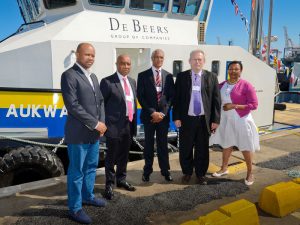
They are being built to carry out supply and support work for the De Beers Group’s offshore diamond mining activities and this first vessel was named Aukwatowa by Mrs Jenny Coltman, spouse of the Chairman of De Beers Group Services.

The Shoalbuster multi-purpose workboats are designed for inland and coastal waters. The 30 m 3009S has a bollard pull of 24.5 tonnes and is fitted with a crane with a lifting capacity of up to 1.7 tonnes, making it suitable for towage, buoy-laying, pushing and all-round support duties.

The two vessels ordered by Smit Amandla will operate out of Port Nolloth in South Africa’s Northern Cape. The shallow waters of the port make it accessible only to vessels with drafts of 2.8 m or less, so the Shoalbuster’s minimal draft was an important factor in Smit Amandla’s selection of the class.

The Aukwatowa was delivered on time and to budget. The trainees in Damen Cape Town’s highly-regarded Apprenticeship Program played a significant role in the project, with all of them getting the opportunity to exercise their newly-acquired skills as the vessel took shape.

The Apprentice Training Program recently received official recognition when the South African Minister of Trade & Industry, Dr. Rob Davies MP, visited the yard to present certificates to nine apprentices who have achieved Artisan status.

The training program makes an appreciable contribution to creating jobs and raising skills levels both locally and in the South African marine industry. Since 2010, 63 young people, including 19 women, have benefited from the program. The shipyard’s efforts also contribute to the South African Government’s economic change initiative, known as Operation Phakisa, one element of which is the development of the country’s maritime sector.

Meanwhile, the build of the second Shoalbuster for Smit Amandla is proceeding smoothly and on schedule for delivery in 2016. Throughout both builds, the Cape Town shipyard has had the full cooperation of Damen Shipyards Hardinxveld in the Netherlands, the yard behind the development of this class. The Dutch yard has transferred the necessary technology and provided full support to ensure a top quality end result.

“We quickly established an excellent relationship with the Smit Amandla Marine project management team,” said Damen Cape Town’s project manager Craig Trethewey. “As a result the project has gone smoothly and is on schedule. We are really pleased with progress and look forward to seeing the second vessel in the water in February next year.”

Sam Montsi, Chairman of DSCT said: “We at Damen Shipyards Cape Town believe that the economic development of our country is a shared responsibility between Government and the private sector. We are therefore proud to be part of this co-operative effort with Smit Amandla and De Beers in having the two vessels built here in Cape Town. The vessels have been built within the budgets and times agreed. We look forward to more cooperation with Smit Amandla and other vessel operators in our country.”

Damen Shoalbuster 3009

shoalbuster

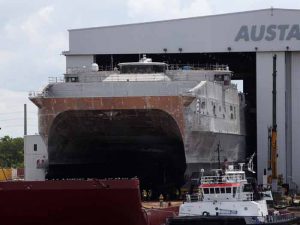
JHSV program gets new name and another $53.4 million


The new name for the series is part of a change in ship type designators that began back in January when Secretary of the Navy Ray Mabus announced that the next flight of “frigatized” Littoral Combat Ships would get the FF, or frigate, designator.

Last month, the secretary brought in a new E designator that, in addition to see the Joint High Speed Vessel (JHSV) become the Expeditionary Fast Transport, or EPF, sees the Mobile Landing Platform (MLP) become the Expeditionary Transfer Dock, or ESD; and the Afloat Forward Staging Base (AFSB) variant of the MLP become the Expeditionary Mobile Base, or ESB.

The EPF will provide high speed, shallow draft transportation capability to support the intra-theater maneuver of personnel, supplies and equipment for the Navy, Marine Corps, and Army.

Austal’s new contract action allows the procurement of ship sets for the specifications supporting integrated propulsion, main diesel generator engines, propeller and shafting, integrated bridge and voice communications.

Fiscal 2015 shipbuilding and conversion (Navy) funding in the amount of $26,739,198 is being obligated at time of award and will not expire at the end of the current fiscal year.

The contract was not competitively procured in accordance with U.S. Code 2304(c)(1) – only one responsible source and no other supplies or services will satisfy agency requirements.
The Naval Sea Systems Command, Washington, DC, is the contracting activity (N00024-16-C-2217).

Nakilat retrofits QMax’s main engines to LNG fueling


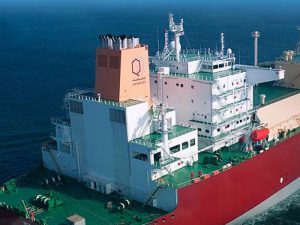
The project involved retrofitting two MAN B&W S70ME-C HFO-burning engines in the chartered Q-Max vessel Rasheeda with gas-burning M-Type Electronically Controlled – Gas Injection (ME-GI) Systems, which have now been successfully commissioned.

The retrofit modification meets all current and foreseen global emissions regulations.

Nakilat-Keppel Offshore & Marine (N-KOM) carried out the conversion at its Erhama bin Jaber Al Jalahma Shipyard facilities in the major Qatari port of Ras Laffan Industrial City.

The project collaborators, including MAN PrimeServ, installed the ME-GI system on the vessel at the shipyard in June 2015. The partner for the ME-GI fuel supply system is TGE Marine Gas Engineering GmbH,

Christian Ludwig, Head of Retrofit and Upgrades, MAN PrimeServ, said: “This is a fantastic milestone in our company’s history. It is a lighthouse project, and there has been a remarkable partnership and cooperation through this historic conversion. Our ME-GI order book now stands at 140 orders – for different vessel sizes and applications, which we see as a compelling case for our technology to be designated the industry standard.”

Nakilat Managing Director Eng. Abdullah Al-Sulaiti, said, “The success of the ME-GI project is the culmination of years of cooperation with Qatargas, RasGas and MAN Diesel & Turbo as turnkey project manager. In late 2013, Nakilat worked with our charterers to implement a pilot conversion on Q-Max Rasheeda, the first retrofit ME-GI project ever to be implemented in the marine industry. This is a milestone moment for all involved parties.”

MAN Diesel & Turbo reports that the vessel’s ME-GI units have displayed a seamless change between fuel-oil and gas operation – a key characteristic of the ME-GI technology.

The Qatar fleet comprises 14 Q-Max and 31 Q-Flex LNG carriers, all using dual MAN Diesel Turbo’s S70-ME low-speed diesel engines for propulsion.

THE ME-GI ENGINE

The ME-GI engine gives shipowners and operators the option of utilizing oil or gas fuel depending on relative price and availability, as well as environmental considerations.

The ME-GI uses high-pressure gas injection, allowing it to maintain the attributes of MAN B&W low speed engines that have made them the default choice of the maritime community.

The ME-GI is not affected by the derating, fuel-quality adjustment or methane-slip issues that have been seen with other dual-fuel solutions.

MAN Diesel & Turbo sees significant opportunities for gas-fueled tonnage as fuel prices rise and exhaust-emission limits tighten. Research indicates that the ME-GI engine delivers significant reductions in CO2, NOx and SOx emissions, with its negligible methane slip makes it the most environmentally friendly technology available.

An ME-LGI counterpart that uses LPG, methanol and other liquid gases is also available and has already been ordered.


Havyard wins order for 90 m fishing vessel for Danish owner

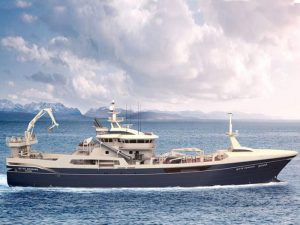
 It  will be the largest pelagic fishing vessel within its segment.

The vessel is to be delivered from Havyard’s Myklebust shipyard Q4 2017 and is being built to SALT 0155 design, developed in a close cooperation between the shipowner, design company Salt Ship Design and Kleven.

It will be able to operate in full diesel electrical mode, in diesel mechanical mode or in a combined hybrid mode. A total 7,720 kW of power driving a 5 m propeller will deliver a bollard pull of more than 130 tonnes.

Norwegian suppliers involved in the project include Brunvoll, Scana Volda, Hareid Elektriske, Karmøy Winch and Havyard MMC, which will provide a complete fish handling package consisting of loading systems from shipside and stern with double drainage, collecting bins and closed distribution to thirteen fish tanks, three MMC SX RSW (Refrigerated Sea Water) systems, remote controlled valves for RSW and ballast systems, quantity calculator for loading of fish, MMC vacuum pump system with tanks and vacuum unit for unloading, ozone system for cleaning of pipes and tanks and automation systems for remote control of MMC systems from deckhouse, control room and bridge.

In all, the vessel will have an RSW tank carrying capacity of 3,600 cu.m and an RSW cooling capacity of approx. 4,000 kW.

“We are very pleased with a new contract so quickly after Salt in September this year signed its first contract in fisheries,” says Egil Sandvik at Salt Ship Design. “Being assigned another large fishing vessel less than two months later is more than we expected.”

“Unlike the current offshore market, fisheries and fish farming are doing very well and these segments represents an increasingly important market for Salt,” he adds.

Great Lakes Shipyard holds a double celebration

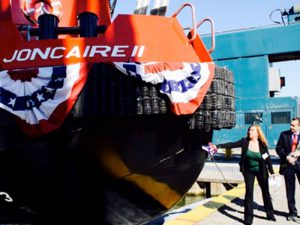
The sponsor of the Commissioning Ceremony was Karen W. Penale, Real Estate Administrator – Western Region, New York Power Authority – Niagara Project.
Breaking the traditional bottle of champagne, she declared “I name this tugboat Joncaire II. May God bless here and all who will sail on her.”

Joncaire II and its sister vessel will be used to service winter operations at the Niagara Power Plant in Buffalo, NY. They will augment and replace aging vessels that are used for the installation, removal, and maintenance of the Lake Erie-Niagara River Ice Boom and for various associated marine construction projects.

Construction for the first tug began last April. The second tug is scheduled for delivery in late-2017.

The new tugs are specially reinforced with heavy stems and shell reinforcement for operations in seasonal ice. The design of the conventional drive tugs includes elevated pilothouses for improved visibility when maneuvering and a spacious work deck aft to facilitate ice boom connections.

In 2010, Great Lakes Shipyard built the New York Power Authority’s new 80′ x 34′ Ice Boom Operations Barge, which incorporates a Terex 80-ton pedestal mounted lattice boom crane.

KEEL LAYING

The tug commissioning was followed by a separate ceremony, marking the keel laying of a new 3,400 H.P. tugboat to be built for Regimen de Pensiones y Jubilaciones del Personal de la Empresa Portuaria Quetzal, Guatemala, Central America. Representing the owner at the ceremony was Eduardo De Jesus Paiz Lemus, Presidente Junta Administrador.

Congresswoman Marcy C. Kaptur, U.S. Representative of the 9th District of Ohio, the principal speaker, commended the Company indicating that “We are fortunate to have a company like Great Lakes – their industry is the gift that keeps on giving. They are [through their education programs] passing on skills to the next generation, who will keep this country great.”

Congresswoman Kaptur also paid compliments to the company’s team – paying special recognition to Ronald C. Rasmus, President of the Great Lakes Group.

She highlighted the significance of the achievement, “To create here, in the heart of America, a shipyard; a place that faces global competition every day, is no small achievement. It is extraordinary. Look at all of the suppliers that benefit from your efforts.”

The tugboat is being built under a contract awarded this August. It will be another of the company’s HandySize Class 3,400 HP twin-screw tugboats and will be used for harbor towing operations in Puerto Quetzal; a growing commercial cargo, container, and cruise port on the Pacific coast of Guatemala.

The buyer, Regimen de Pensiones y Jubilaciones del Personal de la Empresa Portuaria, is a pension benefits plan for port employees and retirees who operate a commercial tugboat service in the port under a Port Authority franchise for the purpose of ensuring future retirement benefits.

Representing the Regimen at the ceremony was Eduardo De Jesus Paiz Lemus, Presidente Junta Administrador, who inscribed his signature on the keel plate declaring that “The keel has been truly and fairly laid.”

The HandySize Class tug was designed by Jensen Naval Architects & Marine Engineers, Seattle, WA.

Set for delivery next year, the tug is specifically designed for harbor work and coastal towing. It is 74-feet long with a beam of 30 feet, and a design draft of 11.5 feet. It is to be built to American Bureau of Shipping (ABS) standards and its Cummins QSK-50 main diesel propulsion engines, each rated at 1700 BHP@ 1600 rpm meet US EPA Tier III emission regulations delivering superior fuel economy, durability, and reliability.

In recognition of the significant achievement for a U.S. domestic shipyard in competitively concluding a foreign sale, the U.S. Department of Commerce’s International Trade Administration and the U.S. Embassy, Guatemala City, was represented at the ceremony by Antonio Prieto, Sr. Trade Specialist, who was credited by the company with facilitating the transparent negotiations and sale.
Damen hands over RoPax ferry to Canadian customer


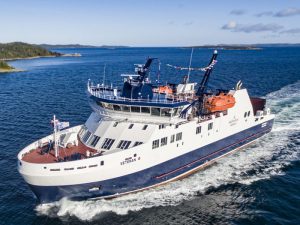
Launched at the end of March by Damen Shipyards Galati in Romania the vessel will start services from Fogo Island and Change Islands before the end of November.

MV Veteran was delivered by the shipbuilder on time and within budget.MV Veteran is the first of a two-vessel contract. Its design results from a partnership between Fleetway of Canada and Denmark’s Knud E. Hansen.

Several Canadian companies have provided services, rangingrom electrical equipment to fire-fighting systems, for the MV Veteran and its sister ship, the MV Legionnaire, which is scheduled for delivery from Galati in the spring of 2016 and will operate on the busy short-haul route from Portugal Cove to Bell Island.

The Veteran will replace the MV Earl Windsor built in 1975. The Legionnaire will replace the MV Beaumont Hamel built in 1985.

Both vessels are part of a large “lifeline” vessel replacement program being undertaken by the Provincial Government to modernize its fleet, which annually transports over 900,000 passengers, 400,000 vehicles and 20,000 tonnes of freight with more than 50,000 arrivals and departures.

As the region in which they operate is located near the Arctic, the vessels have to maneuver in drifting ice.

According to Damen Manager North America Jan van Hogerwou, the two new ferries can handle the impact of 40 cm-thick floating ice at 4 knots.

“Their rudders, hull and propellers have been strengthened and are outfitted with extra plate thickness for heavy winter conditions,” he says.

Damen Ferries Product Director Henk Grunstra says: “The highest certificate available for ferries is the Ice Class 1A Super certificate. These diesel-electric propelled vessels also have redundant systems. The bridge is ergonomically designed and has optimal working space for efficient and safe operation. The modern, low maintenance interior was designed by an internationally recognized designer. The shift crew lives on board the ship in 15 single crew cabins.”

A Canadian service and support hub for these vessels is being established. A certified Damen maintenance center will be located in the capital of the Newfoundland and Labrador region, St. John’s. An agreement with a local Newfoundland-based company is in place and its employees are currently being trained at Damen Shipyards Galati.

German owner to convert containership to LNG fueling

Funding was provided through the federal program Mobility and Fuel Strategy which promotes the maritime use of LNG as an environmentally friendly fuel.

“For many years our shipping company has been committed to ‘Green Shipping’ – through the development and implementation of more efficient alternative propulsion systems,” said Gerd Wessels, Managing Owner of Wessels Reederei GmbH. “With the conversion to LNG we and our partners are showcasing our technical expertise and demonstrating practical environmental solutions for the merchant marine industry.”

Wessels Reederei has been investigating the conversion for the past two years, in collaboration with the main engine manufacturer, MAN Diesel & Turbo, and gas specialist TGE Marine Gas Engineering GmbH.

Delivered in 2011 by China’s Jiangdong Shipyard, Wes Amelie is a modern 1,000 TEU containership that operates in the North Sea and Baltic.

Wes Amelie has 23 sister ships, 16 of them structurally identical, and in selecting the vessel for conversion, special attention was paid to the scalability of the engineering services as well as the development costs, significantly reducing the costs for follow-up projects. continent.

One reason for the providing of funding for the conversion by BMVI is that it contributes to resolving the “chicken and the egg” problem of LNG fuel availability vs. demand by being a a demand-generating flagship project.

Wessels Reederei says that “due to the long delivery time for LNG tanks,” the conversion will begin in fourth quarter 2016, with full operational usage of LNG as fuel planned for early December 2016.

Fednav takes delivery of first BWTS equipped Laker

The ship, the 34,500 dwt ocean going laker Federal Biscay, is fitted with a ballast water treatment system (BWTS) — a first for ships transiting the Great Lakes, says Fednav, the largest international operator in the Great Lakes/Saint Lawrence Seaway System.

Fednav announced in April that it would equip all 12 ships in its Oshima shipyard newbuild program with BallastAce ballast water treatment systems (BWTS) (see earlier story).

Developed by JFE Engineering Corporation in Japan, the BallastAce system will be effective in both fresh and salt water. BallastAce operates through a combination of filtration and sodium hypochlorite (bleach) injection into the ship’s ballast system.

“This is a pivotal step in protecting the Great Lakes against invasive species and preserving biodiversity in the region,” said Paul Pathy, president and co-CEO of Fednav Limited. “Fednav is proud to be the first shipping company to deploy such systems, and we are pleased that the Federal Biscay is serving as a test ship for this technology.”

Fednav will start using BallastAce in the Great Lakes at the opening of the St. Lawrence Seaway in 2016.

With the assistance of Fednav, the BallastAce system (which is already USCG AMS approved) will continue the necessary testing for full U.S .Coast Guard type approval for fresh, brackish, and salt water at the GSI facility in Superior, WI, and at MERC in Baltimore, MD. During the first six months of 2016, the system installed on the Federal Biscay will be be used for the shipboard testing element of the type approval requirements.

Fednav expects that the IMO Ballast Water Management Convention, to which Canada is a signatory, will most likely enter into force in 2016, the year the U.S. Coast Guard and EPA require the installation of systems on ships trading in US waters.

Austal launches first of two HSSVs for Oman

Hull 390 — the future RNOV Al Mubshir — entered the water on schedule after 13 months of construction and fit out.

Based on the proven Expeditionary Fast Transport (EPF) platform — previously known as the Joint High Speed Vessel (JHSV) — being built for the U.S. Navy at Austal’s Mobile, AL, shipyard, the HSSV offers a range of capabilities to support naval operations, including helicopter operations, rapid deployment of military personnel and cargo, search and rescue operations, humanitarian aid and disaster relief missions.

The shipbuilder was awarded the US$124.9 million contract for the design, construction and integrated logistics support of the two Omani HSSVs in March 2014 and construction commenced in August 2014.

This first HSSV will now complete final fitout before sea trials, prior to delivery to the RNO early in 2016. The second HSSV is under construction and is on schedule for completion in mid 2016.

Austal Chief Executive Officer Andrew Bellamy said the on-schedule launching of the first HSSV demonstrates Austal’s proven capability to design, construct (and support) large, multiple naval vessel programs.

“From our defense portfolio, Austal is currently contracted to deliver ten 127 m frigate-sized Littoral Combat Ships and ten 103 m Expeditionary Fast Transport (EPF) vessels to the United States Navy – as well as two OPV-sized 72 m High Speed Support Vessels, here in Western Australia for the Royal Navy of Oman,” said Mr. Bellamy.

“Our track record here in Australia and overseas clearly supports Austal’s strong proposition that we can effectively and efficiently deliver the Australian Government’s Future Frigate and Offshore Patrol Vessel programs,” he added.

LOAD MORE