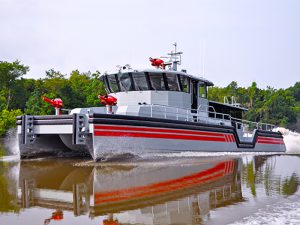
Front Street Shipyard to build carbon fiber hulled ferries

Working in conjunction with Maine Composites Alliance and Martin Grimnes, a Norwegian composites expert living in Maine, Arcadia Alliance is aiming its highly efficient ferries at state and federal agencies seeking to replace aging, less efficient passenger vessels.

Brødrene Aa designs and builds carbon-fiber passenger vessels in a modern shipyard, well suited for manufacturing of composite products, with a total of 3,000 square meters of fully moisture-and temperature controlled indoor facilities, The company has built 50 carbon ferries to date.

Carbon fiber ferries are lighter weight and consume less fuel than aluminum or fiberglass vessels, releasing fewer emissions into the air.

“Given the significance of ferry transport to travelers in coastal regions coupled with concerns about gas consumption and emissions, efficiency of our country’s ferries is critical,” says J.B. Turner, president of Front Street Shipyard. “Brødrene Aa has a progressive design to reduce consumption and emissions, and they have an exceptionally efficient construction method we can apply to the U.S. ferry market at Front Street Shipyard.”

Brødrene Aa is a 60-year-old company that introduced the world’s first carbon-fiber passenger vessel more than a decade ago.

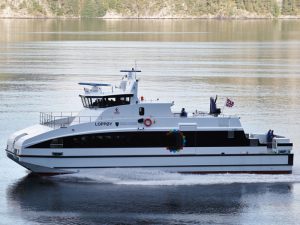
It has built 50 carbon ferries to date. Last month it won an international tender issued by Guangzhou Panyu Lianhuashan Port Passenger Transport Co., Ltd , (subsidiary of Chu Kong Shipping Enterprises Holdings Co. Ltd) to design and build two coastal high speed catamarans for Hong Kong. The contract is for two identical vessels; both made of carbon fiber composites, each with a capacity of 270 passengers.

Representatives from Front Street Shipyard met with officers of Brødrene Aa in Hyen earlier this summer.

“Given Front Street Shipyard’s modern facility and boatbuilding capabilities, we believe their team can deliver the same high-quality vessels in the United States that we produce in Norway,” said Leif Riksheim, chairman of the board at Brødrene Aa.

The organizations are now working together to develop ferry designs for U.S. waters. The Arcadia Alliance sales team will begin marketing the boats later this year, with hopes that Front Street Shipyard will be able to begin construction on the first fast ferry in 2016.

Recent contracts won by Brødrene Aa include two 270 passenger coastal high speed catamarans for Hong Kong

 hong kong

LNG fuel tanks installed in first Crowley ConRo

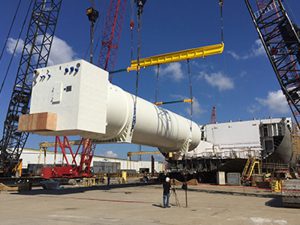
Another important milestone was marked last week, with the installation of three LNG fuel tanks in the first ship.

The double-walled, stainless steel tanks – which are 110 feet in length and 20.6 feet in diameter – weigh 225 metric tons and will hold more than enough LNG fuel for two round-trip voyages between the vessel’s future ports of call, Jacksonville, FL, and San Juan, Puerto Rico.

“While we are all excitedly watching these ships take shape, we are particularly proud of the role we, as a company, are playing to bring the most modern, technologically advanced and environmentally friendly ConRo ships in the world to the Jones Act market of Puerto Rico,” said Tom Crowley, company chairman and CEO. “There are no other ships of their kind being built anywhere else in the world today, and they are being constructed right here at home – in the United States of America. Having that shipbuilding capability here is essential to our national defense and an important reason we as a country need the Jones Act to be maintained and strengthened.”

Crowley’s two Jones Act ConRo ships, which will be named El Coquí (ko-kee) and Taíno (tahy-noh), are are scheduled for delivery second and fourth quarter 2017 respectively.

“It’s very impressive to see these new state-of-the-art Commitment Class ships take shape,” said John Hourihan, senior vice president and general manager, Puerto Rico services. “Seeing those LNG tanks being placed into El Coquí really resonates with me because we are setting a new standard for environmentally responsible shipping.”

The Commitment Class ships have been designed to maximize the carriage of 53-foot, 102-inch-wide containers, which offer the most cubic cargo capacity in the trade.

The ships will be 219.5 meters long, 32.3 meters wide , have a deep draft of 10 meters, and an approximate deadweight capacity of 26,500 metric tonnes. Cargo capacity will be approximately 2,400 TEUs (20-foot-equivalent-units), with additional space for nearly 400 vehicles in an enclosed Ro/Ro garage.

Each ship will be powered by an MAN B&W 8S70ME-GI8.2 main engine and three MAN 9L28/32DF auxiliary engines, all fueled by LNG .

The ship design is provided by Wartsila Ship Design in conjunction with Crowley subsidiary Jensen Maritime.

ceowleyLNG vert

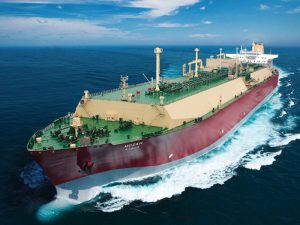
World’s largest LNG fleet owner reports increased profits

It said the results reflected its “strategic development, the success of its joint ventures, and the company’s resilience in the challenging economic climate.”

The Nakilat board said that Nakilat is in an enviable position as its ships are on long-term charter hire contracts that are not impacted by temporary fluctuations in oil prices. The board also affirmed its continued commitment to Nakilat’s growth and development strategy, in line with Qatar’s National Vision 2030.

“Nakilat continues to show robust profits and growth,” said Managing Director Eng. Abdullah Al Sulaiti. “Despite regional challenges, our policy of making prudent investments for achieving higher economic benefit in the short and long-term, and seeking sustainable growth opportunities continues to work in our favor. We have also lowered our operating costs, and our financing costs are decreasing as we have repaid a suitable amount of our loans.”

Mr. Al Sulaiti added: “We have also seen increased profits from our joint ventures, particularly since the launch of new two vessels during the year, along with an additional five vessels that became fully operational. Nakilat’s place as the lynchpin in the Qatari marine services sector will continue to grow unabated.”

Credit rating agency Standard & Poor’s (S&P) has reaffirmed Nakilat’s senior debt credit rating at “AA-” with a stable outlook, which Nakilat says is indicative of its strong capability to meet its financial commitments.

In addition to owning  63 LNG vessels  Nakilat also manages and operates four large LPG carriers via two strategic joint ventures: N-KOM and NDSQ.  It also operates the ship repair and construction facilities at Erhama Bin Jaber Al Jalahma Shipyard in Ras Laffan Industrial City and offers a full range of marine support services to vessels operating in Qatari waters.

NASSCO christens first Kinder Morgan ECO tanker

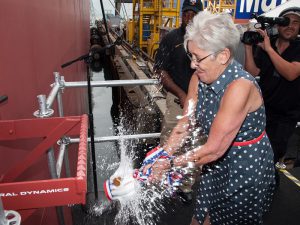
San Diego Mayor Kevin Faulconer spoke at the ceremony, and the ship’s sponsor, Mrs. Helen Downs, christened the ship with the traditional breaking of a champagne bottle.


The ECO tanker, the Lone Star State, is the first of a five-tanker contract between NASSCO and APT, which calls for the design and construction of five 50,000 deadweight ton, LNG-conversion-ready product carriers with a 330,000 barrel cargo capacity. The 610-foot-long tankers are a new “ECO” design, offering improved fuel efficiency and the latest environmental protection features including a Ballast Water Treatment System.

The ships were designed by DSEC, a subsidiary of Daewoo Shipbuilding & Marine Engineering (DSME) of Busan, South Korea. The design incorporates improved fuel efficiency concepts through several features, including a G-series MAN ME slow-speed main engine and an optimized hull form. The tankers will also have dual-fuel-capable auxiliary engines and the ability to accommodate future installation of an LNG fuel system.

“Incorporating new and innovative green ship technology, these tankers are the future of American petroleum shipping. When delivered they will be among the most fuel-efficient and environmentally friendly tankers anywhere in the world,” said Kevin Graney, general manager and vice president for General Dynamics NASSCO.

“This christening ceremony is an important step forward for Kinder Morgan’s expanding fleet of Jones Act product tankers and demonstrates the strong demand for domestic waterborne transportation to move petroleum products and crude oil,” said Robert Kurz, vice president of Kinder Morgan Terminals and president of American Petroleum Tankers. “We look forward to taking delivery of this vessel next month and, along with our seven other operating tankers, providing first-class service to our growing customer base.”

In September 2014, Mayor Faulconer signaled the start of construction of the ECO tanker. In March 2015, San Diego’s First Lady and wife of Mayor Faulconer, Mrs. Katherine Faulconer, laid the keel.

“The Lone Star State is a great example of the kind of innovative technology being employed by NASSCO and our blue tech industry. Its construction has employed hundreds of San Diegans and helped sustain jobs for thousands more,” Mayor Faulconer said. “This ship is a symbol of the jobs and opportunities the maritime industry brings to our city.”

On Friday, October 16, NASSCO shipbuilders began construction on a fifth tanker for APT.

Davie partners with marine accommodations specialist

OCTOBER 19, 2915 — Canadian shipbuilder Chantier Davie Canada, Inc. says it has formalized a partnership with Turku, Finland, headquartered ALMACO Group, which is perhaps best known for its work on cruise

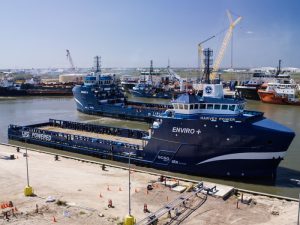
Harvey Gulf takes delivery of second LNG fueled OSV

The vessel is already in service under a five year contract working for Shell Upstream America’s deep water operations in the Gulf of Mexico.

Like her sistership Harvey Energy, Harvey Power is capable of operating on LNG or diesel fuel and also meets the criteria of the ABS Enviro+, Green Passport notation.

When operating on 99% LNG, the dual fuel vessels exceed the requirements of the new EPA Tier IV for reductions of SOX and NOX emissions within the North American ECA can operate in excess of 19 days in normal GOM rig supply mode between refuelings.

Harvey Power will refuel with LNG at Harvey Gulf’s new LNG bunkering facility at Port Fourchon in southern Louisiana, which allows easy access to more than 600 oil and gas rigs and platforms within a 40-mile radius.

Harvey Power is a 310′ x 64′ x 24.5′ platform supply vessel powered by three Wärtsilä 6L34DF dual fuel gensets, providing 7.5 MW of power and fueled by a Wartsila provided LNGPac system.

With 5,219 metric tons of deadweight the vessel is capable of carrying 253,000 USG of fuel oil, 18,000 bbls of liquid mud, 1,600 bbls of methanol, 10,250 cu.ft of dry cement and 73,000 USG of LNG fuel.

When operating on LNG the Harvey Power can operate in excess of 19 days in normal GOM rig supply mode between refueling.

The acquisition of Gulf Coast Shipyard Group by a new Harvey Gulf International Marine affiliate, Harvey Shipyard Group, was announced back in June.

The shipbuilder’s new COO, Marvin Serna, says that new protocols and operational improvements he has put in place are yielding results, such as a 45 day reduction in the commissioning time of the second vessel in comparison with the first.

Harvey Gulf has four more vessels under construction with Gulf Coast Shipyard Group and is confident the shipyard can maintain the high quality of construction while continuing to improve on construction techniques resulting in shorter delivery times.

Mr. Shane Guidry, Chairman and CEO of Harvey Gulf, says: “This is our second vessel capable of operating on LNG and is a testimony of Harvey Gulf’s commitment to its customers and the environment to provide the most affordable, innovative, environmentally-friendly technical solutions to meet their business demands.”

MAN Diesel & Turbo renews agreement with China’s CMP


CMP is an engine-manufacturing division of the Chinese State Shipbuilding Corporation (CSSC), one of the largest Chinese shipbuilders.

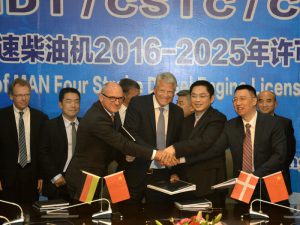
The new agreement, signed at a ceremony last week in Anqing, China, marks the renewal and continuation of a cooperation that first started in the 1980s.

“The extension of the four-stroke license agreement between CMP and MAN Diesel & Turbo is a tribute to the very first license we bonded 35 years ago,” said CMP Chairman Mr. Zhang Haisen. “Furthermore, the comprehensive cooperation scope refers not only to four-stroke diesel engines, but also to two-stroke low speed engines, CPP propellers, turbochargers, and SCR systems. CSSC values MAN Diesel & Turbo as its premium partner, and sincerely expects to continue this important business partnership to another 35-year milestone.”

“We have enjoyed a long, close cooperation with CSSC/CMP that stretches all the way back to 1980, and over the years CMP has produced a broad range of MAN four-stroke engines, but also small two-stroke engines,” said Klaus Engberg – Senior Vice President and Head of Two-Stroke Licensing, MAN Diesel & Turbo. “Especially over the last decade, our two companies have intensified their technical cooperation, making CMP today one of MAN Diesel & Turbo’s major licensees globally for such engines, and the largest producer of MAN four-stroke engines in China.”

Ulrich Vögtle – Vice President and Head of Large Bore Four-Stroke Licensing – said: “We view our relationship with CSSC as pivotal to our success in giving Chinese customers access to our technology. Accordingly, we are very happy and proud today to be able to officially announce the continuation of our excellent business relationship for the next decade.”

To date, CMP has delivered 5,000 units of MAN four-stroke diesel engines, equivalent to 4,700,000 kW. CMP also holds a license agreement for two-stroke MAN B&W engines, which it too renewed for a decade at a ceremony in Beijing earlier this year.

Headquartered in Beijing, CMP parent CSSC handles shipbuilding activities in the east and south of China and consists of various shipyards, equipment manufacturers, research institutes and shipbuilding-related companies. Some of the best-known shipbuilders in China, such as Jiangnan Shipyard and Hudong-Zhonghua Shipbuilding, are currently owned by CSSC.

Zhenjiang Marine Diesel (ZJMD), CMP’s predecessor, was founded in 1976 and signed a 15-year medium-speed licensing agreement with MAN Diesel & Turbo in May 1980. This was subsequently extended in 1995 and 2005.

Vard issues a profit warning

Vard cited disclosures made in its first and second quarter reports regarding the operational challenges at its Brazilian shipyards of the group and what it called “the negative trend in the Brazilian economic and political environment/”It said third quarter and full year results “will be materially negatively affected.”

The details will be disclosed on November 11 when Vard announces its unaudited third quarter financial results. In the meantime, the Board is advising its shareholders and investors to exercise caution when dealing in the shares of the company.

Metal Shark delivers 75 ft port security fireboat

Based on the shipbuilder’s Endurance-class catamaran design, the welded aluminum vessel incorporates sophisticated technology to support fire rescue missions, Command and Control (C2) operations, and around-the-clock port security efforts at the port, which stretches 54 miles along the Mississippi River.

Twin Cat C-18 diesel engines in a conventional straight-shaft inboard configuration propel the vessel’s catamaran hull to cruising speeds of 25 knots while giving it a nominal operating range of over 500 miles.

For firefighting, two dedicated drive engines channel up to 6,000 total gallons per minute through an oversized water main where electronic valves divert water to three radio frequency-controlled monitors. Four additional 2.5″ hydrant connections and a 400-gallon foam reservoir provide maximum flexibility across the spectrum of firefighting needs.

The spacious pilothouse provides 360-visibility and comfortable below decks quarters offer bunking capacity for six or more crew members, fully equipping the vessel to stay on station for extended periods.

A state of the art Command and Control suite facilitiates multi-agency coordination during emergency response events, with a positive-pressure Chemical, Biological, Radiological, Nuclear, and high-yield Explosive (CBRNE) ventilation system protecting the crew in disaster response situations.

“Our 75 ft Endurance is the most advanced fireboat design on the market, incorporating crew friendly features and advanced systems throughout,” said Metal Shark president Chris Allard. “Metal Shark is honored to have been selected by PSLA to deliver this new vessel. We trust that this new Metal Shark will meet PSLA’s needs, help keep their port secure, and potentially save many lives for years to come.”

A product of Metal Shark’s Franklin, LA, shipyard, the 75 ft Endurance can be custom-configured to suit a wide range of mission profiles. Metal Shark offers the vessel with a wide range of power and propulsion systems, including conventional inboards, water jets and pods, to meet various performance requirements.

Virtually every vessel feature, from firefighting equipment and capacity, onboard systems, general arrangement, berth capacity, etc. can be adapted to suit the needs of individual customers and agencies. In addition to port security and fire rescue, the 75 ft Endurance can be configured for dive support, law enforcement, defense, and numerous commercial markets. Endurance-class vessels are available from 45 ft and up.

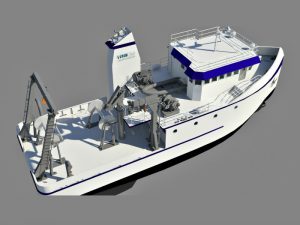
JMS Naval Architects designs research vessel

OCTOBER 14, 2015—Next month, JMS Naval Architects, Mystic, CT, is expected to complete the Contract Design Package of a 93-foot research vessel for Virginia Institute of Marine Science, Gloucester Point, VA to

LOAD MORE