Australian shipbuilding acquisition in the works

Today, Civmec revealed that it is poised to acquire the Forgacs shipbuilding business.

Forgacs is Australia’s largest privately-owned engineering and shipbuilding company and part of the team building the Hobart Class Air Warfare Destroyers (AWD) for the Royal Australian Navy, manufacturing 37 of 93 AWD blocks at its indoor modular shipbuilding facilities.
Singapore listed line with Civmec said today that it has agreed to enter into a due diligence phase for the acquisition of certain Forgacs assets and the Forgacs name.

The proposed acquisition includes a purpose-built shipbuilding site. Forgacs Shipyard – Tomago is located 14 km from the Port ofNewcastle, NSW on the Hunter River. The 17 hectare site has 535 meters of river frontage with two ship basins. The acquisition also includes plant and equipment currently located at the Forgacs Hexham heavy engineering workshop and at the Forgacs Gladstone heavy engineering workshop.

Forgacs’ products’ business, Forgacs-Broens Pty Limited, does not form part of the sale and will continue to operate from its Ingleburn, NSW and Elizabeth, SA facilities.

Civmec says it believes that “the considerable opportunities in the infrastructure sectors on the east coast as well as the long-term outlook within the defense, oil & gas and metals & minerals sectors justifies the investment.”

Civmec CEO Pat Tallon said, “This is a very exciting opportunity for our company to extend our multi-disciplinary operations to the east coast of Australia and to gain a long established foothold in the defense shipbuilding industry. It will also give us the opportunity to acquire in-house submarine building and technical expertise. We will be well positioned to capitalize on the significant infrastructure expenditure planned for the east coast and our increased capacity will allow Civmec to deepen our relationship with existing blue chip clients nationally, as well as bringing on board new regional clients.”

Peter Burgess, Chairman of the Forgacs Group commented, “Forgacs has more than 50 years’ experience in the heavy engineering and projects business and entered the naval ship repair business in 1990. It has grown its naval involvement progressively, undertaking major naval programs including the conversion of HMAS Manoora and HMAS Kanimbla into Amphibious Helicopter support ships; hull modules for the ANZAC frigates and most recently the AWD program. The Tomago shipyard has built some of Australia’s iconic ships such as ice breaker Aurora Australis, HMAS Tobruk and hull sections of Collins Class submarines. Our shipyard is ideally positioned for Civmec’s future plans.”

Subject to satisfactory due diligence, necessary stakeholder approval and the finalization of the sale and purchase agreement, Civmec expects to complete the transaction in December 2015.

Quite how, if at all, this fits in with Civmec’s submarine building ambitions remains to be seen. When it unveiled those plans it said that it had the capability to be the in-country builder for whoever won the submarine contract and that it would add a new dedicated facility for building submarines at its Henderson, Western Australia, facility — which is quite some ways distant from the Forgacs shipyard.

Just to add to the confusion, Australian media reported today that the Australian Government has yet to decide whether to build eight or twelve boats and that the French, German and Japanese bidders for the program had agreed to build them at the ASC facility in South Australia.

Bordelon takes delivery of next generation ULIV

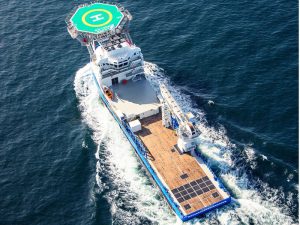
The highly specialized 257 ft x 52 ft vessel features a helideck, a 60 ton AHC crane with 3,000 m of wire, POB (60), a mezzanine deck with internal office and control rooms capable of supporting two full work class ROV systems. The vessel also offers 6,200 sq. ft. of clear useable deck space.

The Brandon Bordelon is equipped with two Sonardyne Ranger2 Pro thru-hull USBL full systems. Ranger 2 is a high performance acoustic position reference system designed for tracking underwater targets and positioning dynamically positioned (DP) vessels. It uses the Ultra-Short BaseLine (USBL) positioning method to calculate the position of a subsea target, for example an ROV, by measuring the range and bearing from a vessel-mounted transceiver to an acoustic transponder fitted to the target.

The vessel delivers a fully integrated ROV control room, ROV support offices, below deck work and storage spaces, extensive communications and ROV data network, plug and play, with patch panel racks installed — all tied into the vessel systems, bridge, office, and accommodation spaces.

The vessel is designed with removable bulwarks around the entire aft of vessel along with power, water, air, and hydraulic oil connections on the deck.

Four additional below deck Tier 3 generators provide fully redundant power to the crane and ROV systems.

“We are very excited to introduce the M/V Brandon Bordelon,” says CEO Wes Bordelon. “This vessel is the next generation design of the Stingray series and continues our commitment of the ULIV concept to the subsea market. With the addition of a helideck and other integrated systems the Brandon provides an additional highly capable and low cost vessel option to our clients.”

Download the vessel’s specs HERE

Brandon 700 bottom

Conrad Shipyards bolsters backlog with new orders

NOVEMBER 16, 2015—Like many shipbuilders along the U.S. Gulf of Mexico, Conrad Industries, Inc., Morgan City, LA, is feeling the pinch of the downturn in the oil patch and the drop in

NSRP looks at shipbuilding cost management software

NSRP is an industry-led, Navy-sponsored collaboration of U.S. shipyards working together to reduce the cost of building, operating and repairing Navy ships by improving productivity and quality through advanced technology and processes. Its various panels strive for the discussion of best practices and overlapping challenges.

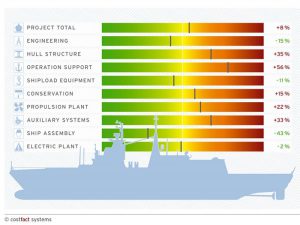
The CostFact software that will be in the spot light at next month’s San Diego has been developed in close cooperation with naval shipyards such as ThyssenKrupp Marine Systems and incorporates a number of best-practice methods.

The meeting in San Diego offers the opportunity to look at selected CostFact features. Case studies will demonstrate the application of CostFact at naval shipyards. The integration of CostFact with the CAD software ShipConstructor will also be shown.

MORE


New Norwegian rescue vessel named for Idar Ulstein

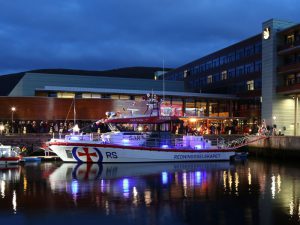
It is the first vessel in the society’s new Ulstein class and is named for long time Ulstein Group CEO Idar Ulstein.

The Ulstein Group has financed the major part of the total NOK 38 million costs.

The boat will be stationed in Fosnavåg, and succeed the RS Emmy Dyvi, which is currently based there.

“This is a gift in memory of Idar Ulstein, Ulstein Group’s CEO and Chair of the Board through many years, who passed away in 2012. Idar Ulstein was a great supporter of RS. This donation, honoring his life and contribution to the maritime industry, will potentially help save the lives of many people experiencing difficulties off the Norwegian coast,” said Tore Ulstein, Chair of the Board in Ulstein Group.

The 22 m rescue vessel has a top speed close to 40 knots. By using powerful twin engines and a water jet, she combines high speed with large bollard pull.

RS Idar Ulstein is outfitted with the latest in modern equipment for tackling demanding rescue operations in difficult weather conditions.

“Short response time is essential to saving lives at sea. With RS ‘Idar Ulstein’ we combine a high-speed vessel with the size needed to operate in the demanding coastal regions,” says Nicolai Jarlsby, President of the Norwegian Society for Sea Rescue (RS)

The Search and Rescue (SAR) vessel is operated by a crew of three; captain, mate and chief. She will primarily serve coastal, fishing and recreational vessels. As well as emergency lifesaving and rescue, the vessel is designed to perform operations including towing, salvage, diving missions, fire, ambulance and medical transportation. The vessel is equipped with the latest in radar technology and an advanced thermal camera. This makes RS Idar Ulstein a complete rescue vessel.

RS Idar Ulstein was built at the Swede Ship Marine shipyard in Sweden. The RS has an option of building three new SAR vessels in the Ulstein class.

Modernizing the RS fleet is essential. “We still have older vessels stationed along the Norwegian coast. We aim to find donators who can help us financing more vessels in the Ulstein class,” says Mr. Jarlsby.

RS Idvar Ulstein Main characteristics
Length: 22 m
Beam: 6.26 m
Depth: 1.2 m
Propulsion: Rolls-Royce water jet
Engines: Two MTU, each of 1660 hp
Bollard pull: 12 tons
Max speed: 38 knots
Building material:  Aluminum
Working deck with towing winch
Fire capacity of 4,000 liters per minute

Plans for giant Brazil ship repair yard move ahead

Dave Saginaw, Commercial Director of McQuilling Services, LLC in New York and the project Director of the Brasil Basin Drydock Company (BBDC) project said today that the project has progressed into the next phase of implementation.

Additional early stage investment funds have been received and applications for environmental licenses have been submitted toauthorities in Brazil.

“We are extremely excited about the advancement of activities in the development of the new ship repair facility in the northeast of Brazil” said Mr. Saginaw, “We are receiving strong support from both our new investors and from state and local authorities in Paraíba and the municipality of Lucena. We couldn’t be more pleased with our current progress, in the midst of quite a challenging investment climate.”

Celso P. Souza, project manager for the BBDC project said from Rio de Janeiro, “The implementation of the new facility is on schedule. With the filing for the environmental permits and the creation of the environmental impact analysis underway, we are now moving forward with the next stage of facility design and engineering. We envision start of construction by late 2016/early 2017 with first repair operations commencing early in 2019.”

The BBDC shipyard in the Brazilian state of Paraíba will carry the name Empresa de Docagens Pedra do Ingá (EDPI). It will be located inside the harbor near the Port of Cabedelo in the municipality of Lucena and is positioned close to major shipping lanes in the Atlantic basin. The 600,000 square meter facility will be purpose-built for ship repairs, and its two graving docks and hydrolift facilities will be capable of drydocking any ship in the world merchant fleet.

HHI sees Saudi Aramco MOU as a turning point

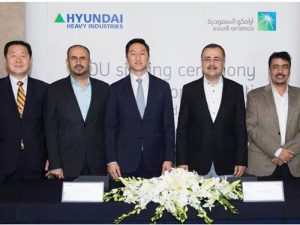
The MOU follows discussions on strategic collaboration that were initiated when Saudi Aramco’s Board of Directors visited HHI’s Ulsan, South Korea, complex in April 2015.

Mr. Chung, who represented HHI for all relations with Saudi Arabia and Saudi Aramco, led the efforts that culminated with a signing ceremony presided over by Saudi Aramco President and CEO Mr. Amin H. Nasser at Saudi Aramco’s Dhahran, Saudi Arabia, headquarters.

According to Mr. Chung, the partnership is “a great opportunity to enhance Korea’s shipbuilding and EPC businesses” and continues a contribution to the Kingdom by HHI that goes back to the 1970s when it was awarded a contract to undertake development of the Jubail port (King Fahd industrial port) project.

“This signing is significant as it provides the potential for the creation of another Jubail that creates tremendous growth opportunities for HHI,” said Mr. Chung.

Saudi Aramco has been looking to develop a yard at Ras Al-Khair, 60 km north of Jubail, in coordination with the National Shipping Company of Saudi Arabia (Bahri) and HHI as potential partners.

The yard would leverage the partners’ offshore business to accelerate localization efforts of Saudi Arabia’s young and promising maritime industry, and its associated supply chain. HHI’s role would include winning shipbuilding vessels while participating in construction and operation of the shipyard and gaining opportunities to provide various value added services.

The project would enable the partners to cater to growing Middle East vessel demand and to build vessel types that it is no longer profitable to build in Korean shipyards.

Also being eyed is a future engine building joint venture that would allow the HHI-developed HiMSEN engine to expand its share of both the marine and power plant sectors in the region.

Another strategic partnership under development relates to HHI’s Middle East EPC business, seen as the seed for a joint cooperation through which a regional EPC champion could be created.

DSME told to halt work on LPG ships following deadly fire

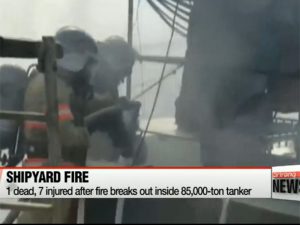
NOVEMBER 11, 2015 — South Korea’s Ministry of Employment and Labor has ordered a halt  to work on five LPG ships under construction at Daewoo Shipbuilding and Marine Engineering’s Okpo shipyard following

Designs on Expansion


To mitigate the shipping industry’s contraction, Spanish engineering firm GHENOVA Ingeniería, Seville, Spain, has seized opportunities in the high-growth markets of Latin America. A key project enabling them to establish a strong foothold is the design of a fleet of LPG tankers for Transpetro, using AVEVA Marine.

According to Ignacio Grau, GHENOVA’s Head of Marketing and Communication, the naval sector has been GHENOVA’s core market since the company’s founding. However, several projects signed in Brazil, both for naval engineering and energy, are now expanding the company’s client base. As a Spanish company, GHENOVA has a head start.

“For us, expansion into Latin America was a natural choice,” says Julián Fontela, GHENOVA’s Manager of Business Development. “We have fewer linguistic or cultural barriers to entry than equivalent North American or other Anglophone companies.”

The depressed shipping market following the slump in 2008 especially impacted GHENOVA’s customer base in Europe and in the naval sector; the company recognized the need to pursue new opportunities in high-growth markets. “Our main office in Latin America is in Brazil, and from there we are orchestrating our expansion into the rest of Latin America,” explains Julián. “Projects executed from the Brazilian office are of strategic importance for us, because each one demonstrates both the high quality of our work and our long-term commitment to our customers in the region as a whole. This strategy really represents a key ingredient for the growth of the company.”

Adds Ignacio, “The focus on both Europe and Latin America has meant intensified activities and a resulting notable staff increment, which are cornerstones of a longer-term growth strategy: we want to reach EURO 50 million in annual revenue and significantly increase our workforce by 2018.”

LPG tanker engineering
In September 2011, a year after GHENOVA first entered Brazil, success came with the signing of a EURO 7 million contract with the STX Promar shipyard (now Vard, part of the Fincantieri group) to carry out the engineering of eight LPG tankers for Transpetro. A subsidiary of Petrobras, Transpetro is Brazil’s largest oil & gas distribution company. It stores and transports oil, ethanol, biofuels and natural gas, and has a network of more than 11,000 kilometers (7,000 miles) of pipelines.

“Our Brazil office is very strong on the marine side and the LPG project is a great reference case,” says Julián. “It clearly demonstrates our capabilities to neighboring countries who are also important oil & gas players on the global stage. We hope that this project will be a springboard for GHENOVA to foster relationships with other oil & gas producers in the region.”

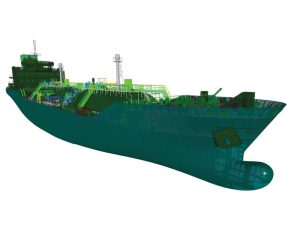
The project consists of the detailed engineering and purchasing support for the prototypes of three LPG carrier designs. A design for four vessels with a pressurized capacity of 7,000 m3 has already been delivered. The first three are already in fabrication. The first vessel in the series has been christened Oscar Niemeyer and will be delivered in December 2014. A further vessel design for two LPGs with a smaller pressurized capacity of 4,000m3 is also complete; at the time of writing, both vessels are being constructed and will be delivered soon. GHENOVA is now working on a design for two semi-pressurized vessels that will each have a capacity of 12,000 m3. GHENOVA is responsible for all the detailed engineering of the structures, piping, equipment and outfitting, the electrical, instrumentation and electronics systems, and HVAC and accommodation. The Brazilian team are using AVEVA Hull, AVEVA Outfitting, and AVEVA Cable Design, collaborating with their colleagues at the Spanish headquarters with the help of AVEVA Global.

The business opportunity
This high-profile project provided an excellent opportunity for GHENOVA to establish a reputation with Petrobras. A link to Petrobras is an endorsement of GHENOVA’s capabilities and sends a strong message to other organizations in the region. Furthermore, GHENOVA has established a connection with this Brazilian oil & gas giant at a crucial time in Petrobras’s history. The offshore Santos Basin discovery means that Petrobras will invest in fleet expansion and renewal to support its future increase in E&P activities and, as a result, there will be opportunities for further projects.

Another key factor that will push forward growth in this market is the Certificado de Registro e Classificação Cadastral (CRCC) certificate, which is awarded by Petrobras to companies that meet all the requirements to become an approved services provider. The CRCC specifically certifies GHENOVA’s ability to carry out comprehensive shipbuilding and tanker-ship projects.

This document allows GHENOVA to tender and participate in bids for work from Petrobras and, combined with the LPG project, marks a significant step forward. GHENOVA describes it as its “passport” into the Brazilian market.

Selecting the right tool for the job
To make the most of this business opportunity, GHENOVA needed the best tool for the job. With previous experience with Tribon, GHENOVA had successfully adapted to AVEVA Marine several years ago and is very happy with the result; their designers and engineers were able to adjust quickly and smoothly to the new system. Their AVEVA deployment forms part of a suite of applications that enables GHENOVA to meet a wide range of client- and project-specific requirements. As a result, GHENOVA selects the design software on a case-by-case basis. “Our business is engineering, first and foremost,” says Julián. “Each of the different types of software that we use is one system within a diverse toolkit. Every client has different requirements and meeting those requirements is key. We don’t only design ships; among other things we also design thermal power plants, so our choice of software for any particular project is usually dictated by the nature of the project and the client’s requirements.”

As a result, AVEVA Marine was chosen specifically for this project because it best matched Transpetro’s needs and was consequently mandated by Vard Brazil. “This is an entirely new project for us, so it was essential to select a 3D engineering and design tool that could deliver true strategic value,” explains Francisco Cuervas, General Director of GHENOVA. “AVEVA Marine met all the requirements that the client set out, making it the ideal choice for such an important project. The integrated AVEVA Marine applications have helped us to save many hours during the design phase, allowing an efficient and accurate model to be delivered to our customer.”

Rui Miguel de Sousa, GHENOVA Brazil’s Branch Director, says, “The AVEVA solution was subjected to a rigorous tender process and its integrated hull and outfitting design capability stood out against the competition. It will enable us to efficiently create clash-free, production-oriented design. We are confident this will help us achieve reduced rework and deliver the highest quality designs. With concurrent global project execution we can also ensure that all sites and users have access to the latest approved data, right down to attribute details.”

“We will continue to use AVEVA Marine as part of an overall service offering as we continue to seek out opportunities in both our European client base, and our expanding new client base in Latin America,” says Julián.
 

Robert Allan designs new RAmparts tug for Chile’s SAAM


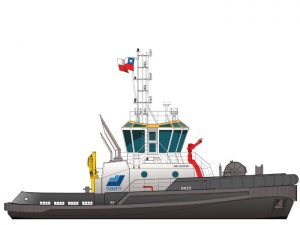
The first two boats, named Chincha and Tupac, are now under construction at the Wuxi Shipyard in China, for SAAM’s Peruvian affiliate Tramarsa, with others soon to follow.

In addition to the design, Robert Allan Ltd. also provided a complete structural steel parts package developed from the design drawings prepared for this project. Parts were defined and nested using ShipConstructor software, complete with part identification code, suitable as input to the shipbuilder’s NC burning code.

The 24.4 m long x 11.25 m beam RAmparts 2400-W Class tugboat is a twin Z-drive, diesel-powered tug, designed for maximum efficiency in the performance of ship-assist and terminal support operations. The hull form and layout have evolved through the extensive experience of the designers. Ship-handling is performed over the bow using a high-performance, split drum hawser winch.

The tugs will also provide firefighting capability and have up to date accommodations for a crew of six in two single and two double cabins.

The design complies with ABS requirements for the following notations: ✠A1, , ✠ AMS, Towing Vessel, UWILD, Fire-fighting Vessel Class 1 Particulars of the RAmparts 2400-W design are as follows: Length overall

LOAD MORE