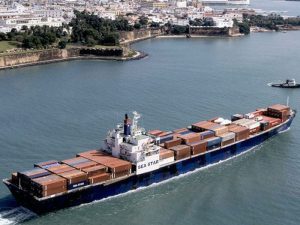
FMC Commissioner Doyle’s statement on El Faro disappearance

The ship was enroute from Jacksonville, FL to San Juan, PR. On Monday, four days after the ship vanished, the Coast Guard concluded it sank near the Bahamas in about 15,000 feet of water. One unidentified body in a survival suit was spotted, and the search continues for the other 32 crew members. The search continues today.

 Commissioner Doyle sailed as an engineer aboard the SS Mayaguez on the Philadelphia – Jacksonville – San Juan trade route in 2001. Doyle issued the following statement today:

“I would like to extend my deepest condolences to the employees, contractors, families and friends of TOTE Maritime, including my brothers and sisters of the Seafarers International Union and the American Maritime Officers Union, on the recent disappearance at sea of the vessel El Faro. I am praying for the safe rescue of any survivors, as well as for those who have passed.

“It is with a heavy heart that my deepest sympathies are extended.

 A Mariners Version of Psalm 23:
The Lord is my pilot; I shall not drift.
He lights me across the dark waters. He steers me through deep channels.
He keeps my log.
He guides me by the star of Holiness for His name’s sake.
As I sail through the storms and tempests of life, I will dread no danger, for You are
near me; Your love and care shelter me.
You quieten the waves with oil, my ship rides calmly.
The Lord looks over me while waiting at sea for a safe harbor
And at the end of my voyage, I shall rest in the port of my Lord.”
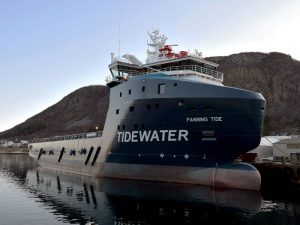

 

Report projects OSV demand will grow 75% by end of 2020

That’s heartening news for Offshore Support Vessel (OSV) operators such as Tidewater, Edison Chouest, Bourbon, Hornbeck Offshore, Seabulk and Maersk, which are dealing with the current challenging offshore oil and gas market. In a presentation at the recent Johnson Rice 2015 Energy Conference, Tidewater reported it had 38 vessels stacked as of the end of June. It has also announed plans to scrap 11 older vessels.

In its most recent monthly report, Baker Hughes reported that there were 29 drilling rigs operating in the Gulf of Mexico, down from 59 a year ago.

 Mordor Intelligence’s report, the Global Offshore Support Vessel Market, focuses on the market sectors by vessel type, including Anchor Handling Tug/Anchor Handling Towing Supply Vessels (AHT/AHTSs), Multi-Purpose/Multi-Role Supply Vessels (MPSV), Platform Supply Vessels, Construction Support Vessel (CSV), Specialty Vessels and others. It also breaks down activity by region: North America, Europe, the Asia-Pacific (APAC), South America and Middle-East & Africa (MEA). The report analyzes and projects the market share of each region for the next 5 years.

Most promising regions for OSV market are the Gulf of Mexico, Brazil, West Africa, the North Sea, South East Asia, the Middle East and Asia. Mordor Intelligence estimates that major part of the demand will be for AHTS, PSVs, and seismic research vessels.

As oil and gas explorations move towards deeper waters, explains Mordor Intelligence, multi-functional offshore support vessels are now called upon to perform different tasks, and have created various niches or categories within the market. Present day offshore support vessels are equipped with increased cargo capacity, panoramic navigation bridge visibility, large accommodation spaces, enhanced crew amenities and state-of-the-art propulsion and automation systems.

According to Mordor Intelligence, AHTS vessels comprise a 56% of the market share, followed by Platform Support Vessels. Inspection, Maintenance and Repair (IMR) Vessels are generally equipped with large accommodation spaces, heavy lift cranes, helidecks and streamlined bow forms for operation in harsh environments. Vessels specialized for multi-tasking carry out maintenance and repair operations on platform facilities, as well as subsea pipelines and equipment.


DOJ reaches settlement with BP in Deepwater Horizon spill

OCTOBER 6, 2015—In what is the largest settlement with a single entity in U.S. history, U.S. Attorney General Loretta E. Lynch announced that the Department of Justice had secured a settlement of

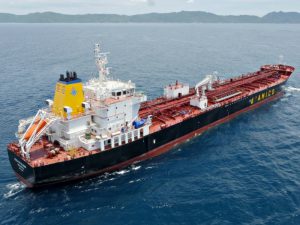
New Eco-Ships launched at Hyundai Vinashin for d’Amico

The energy efficient design of two vessels, the 39,000 dwt Ice Class handysize tanker Cielo di Ulsan, and the 50,000 dwt product tanker High Trader, allow them to already meet IMO standards that will come into force in 2025.

With the addition of the two ships, the DIS fleet now controls through ownership, charters and joint ventures 51.83 double-hull tankers, with an average age of 7.6 years. It owns 25.33 vessels and charters another 26.50. The two eco-ships, worth a total of over $62 million, are a part of $755 million investment plan that DIS started in 2012 and which includes, to date, a total of 22 high performance vessels, 10 of which have already delivered.

Marco Fiori, CEO, d’Amico International Shipping S.A., says, “We have added two more ships of great construction quality to our young fleet, which are capable of offering our customers safety, efficiency and profitability.”

Both of these new tankers are under time charter contracts to two major international oil companies, one lasting 30 months and the other three years, managing to anticipate the extraordinary global demand in the transport of refined petroleum products, today favored both by the transfer of refineries (from the main consuming regions to oil production areas) and the decreasing of crude oil prices.

The 183m x 29m Ice Class Cielo di UIsan is equipped to operate in temperatures as low as -20°C. It will operate in routes in Northern Europe, the Arctic and the Northern Sea. This is the first model of a group of four ships that will join the DIS fleet, resulting from the joint work of the company’s engineers and Hyundai Vinashin.

The 183m x 32m High Trader is the sister ship of two other vessels already delivered to DIS. One of its selling points is that it can guarantee an average savings of 6 tons of fuel per day (with ship fully loaded and a constant speed of 14 knots) and consequently a 20% reduction in CO2 emissions. Moreover, the profitability of the ship is driven by its great commercial versatility: High Trader can carry up to nine different types of cargo during the same trip. Cielo di Ulsan and High Trader are equipped with systems for the treatment of ballast water so as to minimize the impact on marine ecosystems and comply with IMO3 and IMO2 requirements.

DIS has an extensive newbuilding program underway, with 12 new eco-ships on order, including three Handysize, three Medium-Range and six LR1, tankers under construction.

“This extremely positive moment on the market,” says Fiori, “and increasingly close relations with major oil companies and multinational manufacturers of vegetable oils, which request our ships more and more often, confirm that DIS has taken the right route. With the addition of other 12 eco-ships currently under construction by 2018, we will further consolidate our competitive position on the global shipping market that today already sees us among the leaders.”


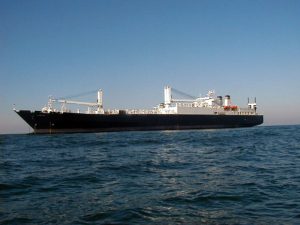
Crowley gets $130 million MSC contract

The contract will see Crowley provide full turnkey operation and management of the fleet, including crewing and scheduled/unscheduled repair and drydocking services initially for one year with four, additional one-year options. The turnover phase for the ships began on October 1.

Of these five vessels, two will remain berthed in Jacksonville and three will be homeported in Norfolk – all within the service area of Crowley’s local offices. This contract will have a positive economic impact through the creation of several new jobs in both Jacksonville and Norfolk. The ships ­– USNS 1st LT Harry L. Martin, USNS LCPL Roy M. Wheat, USNS SGT Matej Kocak, USNS PFC Eugene A. Obregon and the USNS MAJ Stephen W. Pless ­– will be used to transport cargo throughout the world in support of the U.S. military.

“Crowley is proud to have been selected to provide technical management for this government fleet,” says Crowley Government Services General Manager Paul Varghese. “This contract is a perfect fit for us, and would not be possible without the hard work and determination of our remarkable government team and the tremendous support we received from MSC.”

Rotterdam could get LNG Hybrid Barge

A floating energy plant, the LNG Hybrid Barge is designed to provide ships in port with clean power—an alternative to providing ship’s power by plugging into the city grid or producing electricity via generator sets or main engines. During winter season the LNG Hybrid Barge will be able to deliver heat to factories or to the central city heating system in addition to electricity.

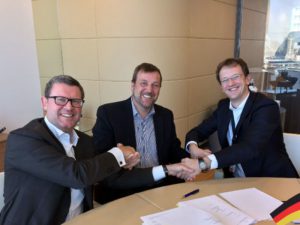
BMS is the owner of the LNG Hybrid Barge and provides services to charter out the barge.  BMS Managing Director Dirk Lehmann, says, “The LNG Hybrid Barge is the first flexible solution supplying clean LNG energy to cruise ships during summer season and providing the flexibility of generating electric energy and heat into a public grid system or industrial users during winter season. We see this advanced flexible solution as an opportunity for Rotterdam and other international ports.”

Primarily the LNG Hybrid Barge will support cruise ships moored in Rotterdam, traditionally key clients of KOTUG. KOTUG will move the LNG Hybrid Barge and will provide commercial, technical and operational management of the LNG Hybrid Barge.

KOTUG CEO Ard-Jan Kooren, says, “As a leading towage company and with our strong focus on innovative technical and environmental solutions, we strive for reducing our environmental footprint and encouraging our suppliers, clients, business partners and stakeholders to reduce their environmental impact. We are proud to be working with innovative partners like Becker Marine Systems and we look forward to making together a significant step in supporting our clients in a greener, safer and more efficient operation.”

This new, innovative concept and unique cooperation has also drawn significant attention from key players in the LNG market, like Cruiseport Rotterdam, Dutch National LNG Platform and Shell. Arjan Stavast, Shell’s Downstream LNG Business Development Manager for Europe says, “We see the LNG Hybrid Barge as a unique solution for the maritime industry. We will follow these developments closely as we do believe that the delivery of electricity through LNG is possible for (cruise) ships, factories and cities, while not having to invest heavily in additional electricity infrastructure.”

“We are delighted to learn about this initiative and are looking forward to welcome the LNG Hybrid Barge in Rotterdam,” says Mai Elmar, Executive Director of Cruise Port Rotterdam.

Gerrit van Tongeren, Chairman of the Dutch National LNG Platform, says the initiative “is another great and unique example of how (in their respective fields) leading maritime companies can work together in the entire LNG chain and together strive to get LNG introduced in the market and contribute to a cleaner and greener environment. We therefore follow and support this initiative and wish all parties good luck in achieving the objectives.”


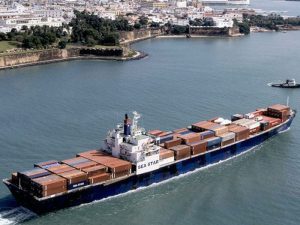
Coast Guard believes El Faro sank, searches for survivors

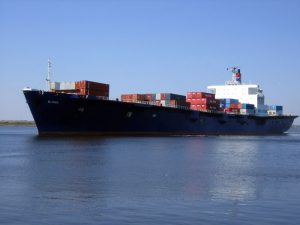
Coast Guard spokesman CAPT Mark Fedor said during a press conference in Miami this morning that one body was found in a survival suit in a 225-square mile debris field near the Bahamas. The body was “unidentifiable” and was not recovered. CAPT Fedor said the Coast Guard also recovered one of the ship’s two lifeboats with no one on board. He said that the Coast Guard was still hopeful of finding survivors among the 33 crew on board. Despite the difficult conditions of being subjected to 140 mph winds and 50-foot waves, “I’m not going to discount someone’s will to survive,” says Fedor.

According to Fedor, there were 46 survival suits on board and each lifeboat is certified to carry 43. “These are trained mariners and they know how to abandon ship.”

The search for survivors will continue with aircraft and commercial ships in the area.

The Coast Guard said Sunday evening that the search teams, which also include personnel and resources from U.S. Air Force and the U.S. Navy, have covered more than 70,000 square miles.

The U.S. National Transportation Safety Board, with involvement from the U.S. Coast Guard, is expected to conduct a full investigation. Fedor says the Coast Guard is also expected to conduct its own investigation.

The El Faro, owned by Tote Maritime, was built in 1974 and updated in 1992 and 2006. It was carrying 391 containers and 294 trailers and cars.


Debris field found near missing El Faro’s last position

OCTOBER 5, 2015—The U.S. Coast Guard is reporting that it has located a debris field of in the vicinity of the U.S.-flag containership El Faro’s last known position 35 nautical miles northeast

Freeport McMoran discovers oil in Deepwater GOM

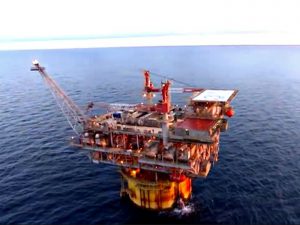
SEPTEMBER 29, 2015—Publicly traded Freeport-McMoRan reported that it discovered oil from its Horn Mountain Deep well in the Deepwater Gulf of Mexico (GOM). Initial production from the well, which will be tied back to

USCG to review WSF plan to handle LNG at terminals

Last year on June 27, the Coast Guard Sector Puget Sound had received a Letter of Intent (LOI) and a Waterway Suitability Assessment (WSA) from Washington State Ferries to modify their marine terminals to handle LNG. In accordance with regulation and policy guidance, the Captain of the Port (COTP), Coast Guard Puget Sound Sector, in cooperation with key stakeholders, will review and validate the information in the WSA. Once the COTP reviews the WSA, he will issue a Letter of Recommendation to the Washington Department of Transportation recommending the suitability of the Puget Sound waterways the will be used for LNG marine traffic as it relates to safety and security.

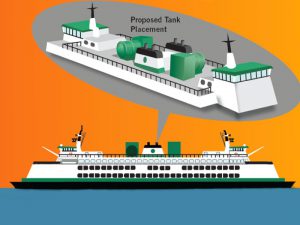
Public comments received last November regarding WSF’s proposal will be considered in the development of the COTP’s Letter of Recommendation. Some of the comments received expressed concern about the exposed location of the LNG tanks on the top deck of the converted ferries posed a security threat. Other comments thought that LNG poses a pollution threat to the environment. The Coast Guard will examine WSF’s Emergency and Operations Manuals covering the LNG transfer system and transfer procedures.

Proposed conversion

Once WSF receives the Letter of Recommendation from the Coast Guard, it will be able to move forward with the retrofit of the first Issaquah Class ferry, which will serve as a proof of concept for the remaining vessels in the class. The diesel-powered ferries carry about 1,200 passengers and 124 vehicles.

The state’s ferries, says WSF, are the largest single source of marine carbon emissions in the state. It expects to cut CO2, particulate matter, SOx, and NOx emissions significantly with the use of LNG s a marine fuel.

The WSDOT also expects to reap some cost savings, although the picture is not as compelling as it was last year when oil was at $100 per barrel. During testimony this past January before a State Senate Energy, Environment and Telecommunication Subcommittee, Lynne Griffith, Assistant Secretary of Transportation, Ferries Division, said there would be a $1 per gallon savings when burning LNG as compared with burning Ultra Low Sulfur Diesel. WSF burns about 18 million gallons of fuel annually. The cost of fuel now represents about 23 percent of the Fiscal Year 2013-2015 operting budget as compared with 11 percent in Fiscal Year 2000-2001. Any ferries that would burn LNG would have to be refueled by tanker truck every seven to 10 days.


LOAD MORE