Joint venture targets offshore, marine winches and cranes

FEBRUARY 1, 2016—Scantrol, MEC/MJR and Hydrofit have formed a new U.K.-based joint venture called Dynamic Integrating that will offer electric and hydraulic drive and control solutions for marine and offshore winches. Derek

Prestige Master sentenced to two years in prison

JANUARY 30, 2016—In one of the most highly politically charged international oil spill cases, the international association for ship managers has condemned the recent sentencing of the Master of the Prestige to

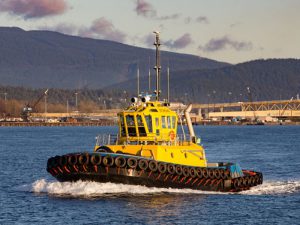
ABD Shipyard delivers first of two tugs to Saam Smit Towage

JANUARY 29, 2016— Saam Smit Towage (SST), a joint venture between SAAM and Royal Boskalis and operating in various locations in the Americas, recently took delivery of the SST Capilano, a new

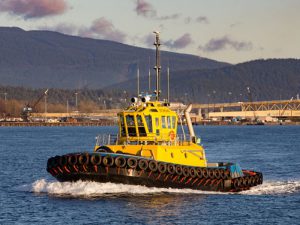
ABD Shipyard delivers first of two tugs to Saam Smit Towage

JANUARY 29, 2016— Saam Smit Towage (SST), a joint venture between SAAM and Royal Boskalis and operating in various locations in the Americas, recently took delivery of the SST Capilano, a new

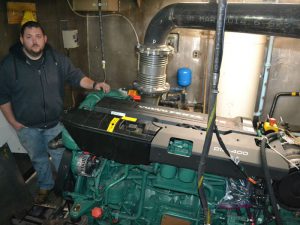
New engines for Niagara Falls tour boat

JANUARY 29, 2016—For a second consecutive year, a seven-man crew, led by Joseph Craine, owner and president of Lake Erie Ship Repair and Fabrication (LESR) based in Jefferson, OH, has repowered a

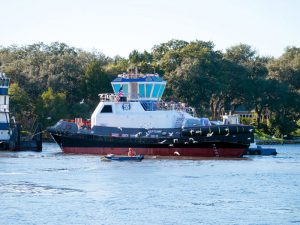
Tug launched for Suderman & Young at Eastern

JANUARY 22, 2016—The 5,150 hp Neptune, the second in a series of four Z-Tech 2400 class escort tugs for Suderman & Young, was recently launched at the Nelson Street facility of the Eastern Shipbuilding Group,

Evac secures major order to supply four cruise ships

JANUARY 21, 2015—Evac Group has received an order to supply total waste management systems for four large cruise ships—the largest biggest cruise vessel contract in the company’s history. Evac Group says the order

Major pilot boat contract for Maritime Partner

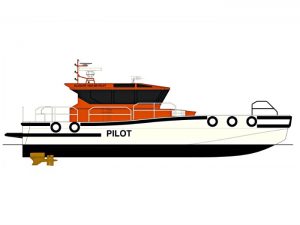
JANUARY 18, 2016—Maritime Partner AS, Alesund, Norway, has signed a contract with Buksér og Berging AS for the delivery of two 15m, 30-knot pilot boats, including an option for a further eight

Propulsion: Powering up your choices

The International Workboat Show in New Orleans, LA, offers the marine industry an ideal time to not only assess the current state of the industry, but also an opportunity to view some of the newest technologies, products, and services. With stricter emissions regulations coming into play in 2016 and operators strongly focused on efficiency and the bottom line, this year’s show saw a number of new power and propulsion technologies unveiled. GE Marine, for example, extended its EPA Tier 4 engine series to include 16- and 12-cylinder V-models, an 8-cylinder inline model, and a 6-cylinder inline model that is currently planned for development.

GE says the engine series meets the Environmental Protection Agency’s (EPA) Tier 4 emission standards without the use of urea after-treatment, while maintaining fuel efficiency and service intervals. In addition, the engines have a faster response time to load steps, and a Maximum Continuous Rating (MCR) that is 12 percent higher than their Tier 3 compliant predecessors. 

Coastal tug and barge operator Reinauer Transportation purchased two 12V250MDC Tier 4 diesel engines for its new Articulated Tug Barge (ATB) unit under construction at Senesco Marine in Kingstown, RI. One of the engines was displayed at GE’s booth at the Workboat Show.

“We chose the new GE Marine engines because we like their robust design and component configuration,” says Christian Reinauer. “The engine closely matches the footprint of our current vessel design. This limits the amount of re-engineering while meeting Tier 4 emissions requirements without the complications of urea after-treatment.”

GE’s Marine Product Manager Rob Van Solingen says the engines offer several advantages as compared with engines that use an SCR-based emission control system.

He says that the GE Tier 4 engines are less complex, allowing ship designers to develop engine rooms that make the most efficient use of space. This reduction in complexity also translates into improved labor efficiency at shipyards.

The engines also offer space and weight savings, since there is no large SCR reactor system in the exhaust piping of each engine nor any urea tank, dosing equipment, monitoring/control systems, and related piping, and air supply system required.

“Depending on size and urea quantities, space and weight savings of the engine and complete SCR system with all components and urea tanks can save up to 75% on each when compared to the GE T4 diesel engine,” says Van Solingen.

In addition, says Van Solingen, “The EGR system is designed to not require any special maintenance between the normal scheduled overhaul intervals for our engines.”

Other U.S.-based customers Harvey Gulf International Marine and Oceaneering have also ordered 12V250MDC Tier 4 engines to meet stricter EPA emissions standards. Two 12V250MDC Tier 4 diesel engines will power Harvey Gulf’s new Robert Allen designed Multi-Purpose Field Support Vessel, currently under construction at Eastern Shipbuilding Group in Panama City, FL.

Meanwhile, Oceaneering has ordered five 12V250MDC Tier 4 diesel engines for its new Inspection, Maintenance and Repair (IMR) vessel MSV Ocean Evolution under construction at BAE Systems in Mobile, AL.

NEW ENGINE FROM MAN
Also on display at the WorkBoat Show was a new inline six-cylinder diesel engine range for workboats, ferries, fishing trawlers, and pilot boats based on the MAN D2672 diesel engine from MAN Engines. Offered in a range of outputs from 323 kW to 588 kW (440 to 800 hp), the basic six-cylinder engine has been proven in a wide range of on- and off-road machinery since it was first introduced in 2007. Its robustness and reliability in workboats has also been demonstrated in extensive field trials over several thousand hours of use in ferries, pilot boats and high-speed catamarans.

The modern common rail injection system used in the D2676, with fuel pressures up to 1,800 bar, ensures high mean pressures and optimized combustion. This increases on-board comfort due to reduced vibration and noise emissions. The inclusion of a Miller or Atkinson camshaft has helped to achieve an average 10% reduction in fuel consumption compared to the engine’s predecessors.

As part of this improvement in fuel consumption, all engines also comply with the current strict EPA emissions.

The new MAN D2676 marine diesel engines replace the predecessor models D2866 and D2876.

The new D2676 engines also offer the wide torque plateau that is characteristic for MAN marine engines. The 323 kW (440 hp) power unit provides 1,950 Nm of torque between 1,200 and 1,600 rpm for heavy operations, while the 588 kW (800 hp) high-performance model manages to generate 2,700 Nm between 1,200 and 2,100 rpm for light operations. This ensures maximum torque over a broad engine speed range at the lowest specific fuel consumption.

SCANIA MAKES IN ROADS
Scania has been making inroads in the marine propulsion sector because of its compact, proven engine platforms. Some recent installations in the U.S. Gulf of Mexico include the high-speed crewboat Fourchon Runner, which is powered by quadruple Scania 16L engines for a total of 2,400 hp.

Naiad Inflatables recently delivered the Karankawa, a twin-screw pilot vessel for the Matagorda Bay Pilots of Texas.  The pilot boat has two Scania DI13 77M main engines, with Twin Disc MGX-5114A gears and ZF controls. It employs shaft propulsion with driveline components from H&H and Michigan Wheel propellers. The pilot boat has a top speed is 33 knots.

At the Workboat Show, Scania showcased its Tier 3 platform, including its 16-liter V8 and 13 liter inline engines.

Scania engines are all based on Scania’s new modular engine platform—well proven in the company’s truck and bus engines. Scania V8 engines are engineered to produce high power, while maintaining a size that is compatible for auxiliary equipment. The V design reduces the overall length of the engine and ancillaries can be effectively accommodated inside the footprint of the engine.

The output ratings for Scania’s newest Tier 3 version of the 16-liter marine propulsion engine range from 550 to 900 hp, with outputs between 550 to 1,000 hp available for use in international and exempt markets.

For auxiliary applications, the range for EPA Tier 3 is 468 kW – 553 kW, and the current range will continue to be offered between 430 kW – 596 kW for international and exempt markets. Scania also expects to see an increase in the output ratings of V8 engines used for keel-cooled applications.

The output ratings for Scania’s newest Tier 3 version of the 13-liter inline marine propulsion engine range from 250 – 675 hp, with outputs up to 750 hp available for use in international and exempt markets. For auxiliary applications the range for EPA Tier 3 is 269 kW – 426 kW.

Scania’s centrifugal oil cleaner effectively removes small particles from the lubrication oil, while reducing the size of the replaceable filter cartridge. The Scania saver ring, placed at the top of each cylinder liner, reduces carbon deposits on the edge of the piston crown and reduces cylinder liner wear.

In spite of higher performance and tighter emission levels, Scania has been able to increase maintenance and oil change intervals by 25% (now 500 hours) in comparison to its predecessor.

NEW CONCEPT: TWIN FINS
During a presentation for the trade press at the Workboat Show, Caterpillar highlighted the development of its Twin Fin Propulsion Systems. The initial Twin Fin Propulsion System was retrofitted on the seismic vessel Polarcus Naila at Shipdock in Amsterdam in March 2014.

“In the seismic business, seismic assets or the vessel is a huge workhorse,” says Peter Zickerman, Polarcus Executive Vice President. “About 85 percent of its lifetime, the vessel is under constant tow in various weather conditions. It is imperative that the reliability of the vessel and its propulsion system are top notch.”

The Twin Fin is designed for vessels that operate on a diesel-electric propulsion system. With thrusters, vessels can have more cargo capacity. With conventional propellers, operators benefit from added reliability and safety. Twin Fin offers the advantages of both. It offers higher thrust performance, reduced fuel consumption, and a better emissions profile.

According to Mattias Hansson, naval architect and sales manager at Caterpillar Propulsion, development of the Twin Fin Propulsion Systems started with the company’s partners in the third quarter of 2012 and a patent application was filed in the first half of 2013. Hansson points out that the Twin Fin Propulsion System also incorporates some green aspects, including, a water-lubricated stern tube, instead of an oil-lubricated system.

For the retrofit, the twin fins were prefabricated in about 15 days and readied for the Polarcus when she arrived at the shipyard.

“This new system provides an excellent course keeping stability for the ship—important for a scientific ship like this,” says Henning Kuhlmann, Managing Director, Becker Marine Systems. Becker Marine Systems supplied highly efficient flat rudders for the installation of the Twin Fins.

The payback period for the system is about three years based on fuel consumption savings, efficiency gains, improves environmental footprint, and improves reliability when operating in remote areas.

In the coastal market, Caterpillar is supplying two harbor tugs being built for Harley Marine Services, Seattle, WA, at Diversified Marine, Inc., Portland, OR.

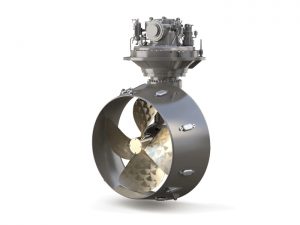
Each of the Harley Marine tugs will be outfitted with Cat 3516 main engines—each rated at 2,575 hp at 1,600 rev/min—and two MTA 524-T azimuthing thrusters. The thrusters will have 95.5 in. diameter fixed-pitch propellers.

Cat Propulsion’s Emil Cerdier says the MTA-T thrusters deliver “excellence of economy and performance to the tug market.” The tugs will be delivered by Diversified Marine in 2017.

Z-DRIVES GO INLAND
While Z-drives are fairly commonplace in the tug market, they are a relatively new phenomena in the inland towboat market. While some were installed as early as the 1980s, Z-drives got a major boost in 2006, when Bill Stegbauer and Ed Shearer began exploring the use of alternative propulsion, including Z-drives in inland towboats. Stegbauer, then President of Southern Towing Co., eventually opted for a design that would use Z–drives in a series of 3,200 hp towboats.

There are now about two dozen towboats operating with Z-drives and more are under construction. One of the latest series of three 6,300 hp towboats designed by The Shearer Group that are being built at C&C Marine and Repair, Belle Chasse, LA, for SCF Marine Inc. As you might guess, Ed Shearer is the President of The Shearer Group.

The towboats will each have three Cummins QSK60-M diesel engines coupled to three Steerprop SP-25D z-drives. Cummins Mid-South is supplying the engines, while Karl Senner, LLC, Kenner, LA, is supplying the Z-drives.

The Z-drives were selected only after a through analysis. “We worked closely with the both the owner and the naval architect, but at the end of the day, the decision was up to the owner, SCF,” says Karl Senner.  “Tim Power and Myron McDonough were very diligent in the selection process, and we very much appreciate the in-depth approach and attention to detail.  We pride ourselves in offering robust products and superior support, factors that are critical while operating in the demanding environment of the inland waterways.  Steerprop units are designed for the longest time between overhauls on the market.  We have also been supporting inland operators since our company’s inception in 1967.  We are very excited about our relationship with SCF and we know it will continue for a long time to come.”

Steerprop SP25D Z-drives are designed for operating in harsh environments.  These specific drive units were selected and configured similar to that of ice-class applications.  Ice class design is Steerprop’s forte, having designed and supplied Z-drives on board three of the world’s largest mechanical Z-drive ice breakers build to date. 

These will be the first inland towboats in the U.S equipped with Steerprop Z-drives.  “The inland waterways have been a major focus of our business since 1967 for Reintjes gearboxes,” says Senner. “We pride ourselves in knowing what it takes to support the high demands of our inland customers, from sizing the appropriate equipment, to stocking spare parts, and providing quick service turnarounds. We are a family-owned and -operated company, flexible to respond to customer needs quickly and effectively.” 

“We are in discussions with multiple other inland projects, but not at liberty to discuss them at this point in time.”

Z-drives have begun to catch on with inland transportation operators because of the safety, operational efficiencies and fuel savings they offer. As operators of harbor tugs have long been aware, the Z-drive can deliver full thrust in any direction almost instantly, where as the conventional rudder set aft of the propeller and even the flanking rudders set ahead of the rudder as is the practice on many inland river towboats, will sacrifice time and power by the inefficient nature of the conventional drive and rudder system.

Due to the greatly improved maneuverability with Z-drives, tows do not need to slow down in turns and bends in the river. Trip times are reduced and require a lot less fuel. A study conducted by The Shearer Group, Inc. last year showed an average of 28% fuel savings and 11% trip time savings during a set of controlled experiments with unit tows when using Z-Drives instead of conventional shafts and rudders.

SCF Marine, Inc., St. Louis, MO, is part of SEACOR’s Inland River Services group. SCF Marine operates a fleet of hopper barges along the U.S. Inland River Waterways and South America, transporting agricultural, industrial, and project cargoes.

Thrustmaster of Texas, Inc., Houston, TX, says towboats with Z-drives are not significantly more expensive than conventional towboats. The initial cost of the Z-Drives is significantly offset by reduced construction costs and installation man-hours. Shipyards have reported that the cost of building Z-drive boats is actually less than building conventional boats.

One of the latest applications of Z-drive propulsion is in a fleeting boat by Carline Companies. Carline recently added the 68 by 34-foot towboat USS Cairo for barge fleeting on the lower Mississippi.

Designed by Christian Townsend of CT Marine and built by Raymond & Associates, the USS Cairo is fitted with two six-cylinder Tier 3 compliant Cummins QSK19 main engines turning Thrustmaster TH750MZ Z-drives with 57-inch propellers.

According to Thrustmaster of Texas, a Z-drive replaces the propeller, shaft, stern tube, marine gear, rudder and steering gear all with a single unit.  Z-drive azimuthing thrusters provide maximum thrust in any direction, independent of vessel speed, offering superior pinpoint maneuverability under all conditions. Rudders are completely eliminated. Rudder drag no longer exists. All of this can be done with a lot less power. A 1,500 hp Z-drive boat can replace a 2,000 hp conventional towboat and a 3,000 hp Z-drive boat can replace a 4,000 hp conventional towboat.


Navy Shipbuilding: Beltway Strategy


In the closing weeks of last year, all sorts of things happened that demonstrated that the way Navy ships actually get ordered is a little different from the way that the process is publicly portrayed.

Things began with the news that the Navy had placed a $200 million advanced procurement contract with Huntington Ingalls Industries’ Ingalls Shipbuilding division for LPD 28, the 12th amphibious transport dock of the San Antonio (LPD 17) class. The fact that there will be a 12th ship in the class illustrates how lobbyists can influence what Navy tonnage gets built—even ships that weren’t ever formally requested in the Navy’s budget submission.

Once that news was announced, the beltway types knew that another shoe would soon drop: an additional DDG 51 destroyer contract for General Dynamics Bath Iron Works.

Defense media predicted that BIW would get the additional destroyer under a “hull swap” agreement in a 2002 MOU between the Navy and its two largest shipbuilders that, among other things, reportedly included an agreement that, should a12th LPD be ordered, a fourth DDG 51-class ship or equivalent workload would be awarded to BIW.

Now where would the money for such a ship come from? We got the answer in the omnibus spending bill that the Congress passed just before Christmas (see this month’s Inside Washington column for more details). If you are to take at face value what they has to say it all happened thanks to Maine’s U.S. Senators.

As the bill was nearing passage, Sen. Susan Collins, a senior member of the Defense Appropriations Committee, and Sen. Angus King, a member of the Senate Armed Services Committee, said that the final omnibus spending bill includes $1 billion toward the construction of an additional DDG 51 destroyer that would “likely” be built at Bath Iron Works and would be in addition to those already included in the current multi-year procurement contract.

The statement issued by the two senators, interestingly, contained no acknowledgement whatsoever that the funding was any kind of pre-arranged “done deal,” widely expected by defense industry insiders.

It said that “as a senior member of the Defense Appropriations Committee, Senator Collins requested the funding toward the additional DDG-51 to help meet combatant commander requirements for destroyers across the globe. Senator Collins successfully advocated for the inclusion of the $1 billion in funding in the Senate Defense Appropriations Bill. The House Defense Appropriations Bill, however, allocated no funding for this additional destroyer. Following weeks of negotiations between the House and Senate regarding the bill, the omnibus bill appropriated the full $1 billion in funding toward this additional ship, affirming the strategic importance of our Navy and shipbuilding programs.”

ANOTHER QUESTION MARK OVER LCS
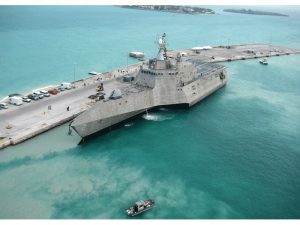
One of the Navy’s shipbuilding programs that has been evolving has been the Littoral Combat Ship (LCS). As compared with other surface combatants, either variant of the LCS is a small, relatively lower cost, ship. Now, however, it has been decided that future versions of the LCS would be beefed up to become frigates. Under either label, the ship is still affordable enough to enable the Navy to bring up the numbers in its shipbuilding plan to more easily reach its target of a 308-ship battle force.

That plan was thrown into disarray by a December 14 memo sent by Secretary of Defense Ash Carter to Secretary of the Navy Ray Mabus, essentially telling him to rethink the Navy’s budget priorities. Among other things, it directs him to reduce the Navy’s buy of Littoral Combat Ships (including frigatized versions) and to downsize to one of the two variants of the ship.

Before looking at that memo in more detail lets recap on the program as summarized in a recent Congressional Research Service report by veteran analyst Ronald O’Rourke.

“From 2001 to 2014, the program was known simply as the Littoral Combat Ship (LCS) program, and all 52 then-planned ships were referred to as LCSs. In 2014, at the direction of Secretary of Defense Chuck Hagel, the program was restructured. As a result of the restructuring, the final 20 ships in the program (ships 33 through 52), which were to be procured in FY2019 and subsequent fiscal years, were to be built to a revised version of the baseline LCS design, and were to be referred to as frigates rather than LCSs.

“Under this plan, the LCS/Frigate program was to include 24 baseline-design LCSs procured in FY2005-FY2016, 20 frigates to be procured in FY2019 and subsequent fiscal years, and eight transitional LCSs (which might incorporate some but not all of the design modifications intended for the final 20 ships) to be procured in FY2016-FY2018, for a total of 52 ships.”

Two baseline LCS designs are currently being built. One was developed by an industry team led by Lockheed; the other—based on an Austal design—was developed by an industry team led by General Dynamics. The Lockheed design is built at Fincantieri Marine Group’s Marinette Marine shipyard at Marinette, WI; the General Dynamics design is built at the Austal USA shipyard at Mobile, AL, with Austal now also being the prime contractor. Ships 5 through 24 in the program are being procured under a pair of 10-ship block buy contracts that were awarded to the two LCS builders in December 2010.

“The 24th LCS—the first of the three LCSs requested for procurement in FY2016—was to be the final ship to be procured under these block buy contracts, but the contract might be extended to include the 25th and 26th ships (i.e., the second and third ships requested for FY2016) as well,” notes the CRS report.

THE MEMO
The December 14 memo sent by Secretary of Defense Ash Carter to Secretary of the Navy Ray Mabus, not only directs him trim the Navy’s LCS buy of Littoral Combat Ships, but also seems to indicate a very deep divide on what should be the Navy’s budgetary priorities overall.

The memo has already prompted Congressional supporters of the LCS to promise to thwart any attempt to trim the shipbuilding program.

But the memo was leaked and here are some extracts:
“The Navy is critical to our nation’s defense. Recognizing the importance of the fleet, the Department has and will continue to increase the size and capability of the battle force—as the Navy has noted, compared to the 278 ships in 2008, today we have 282 ships in the fleet, and more than 30 are currently under construction. We are well on our way to reaching the 308-ship goal that will meet the Department’s warfighting posture requirement. This requirement should be met, but not irresponsibly exceeded.

“For the last several years, the Department of the Navy has overemphasized resources used to incrementally increase total ship numbers at the expense of critically-needed investments in areas where our adversaries are not standing still, such as strike, ship survivability. electronic warfare. and other capabilities. This has resulted in unacceptable reductions to the weapons, aircraft. and other advanced capabilities that are necessary to defeat and deter advanced adversaries.

“Earlier this year the Department of Defense gave guidance to correct and reverse this trend of prioritizing quantity over lethality; however, counter to that guidance, the Department of the Navy’s latest program submission fails to do so. It is accordingly unbalanced, creates too much warfighting and technical risk, and would exceed the numerical requirement of 308 ships.

“I have made clear in our discussions, in my budgetary guidance, and in public remarks that our military is first and foremost a warfighting force, and while we seek to deter wars, we must also be prepared to fight and win them. This means that overall, the Navy’s strategic future requires focusing more on posture, not only on presence, and more on new capabilities, not only ship numbers.

“The Department’s priorities are 1) to build advanced capabilities, 2) to close growing gaps in naval aviation, and 3) to ensure sufficient ship capacity. To meet these priorities, the Department will build to a total of 40 Littoral Combat Ships (LCS) and frigates (FF), the number that the Navy’s own warfighting analysis says is sufficient to need. This plan reduces, somewhat, the number of LCS available for presence operations, but that need will be met by higher-end ships, and it will ensure that the warfighting forces in our submarine, surface, and aviation fleets have the necessary capabilities and posture to defeat even our most advanced potential adversaries. Under this rebalanced plan, we will still achieve the Navy’s 308-ship goal, we will still. exceed 300 ships in each year from FYI9 to FY30, and we will be better positioned as a force to be overwhelming in posture rather than overextended in presence.

“Specifically, the Department of the Navy will:
Reduce the planned LCS/FF procurement from 52 ships to 40 ships (creating a 1/1/1/1/2 profile for eight fewer ships within the FYDP) by down-selecting LCS/FF production to one variant in FY2019. Forty LCS/FF will exceed recent historical presence levels and will provide a far more modern and capable ship than the patrol coastals, minesweepers, and frigates that they will replace. CAPE will provide specific implementation direction and the decision will be documented in the Resource Management Decision (RMD).

Procure 10 Flight III destroyers (DDGs) within the FYDP. Recognizing the significant capabilities that Flight III destroyers provide, the Department will continue to procure 10 DDGs across the FYDP. In addition, we will upgrade additional Flight IIA DDGs, procure additional advanced electronic warfare capabilities, and invest in munitions that will enable the fleet to hold adversary surface ships at risk. The rebalance will allow us to upgrade a large portion of the current DDG fleet, while still protecting procurement of new DDGs.

“The Navy’s amended budget cuts two submarine combat system upgrades, reduces towed array procurement, and misses a key opportunity to add Virginia Payload Modules (VPM) to our fast attack submarines. VPM is the most cost-effective way to increase the capability and capacity of our submarines; therefore the Navy will invest in an additional Virginia Payload Module in FY20. Waiting until FY20 to procure an additional VPM will provide substantial time to allow the Navy to plan for and execute this increased workload even as production of the Ohio Replacement Program begins. The Department will also restore the two combat system upgrades cut in the Navy’s submission and procure an additional 10 SSN upgrades. These upgrades will ensure we continue to have the most lethal submarine force in the world.”

The memo then spells out a number of things other than ships which Secretary Carter deems needed by the Navy and concludes: “These choices will create a Navy that is far better postured to deter and defeat advanced adversaries, while still continuing to grow the size of the fleet. As both you and I have noted, ship count alone is a poor measure of the effectiveness of the force. With the rebalance laid out this memo, our fleet will not only be larger and more effective than it is today; it will also be equipped with the weapons and capabilities it needs to win any potential war.

“The Department of Defense is relying on the Department of the Navy to support and carry out these critical strategic decisions.”

THE WASHINGTON GAME
Ash Carter has held a number of key Department of Defense posts that began with serving as Assistant Secretary of Defense for International Security Policy during President Clinton’s first term, from 1993 to 1996. He was Under Secretary of Defense for Acquisition, Technology, and Logistics from April 2009 to October 2011, and Deputy Secretary of Defense from October 2011 to December 2013.

So, he knows how the Washington game is played. This has led to speculation that what is playing out here is a tried and tested strategy whereby you don’t budget for the things that you know the Congress will insist on funding anyhow.

The leaking of the memo, which appeared on the Navy League’s website within days of being issued, has already galvanized Alabama congressmen into speaking out loudly in defense of the LCS.

SHIPBUILDING PLAN
You never know what ships exactly will be ordered by the Navy until it makes its budget request—and until that budget has gone through the Congressional grinder. However, the Table below based on the Navy’s FY 2016 budget submission indicates that, at the time that budget was submitted, the intention was for the FY 2017 budget to ask for two Virginia Class submarines, two Arleigh Burke class destroyers, three Littoral Combat Ships, one LHA(R) amphibious assault ship, one Fleet tug/salvage ship (TATS) and Mobile Landing Platform (MLP)/Afloat Forward Staging Base (AFSB).

It will be interesting what actually gets ordered. Even more interesting will be to see what will be in the next rendition of the Navy’s 30 year shipbuilding plan, particularly where LCS/FF numbers are concerned.

LOAD MORE